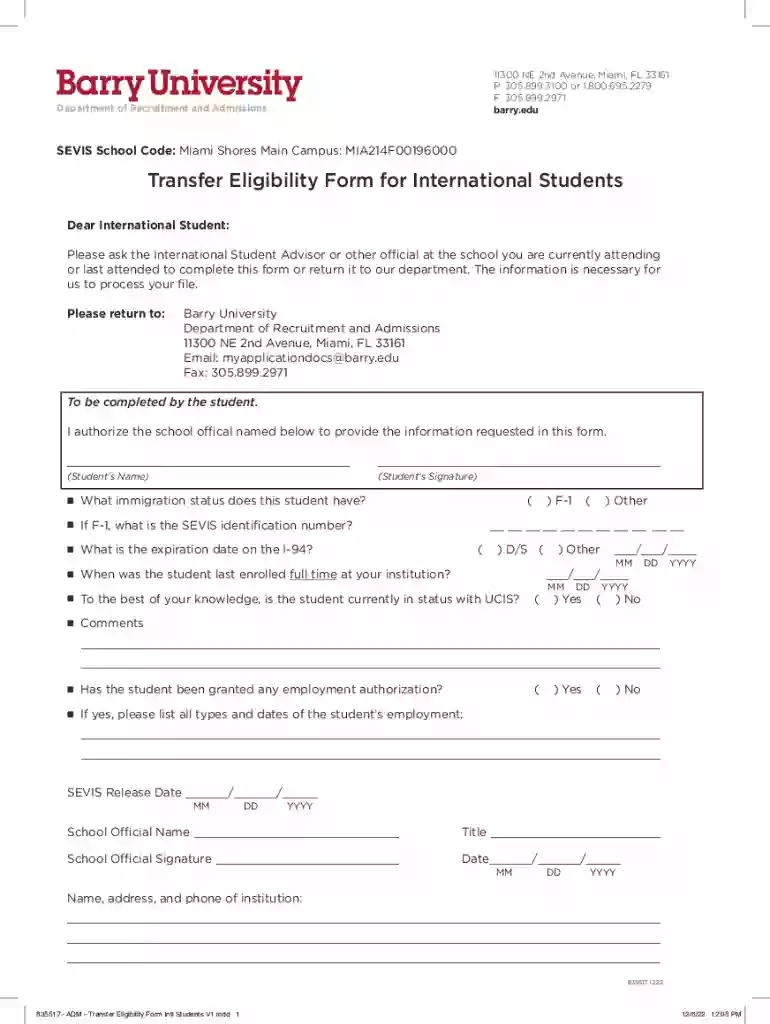
Transfer Eligibility Form for International Students 2026

Get Form
Transfer Eligibility Form for International Students Preview on Page 1

Here's how it works

01. Edit your form online
Type text, add images, blackout confidential details, add comments, highlights and more.

02. Sign it in a few clicks
Draw your signature, type it, upload its image, or use your mobile device as a signature pad.

03. Share your form with others
Send it via email, link, or fax. You can also download it, export it or print it out.

Definition and Meaning

The Transfer Eligibility Form for International Students is a crucial document used within academic institutions to facilitate the transfer of international students from one educational institution to another. This form primarily verifies the student’s immigration status and ensures that their Student and Exchange Visitor Information System (SEVIS) record is eligible for transfer. Institutions use this form to confirm that a student is in good standing on their immigration requirements, thus allowing a smooth transition between schools. It is vital for both the student and the issuing institution to ensure all necessary details are accurately recorded to prevent any potential delays in the transfer process.

Key Elements of the Transfer Eligibility Form

The form includes specific sections that must be filled out correctly. Important elements of the Transfer Eligibility Form for International Students typically include:

  • Student Information: Contains personal details, such as the student’s name, SEVIS ID, and contact information.
  • Current School Details: Information about the current or last attended school, including its name, address, and official contact.
  • New School Information: Details about the transfer destination, specifying the name and address of the receiving institution.
  • Immigration Status Confirmation: Verifies that the student is maintaining legal student status as per U.S. immigration law.
  • SEVIS Transfer Authorization Date: The date on which the SEVIS record will be released to the new institution.
  • Signature and Date: The current school's international advisor or a designated school official must sign and date the form to authenticate the information provided.

How to Obtain the Transfer Eligibility Form

Securing a Transfer Eligibility Form is a straightforward process typically initiated by the student or the new institution. Here are the steps:

  1. Contact Current Institution: International students should reach out to their current school’s international student office to request the form. This office usually manages SEVIS records and pertinent documentation.
  2. Download from School Portal: Many institutions provide the form via their online student portals, where students can download and complete it as part of their transfer proceedings.
  3. Request by Email or Phone: Some students may need to request the document directly via email or phone call, especially if they have specific inquiries or unique circumstances related to their transfer.

Steps to Complete the Form

Completing the Transfer Eligibility Form involves several key steps, ensuring accuracy and compliance:

  1. Accurately Fill Student Information: Clearly and correctly fill out all personal information sections. Cross-check the SEVIS ID for any discrepancies.
  2. Complete Current School Section: Include all relevant details regarding the current institution, such as the official contact who can verify student status.
  3. Specify New School Information: Ensure that the new school's name, address, and other relevant details are listed without error.
  4. Verify Immigration Status: Work with the international student office to confirm that the immigration status is properly documented.
  5. Authenticator Signature: Secure a signature from a designated official at your current school to validate the form.

Who Uses the Transfer Eligibility Form

The primary users of the Transfer Eligibility Form include:

  • International Students: The form serves as a formal document indicating an intention to transfer between institutions in the U.S.
  • International Advisors: They play a critical role in processing and advising on the transfer process, ensuring that the student complies with immigration rules.
  • Receiving Institutions: New schools use the information to facilitate the admission and ensure a seamless transition of the student’s SEVIS record.

Legal Use of the Form

The form is legally significant as it facilitates compliance with U.S. immigration regulations. It ensures that the student’s SEVIS record is accurately transferred between institutions, adhering to federal guidelines. Failure to complete or file this form correctly can lead to potential immigration issues or transfer delays, impacting the student’s ability to continue studies in the U.S.

Examples of Utilizing the Form

Practical scenarios where the Transfer Eligibility Form proves essential include:

  • Transferring Mid-Year: A student at a university decides to transfer to another institution mid-year. The form helps coordinate the transfer of their SEVIS record to the new school without any interruption in their immigration status.
  • Changing Educational Levels: When moving from an undergraduate program to a graduate program at a different institution, the form confirms the transfer and continuation of the student’s legal status in the U.S.

Important Terms Related to the Form

Understanding key terms related to the Transfer Eligibility Form is crucial:

  • SEVIS ID: A unique identification number assigned to each international student under the Student and Exchange Visitor Information System.
  • Designated School Official (DSO): An official at a SEVP-certified school who interfaces with SEVIS and assists international students with immigration-related issues.
  • F-1 Visa: A non-immigrant student visa allowing international students to pursue education in the U.S. institutions such as universities and colleges.

Form Submission Methods

Choosing the appropriate method for submitting the form ensures a smooth transfer process:

  • Email Submission: A widely accepted method where students or institution officials can send completed forms as attachments.
  • Online Portals: Many institutions have specific portals for international student documentation. Submitted directly online, these forms typically require logging into a student or institutional account.
  • In-Person: Some schools still require hand delivery of forms, where a hard copy is submitted directly to the international student office.

Eligibility Criteria for Transfer

International students must meet specific eligibility criteria to use the Transfer Eligibility Form:

  • Enrollment Status: Students must be currently enrolled at a SEVP-certified institution and have active status in SEVIS.
  • Good Academic Standing: Maintaining a satisfactory academic record as per the institution's policies is essential to qualify for transfer.
  • Valid I-20 Form: The student must have a current I-20 form, which details their current eligibility for educational studies in the U.S.

These sections collectively ensure thorough, informed use and completion of the Transfer Eligibility Form for International Students, promoting a smooth transfer process aligned with legal standards.


decoration image ratings of Dochub

See more Transfer Eligibility Form for International Students versions

We've got more versions of the Transfer Eligibility Form for International Students form. Select the right Transfer Eligibility Form for International Students version from the list and start editing it straight away!
Versions Form popularity Fillable & printable
2022 4.6 Satisfied (44 Votes)
2017 4.8 Satisfied (59 Votes)
2009 4 Satisfied (41 Votes)
be ready to get more

Complete this form in 5 minutes or less

Get form

Got questions?

We have answers to the most popular questions from our customers. If you can't find an answer to your question, please contact us.
Contact us
Do only US citizens need to complete the I-9? No, any new (student) employee must fill out the I-9. International students eligible to work in the United States must note down their Alien Registration Number OR Form I-94 Admission number on the form.
Your Form I-20 proves that you are legally enrolled in a program of study in the United States. Therefore, it may be needed when you apply for the benefits available to F and M students. If you are eligible to apply for a drivers license or a social security number, remember to bring your Form I-20 with you.
While international students need to take a few extra steps and precautions to successfully transfer schools, it is a very approachable process.
F-1 Students. An F-1 student who is maintaining status must notify the Designated School Official (DSO) at the students current school of the request to transfer to another school certified by the U.S. Immigration and Customs Enforcements (ICE) Student and Exchange Visitor Program (SEVP).
You dont need to get a new F1 visa just because youre transferring schools. As long as your current F1 visa is still valid (not expired), you can use it to reenter the US even though it has your old schools name on it. What does need to be updated is your I-20.

Security and compliance

At DocHub, your data security is our priority. We follow HIPAA, SOC2, GDPR, and other standards, so you can work on your documents with confidence.

Learn more
ccpa2
pci-dss
gdpr-compliance
hipaa
soc-compliance

People also ask

International students already at 4-year colleges and universities can transfer schools as well. Some colleges are very specialized and offer limited academic programs. Students at these schools who want to change their focus may need to apply to a different type of school to finish their bachelors degree.

Related links