
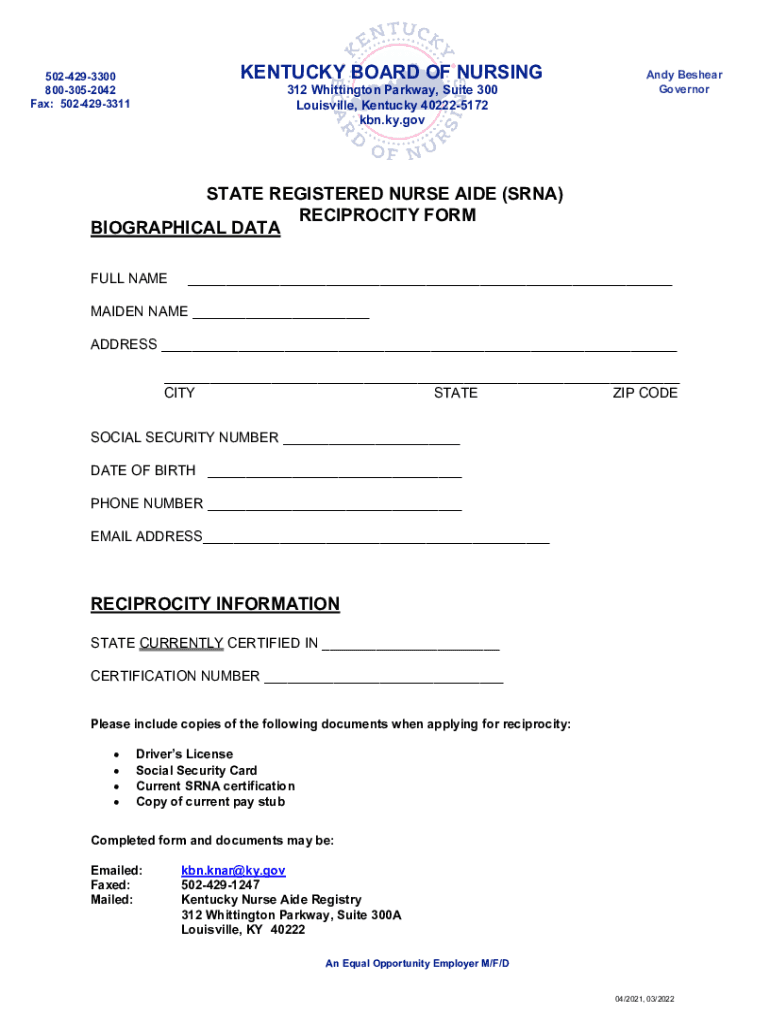







Definition and Meaning of State Registered Nurse Aide (SRNA) Reciprocity
State Registered Nurse Aide (SRNA) Reciprocity is the process that allows an SRNA certified in one state to have their qualifications recognized in another state, specifically Kentucky in this context. Reciprocity ensures that certified nurse aides can transition seamlessly across state lines without needing to complete additional certification programs. It serves as an acknowledgment of their skills and training, facilitating their ability to continue working as healthcare professionals in different state jurisdictions. This process is critical for addressing workforce mobility and maintaining consistent patient care standards across states.
How to Use the State Registered Nurse Aide (SRNA) Reciprocity
To utilize SRNA reciprocity, applicants must navigate specific steps designed to verify their existing certification's validity and compatibility with Kentucky standards. This typically involves submitting a reciprocity application to the Kentucky Board of Nursing, along with the required biographical and certification information. The process may include verifying the original certification's status and ensuring it is active and free from disciplinary issues. Introducing this process helps maintain a robust and qualified nursing aide workforce within the state, ensuring that incoming professionals meet local regulatory standards.
Required Documents for SRNA Reciprocity
For the SRNA reciprocity application, several documents must be submitted:
- A completed reciprocity application form.
- Proof of current, active certification as a nurse aide in another state.
- A photo identification document, such as a driver's license or passport.
- Possible submission of fingerprints or a background check, depending on the Kentucky Board of Nursing's requirements.
- Any disciplinary records that might exist from the state of origin. Completing the documentation accurately is crucial to avoiding delays or rejection.
Steps to Complete the SRNA Reciprocity Process
- Obtain the Reciprocity Application Form: Access the form through the Kentucky Board of Nursing's website or request it by mail.
- Complete the Application: Fill out all necessary sections of the form, providing detailed personal and professional information.
- Gather Required Documents: Compile all needed documentation, ensuring that each is up-to-date and correctly filled out.
- Submit the Application: Send your application and documents via mail or, if available, through an online submission portal.
- Await Confirmation: Monitor the status of your submission, anticipating possible communication from the Board regarding any additional requirements.
- Receive Certification: Once approved, you will receive confirmation of your SRNA status in Kentucky, allowing you to work legally as a nurse aide in the state.
Why Choose SRNA Reciprocity?
SRNA reciprocity offers several advantages, including:
- Seamless transition into the Kentucky healthcare workforce.
- The ability to maintain employment without undergoing repetitive training.
- Recognition of professional achievements and qualifications beyond the state of origin.
- An expanded range of employment opportunities within Kentucky's healthcare facilities. Understanding the benefits of reciprocity can help nurse aides make informed decisions about transitioning their careers across state lines.
Eligibility Criteria for SRNA Reciprocity
To qualify for SRNA reciprocity:
- The applicant must hold a current and active certification as a nurse aide from another state.
- Their certification must be free from any disciplinary actions or suspensions.
- Applicants must meet Kentucky's health and safety compliance standards.
- Residency status may be considered, with some states requiring proof of living in Kentucky. Meeting these eligibility criteria is essential for the successful transfer of certification.


State-Specific Rules for SRNA Reciprocity in Kentucky
Kentucky imposes specific requirements that differ from other states to ensure consistency in care quality:
- Applicants may need to complete a background check if mandated.
- Certain continuing education credits may be required to align with state standards.
- Reciprocity applications must be submitted within a defined period post-certification expiration in the originating state. Comprehending these differences helps applicants plan adequately and avoid common pitfalls during the application process.
Legal Use and Compliance for SRNA Reciprocity
Using SRNA reciprocity legally involves adhering to state and federal regulations:
- Compliance with the Health Insurance Portability and Accountability Act (HIPAA) during certification transition.
- Maintenance of professional conduct as outlined by Kentucky's Board of Nursing.
- Adherence to updated guidelines that might affect practice based on health and safety regulations. By remaining compliant, nurse aides not only secure their professional standing but also contribute to the overall integrity of the healthcare system in Kentucky.
Form Submission Methods for SRNA Reciprocity
Applicants have several submission options:
- Online Submission: Some applicants may be able to file applications via an online portal, offering convenience and faster processing.
- Mail Submission: Standard mail remains a reliable method, accommodating those who prefer tangible documentation.
- In-Person Filing: If accepted, this allows for direct submission to the Board of Nursing, reducing the likelihood of lost documents. Choosing the right submission method can impact the efficiency and speed of the reciprocity process.




