




01. Edit your form online
Type text, add images, blackout confidential details, add comments, highlights and more.

Type text, add images, blackout confidential details, add comments, highlights and more.

Draw your signature, type it, upload its image, or use your mobile device as a signature pad.

Send it via email, link, or fax. You can also download it, export it or print it out.
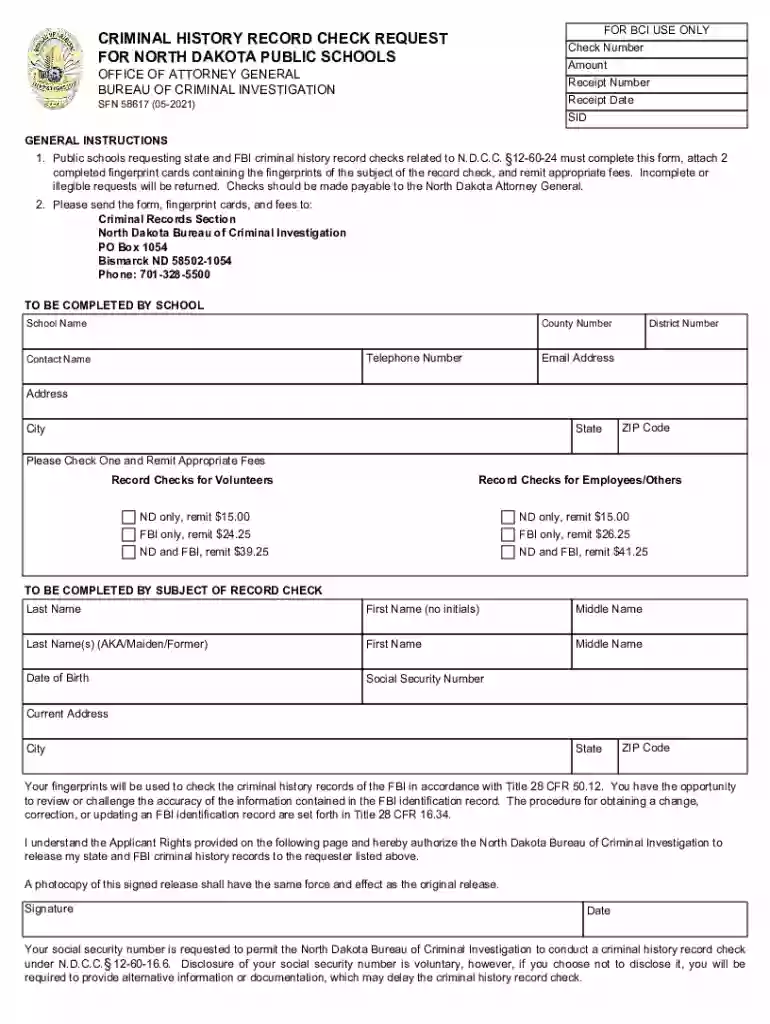
The Criminal History Record Check Request form is a vital document utilized by public schools in North Dakota. Issued by the Office of Attorney General's Bureau of Criminal Investigation, this form serves as a formal request for conducting state and FBI criminal history checks. The primary purpose is to ensure the safety and security of the school environments by verifying the backgrounds of prospective and current employees, volunteers, or other individuals who will have access to students.
Public schools in North Dakota use the Criminal History Record Check Request form to initiate a background check process. The form requires detailed information about the individual being checked, including personal identifiers and consent to perform fingerprint-based checks. Schools are responsible for ensuring the form is filled accurately and completely before submission to the Bureau of Criminal Investigation.
The form can typically be obtained directly from the Office of Attorney General's Bureau of Criminal Investigation or through its official website. School administrators can contact the Bureau for physical copies or information on downloading the form electronically.
Completing this form involves several precise steps that ensure the background check is conducted efficiently and securely. Here is a step-by-step approach:
Performing comprehensive criminal history checks is crucial for maintaining a safe educational environment. These checks help identify potential risks from individuals with histories that may be harmful to the students or staff. Therefore, the form holds great importance for schools to uphold their duty of care to their students and community.
The primary users of this form include:
These users are tasked with ensuring that only eligible and verified personnel are involved in school activities.


The form is legally mandated for performing background checks within public schools in North Dakota. Only authorized personnel should access and process these forms, respecting the applicant's privacy rights and adhering to legal standards for data protection.
Several documents are crucial when filing the Criminal History Record Check Request:
Without all these documents, the request may be delayed, affecting the hiring or approval process for the personnel in question.
The submission method varies based on convenience and preference:
Understanding these methods allows schools to choose the most efficient path that aligns with their operational capabilities.
We've got more versions of the FOR NORTH DAKOTA PUBLIC SCHOOLS form. Select the right FOR NORTH DAKOTA PUBLIC SCHOOLS version from the list and start editing it straight away!
| Versions | Form popularity | Fillable & printable |
|---|---|---|
| 2021 | 4.7 Satisfied (24 Votes) |
At DocHub, your data security is our priority. We follow HIPAA, SOC2, GDPR, and other standards, so you can work on your documents with confidence.


