




01. Edit your south carolina continuing legal education online
Type text, add images, blackout confidential details, add comments, highlights and more.

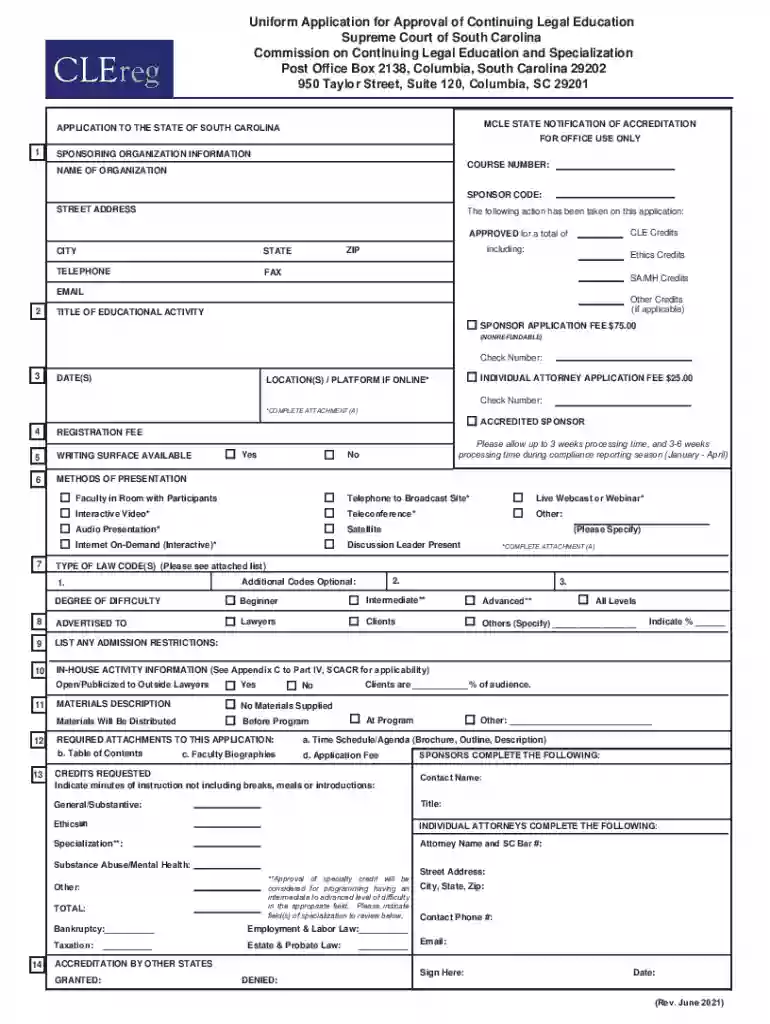
Type text, add images, blackout confidential details, add comments, highlights and more.

Draw your signature, type it, upload its image, or use your mobile device as a signature pad.

Send it via email, link, or fax. You can also download it, export it or print it out.
The Commission on Continuing Legal Education (CLE) and Specialization within the South Carolina Bar is a regulatory body that ensures the ongoing education and professional development of attorneys. It oversees the accreditation of educational programs aimed at enhancing legal knowledge and skills. By setting standards for course content, presentation methods, and faculty qualifications, the commission supports the legal community in maintaining high professional standards.
Legal professionals benefit from the commission's activities by remaining informed about the latest legal developments and meeting mandatory education requirements to maintain their licenses.
To effectively use the services of the Commission, attorneys and organizations must understand its role in the approval and accreditation of CLE activities. Legal professionals can submit their educational programs or individual applications for approval to ensure that their training meets the established standards.
Compliance with the Commission's guidelines ensures access to a wider audience and fulfillment of professional obligations by practitioners.
Completing the application for accreditation or program approval involves several structured steps. This process is crucial for attorneys seeking to validate their continuing education programs under the standards set by the South Carolina Bar.
The application for the commission's approval comprises several critical components that ensure the quality and relevance of the educational program.
Ensure all elements are complete and thoroughly documented to prevent delays in approval.
The legal framework surrounding the commission ensures that the continuing education undertaken by attorneys adheres to a standard conducive to professional enhancement. Programs accredited by the commission count towards mandatory CLE requirements.
The South Carolina Bar's rules for CLE and specialization are specifically tailored to the legal environment and professional requirements within the state. Understanding these rules is necessary for practitioners operating within South Carolina.
Utilizing the commission's resources effectively involves understanding how their standards and approvals can align with legal practices.
The process to gain approval for CLE programs is structured, ensuring that educators provide high-quality legal education. Understanding the timeline and process helps in planning and executing training programs effectively.
Approval can vary based on the completeness of applications and response times from the commission, but generally occurs within several weeks.
Specific documentation is necessary to support an application for CLE program approval with the South Carolina Bar. These documents demonstrate the applicant's compliance with educational and professional standards.
Proper preparation and attention to documentation ensure a complete and efficient submission process.
We've got more versions of the south carolina continuing legal education form. Select the right south carolina continuing legal education version from the list and start editing it straight away!
At DocHub, your data security is our priority. We follow HIPAA, SOC2, GDPR, and other standards, so you can work on your documents with confidence.


