
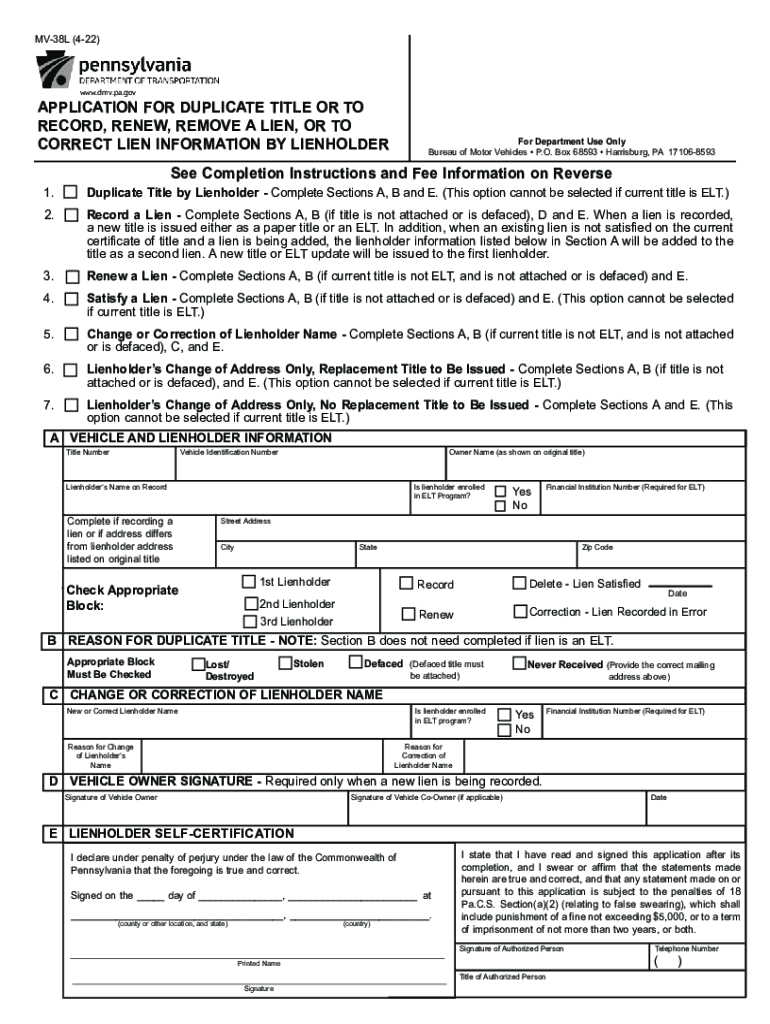







Definition & Meaning
The "Application for Duplicate Certificate of Title By Owner" is a formal request submitted by a vehicle owner to obtain a replacement for their lost, stolen, or damaged certificate of title. The certificate of title is an official document that proves ownership of a motor vehicle. This form is critical for those needing to maintain legal rights to their vehicle and is usually processed by the respective state’s Department of Motor Vehicles (DMV) or equivalent agency.
Key Features
- Demonstrates current ownership of a vehicle.
- Used when the original title is unavailable due to loss or damage.
- Required for legal transactions involving the vehicle, such as selling or transferring ownership.
How to Use the Application for Duplicate Certificate of Title By Owner
To use the application effectively, the owner must fill out personal and vehicle-specific information carefully. The form usually requires details such as the vehicle identification number (VIN), make and model, and the owner’s contact information. Accurate completion ensures the swift processing of the duplicate title.
Important Steps
- Gather Required Information: Collect accurate details related to the vehicle and ownership.
- Complete the Form: Fill out each section of the application, ensuring no fields are left incomplete.
- Fee Submission: Include any necessary fees as outlined by the issuing agency.
Steps to Complete the Application for Duplicate Certificate of Title By Owner
Completing the application involves a series of well-defined steps. Failing to follow these correctly may delay the issuance of the duplicate certificate.
- Personal Information: Provide the vehicle owner's full name, address, and relevant identification details.
- Vehicle Information: Enter the vehicle’s details, including the VIN, license plate number, make, model, and year of manufacture.
- Reason for Request: Clearly state the reason for requesting a duplicate, such as theft, loss, or damage.
- Notarization: Some states require the form to be notarized. Check local guidelines to ensure compliance.
Required Documents
Several documents must accompany the application for a duplicate certificate:
- A valid form of photo identification (e.g., driver’s license).
- Proof of ownership if applicable (such as a bill of sale).
- A completed affidavit if the title was lost or stolen under specific circumstances.
Scenarios Requiring Additional Documentation
- Name Change on Title: Provide legal proof of the name change.
- Lienholder’s Consent: If applicable, a lien release document or consent letter might be necessary.
State-Specific Rules for the Application for Duplicate Certificate of Title By Owner
Each state may have variations in the process and requirements. It's essential to verify the rules applicable to your state to ensure full compliance.
Examples of Variations
- Processing Time: Can vary significantly from state to state.
- Notarization Requirements: Some states demand notarized applications, while others do not.
- Fees: State-specific fees can apply and fluctuate based on the type of application or the urgency requested.
Important Terms Related to Application for Duplicate Certificate of Title By Owner
Understanding key terms associated with the application helps mitigate errors during completion:
- VIN (Vehicle Identification Number): A unique code used to identify individual motor vehicles.
- Lienholder: A financial institution that has a legal claim on a vehicle until the loan is repaid.
- Certificate of Title: An official document proving vehicle ownership.
Who Issues the Form
Typically, the Department of Motor Vehicles (DMV) or a similar governmental agency issues the form. This ensures that the duplicate title remains a legally recognized document, safeguarding the owner's rights over the vehicle.
Agency Functions
- Verification: Ensure accuracy and eligibility of the application.
- Issuance: Provide the duplicate title upon satisfactory processing of the application.
Eligibility Criteria
The form is intended for registered vehicle owners whose title documents have been compromised. However, eligibility can extend under certain conditions, such as:
- Trustees: Acting on behalf of an owner who cannot complete the application themselves.
- Authorized Representatives: In cases where a legal representative must act on an owner's behalf.


Filing Deadlines / Important Dates
In some instances, there might be timeframes within which the application needs to be submitted, especially if the title was lost under circumstances necessitating urgent replacement, like a theft report.
Timely Filing Benefits
- Avoiding legal complications when transferring vehicle ownership.
- Ensures continuous proof of ownership, necessary for varied vehicle-related transactions.
Penalties for Non-Compliance
Failing to secure a duplicate certificate when required can lead to legal and financial implications:
- Fines: Some states may impose penalties for non-compliance.
- Transaction Delays: Inability to sell or transfer the vehicle due to lack of title documentation.
Preventing Penalties
- Promptly addressing instances of misplaced or damaged titles.
- Adhering to all local guidelines regarding proper documentation and fee submissions.




