




01. Edit your new zealand auckland council online
Type text, add images, blackout confidential details, add comments, highlights and more.

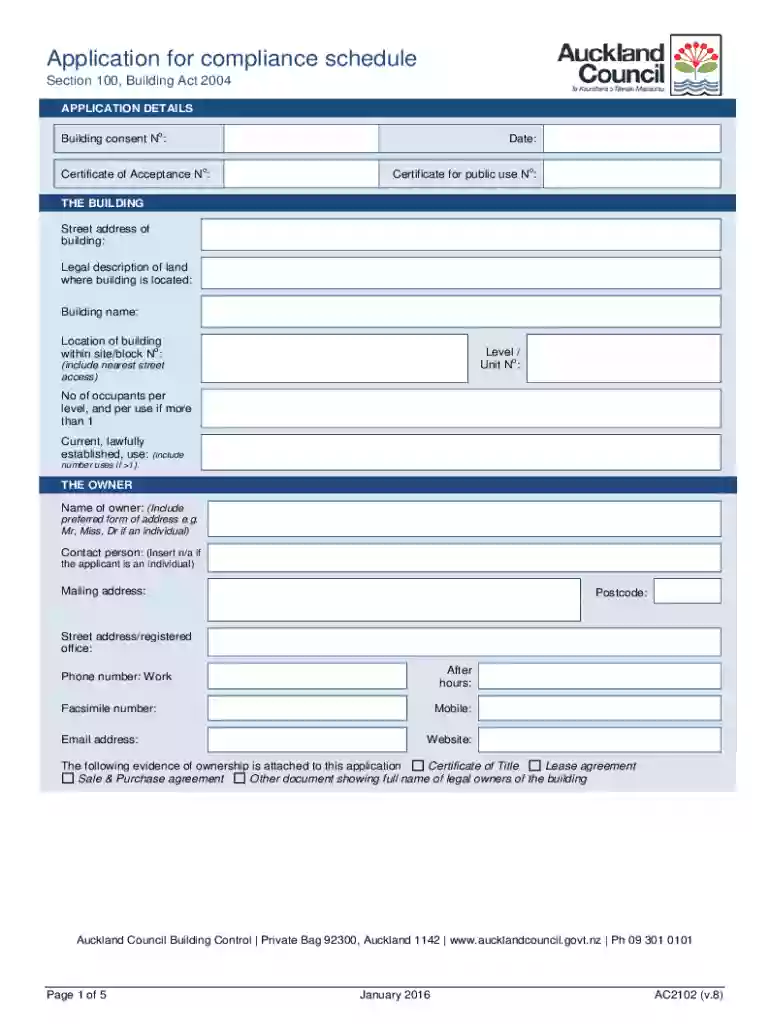
Type text, add images, blackout confidential details, add comments, highlights and more.

Draw your signature, type it, upload its image, or use your mobile device as a signature pad.

Send auckland council compliance schedule form via email, link, or fax. You can also download it, export it or print it out.
The AC2102 Application for Compliance Schedule is a crucial document within the framework of the Building Act 2004. It serves as a formal application for establishing a compliance schedule, detailing the procedures for ensuring that safety systems within a building are maintained and operate correctly. Comprising several sections, it gathers essential information regarding the building, its owner, and the maintenance processes for installed safety systems. This document ensures that buildings meet legal safety and operational standards, helping maintain a safe environment for occupants and visitors.
To obtain the AC2102 Application for Compliance Schedule, individuals can access it through local building authorities or download it from relevant government websites. These platforms provide the most current and legally compliant forms. Once obtained, it's essential to read through the form thoroughly before starting to complete it. Understanding the form's sections helps in gathering the necessary information beforehand, facilitating a smoother completion process.
Completing the AC2102 Application for Compliance Schedule requires careful attention to detail across several sections. Here is a general guide to help through the process:
The AC2102 form includes several key elements designed to capture all necessary information for compliance scheduling:
Adhering to the key elements during completion not only ensures legal compliance but also contributes to the safety and operational efficiency of the building.
Users of the AC2102 form span various roles and industries, primarily those involved in building management and regulatory compliance.


Industries such as construction, real estate management, and facility operations frequently interact with this form, particularly in the context of new builds or significant renovations.
Legally, the AC2102 Application for Compliance Schedule plays a fundamental role in maintaining safety standards as stipulated under Section 100 of the Building Act 2004. The form serves as a contract between building owners and regulatory bodies, outlining the agreed-upon inspection and maintenance routines.
The form can be submitted through several methods, each catering to different preferences for accessibility and convenience:
By understanding these fundamental aspects of the AC2102 Application for Compliance Schedule, users can ensure they complete the form accurately and submit it through the most effective channels. This careful preparation helps maintain building safety standards and abide by regulatory requirements.
We've got more versions of the new zealand auckland council form. Select the right new zealand auckland council version from the list and start editing it straight away!
At DocHub, your data security is our priority. We follow HIPAA, SOC2, GDPR, and other standards, so you can work on your documents with confidence.
AC 2102 - Introductory Managerial Accounting. Focuses on the use of accounting information for internal decision-making. Topics include budgeting, cost behaviorRead more
Mar 18, 2026 The procurements a sponsor makes under the AIP must comply with all applicable federal contract provisions as established by various laws and regulations.Read more


