




01. Edit your form online
Type text, add images, blackout confidential details, add comments, highlights and more.

Type text, add images, blackout confidential details, add comments, highlights and more.

Draw your signature, type it, upload its image, or use your mobile device as a signature pad.

Send it via email, link, or fax. You can also download it, export it or print it out.
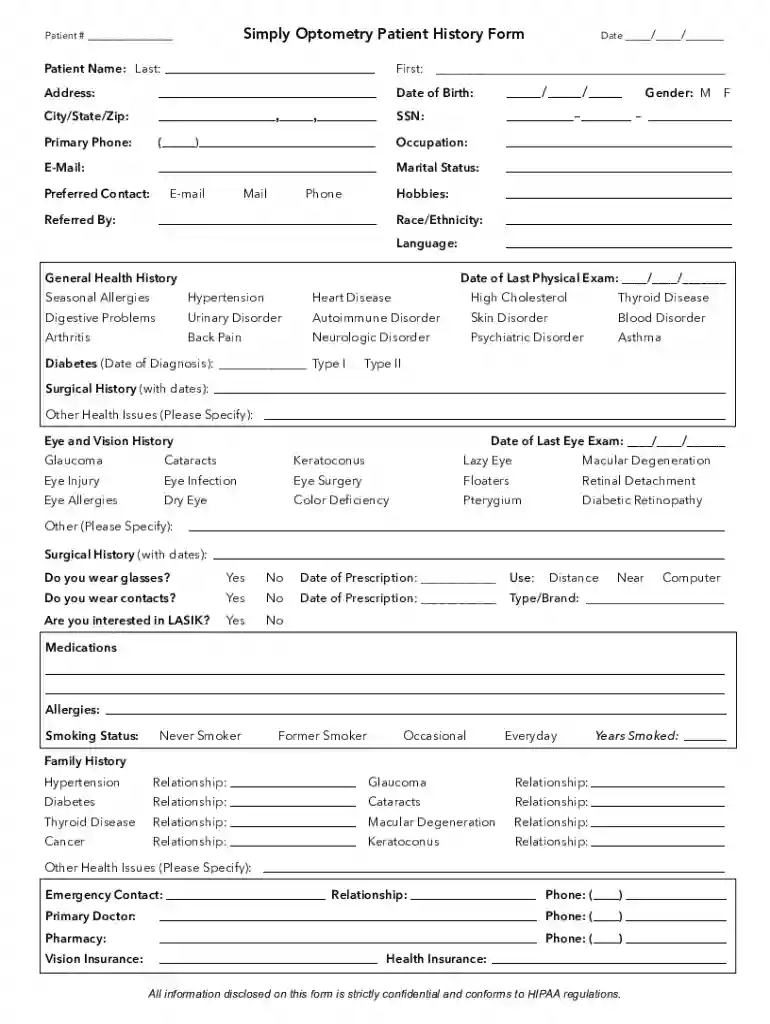
The "Patient History Form ver 3.0" serves as a comprehensive document used in optometry practices for collecting detailed patient information. It is designed to gather personal, health, and vision-related details essential for providing personalized and effective eye care. This version of the form reflects updated guidelines and practices in optometry, offering a structured approach to document patient histories systematically.
The form includes several critical sections:
Patients typically fill out the form during their initial visit or update it on subsequent visits if there are changes in their health status. The form should be completed accurately to ensure a tailored approach to eye care.
This form is primarily utilized by:


The form must comply with HIPAA regulations, ensuring patient data confidentiality. It is a legally bound document which, once completed and signed by the patient, is used to develop treatment plans aligned with the patient’s health history. Misuse of the form or the provided information can lead to legal ramifications.
Optometry practices often offer both paper and digital versions for flexibility and patient convenience:
DocHub’s platform supports various file formats such as PDF, DOC, and others, allowing the Patient History Form ver 3.0 to be edited, filled, and signed electronically. The compatibility with Google Workspace makes it easy to integrate documents with systems already in use by many healthcare providers.
In practice, the form might be used to:
The "Patient History Form ver 3.0" plays a crucial role in ensuring comprehensive patient care by providing optometrists with valuable insights into their patients' health.
We've got more versions of the Patient History Form ver 3.0 form. Select the right Patient History Form ver 3.0 version from the list and start editing it straight away!
At DocHub, your data security is our priority. We follow HIPAA, SOC2, GDPR, and other standards, so you can work on your documents with confidence.
This form is to be completed by the clinician or ADC staff. History of cigarette smoking and alcohol use. UDS (v3.0, mArCh 2015) (206) 543-8637 (v3.0, mArCh
the tox:version section contains the versions of all packages tox depends on with their version. passing -l now allows only listing default target envs. allowsRead more


