
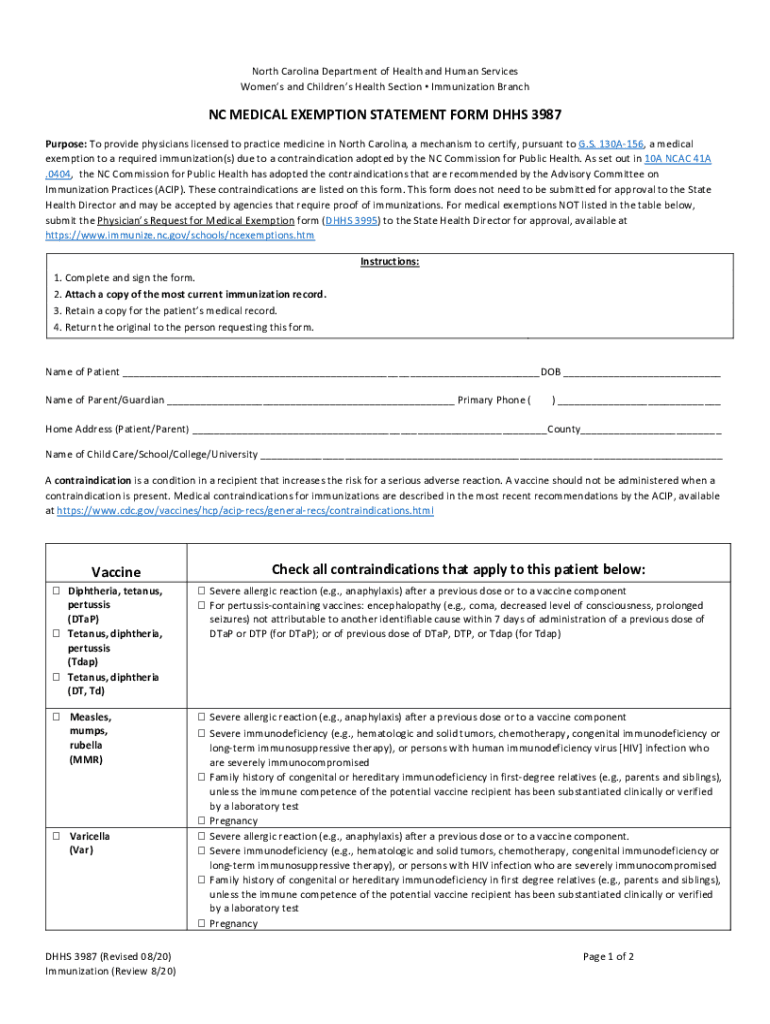







Overview of the NC Medical Exemption Statement Form (DHHS 3987)
The NC Medical Exemption Statement Form, officially known as DHHS 3987, is a document issued by the North Carolina Department of Health and Human Services. It provides a standardized method for healthcare professionals to certify exemptions from required vaccinations based on specific contraindications recognized by the NC Commission for Public Health. This form is utilized within North Carolina to ensure that medical exemptions are documented in a consistent manner and are compliant with state health regulations.
How to Obtain the NC Medical Exemption Statement Form DHHS 3987
To acquire the NC Medical Exemption Statement Form DHHS 3987, individuals can access the document through the North Carolina Department of Health and Human Services' official website or request it from healthcare providers. Additionally, local health departments may provide copies of the form. It is important for individuals seeking a medical exemption to consult with their healthcare provider, as the completion of the form requires professional medical evaluation and certification.
Steps to Complete the NC Medical Exemption Statement Form DHHS 3987
-
Read Instructions Carefully: Begin by thoroughly reading the form's instructions to understand the requirements and necessary information.
-
Enter Personal Information: Fill in the form with personal details, including the name of the individual requiring the exemption and their date of birth.
-
Medical Certification: A licensed healthcare provider must complete this section, specifying the medical contraindications that justify the exemption from specific vaccines.
-
Physician's Details: Include the healthcare provider's contact information, medical license number, and signature to validate the certification.
-
Review and Submit: Once complete, review the form for accuracy before submitting it as required by the school or relevant authority.
Eligibility Criteria for Medical Exemption
Eligibility for a medical exemption through the use of Form DHHS 3987 is determined by medical contraindications recognized by the NC Commission for Public Health. These contraindications may include severe allergic reactions to vaccine components or specific medical conditions that prevent safe administration of certain vaccines. The healthcare provider must assess the individual's health status against these criteria to certify a legitimate exemption.


Key Elements of the NC Medical Exemption Statement Form
- Contraindications: Detailed documentation of medical reasons for exemption.
- Healthcare Provider Certification: Official validation that requires a healthcare professional's assessment and signature.
- Focused Criteria: Adherence to specific medical guidelines recognized by health authorities.
Legal Use of the NC Medical Exemption Statement Form DHHS 3987
The form is legally utilized to document and verify recognized medical exemptions from state-mandated immunizations. It ensures that the exemption process complies with public health laws while safeguarding individual health needs. The form's certification does not require state health director approval, streamlining its use in local jurisdictions, especially within educational institutions that require proof of immunization status.
State-Specific Rules for the NC Medical Exemption Statement Form
In North Carolina, the NC Medical Exemption Statement Form must adhere to state guidelines regarding exemptions. While similar forms might exist in other states, each state maintains unique requirements that affect the applicable criteria and procedures. The form is specifically designed for North Carolina and aligns with its public health policies, ensuring regional compliance.
Examples of Using the NC Medical Exemption Statement Form DHHS 3987
-
Educational Settings: Parents can submit the completed form to schools as part of their child's immunization record when enrolling them in daycare or school systems.
-
Healthcare Institutions: Healthcare providers maintain records of patients with medical exemptions using the form for future reference in medical treatment or public health inquiries.
-
Employment Requirements: In roles where vaccinations might be mandated by employers, individuals can present this form to validate a legally recognized exemption.
Important Terms Related to the NC Medical Exemption Statement Form
- Exemption: The act of being freed from an obligation or requirement, in this case, vaccination due to medical reasons.
- Contraindications: Specific factors or conditions that serve as reasons to withhold a certain medical treatment due to harm.
- Certification: The formal process through which a healthcare provider confirms the validity of a medical exemption per state guidelines.
Form Submission Methods (Online / Mail / In-Person)
- Online Submissions: Some educational institutions may allow digital submissions if equipped to handle electronic documentation.
- Mail Submissions: Traditional mailing can be used to send the completed form to the relevant authority.
- In-Person Submissions: Direct submission to schools or offices offering public health services, where the form can be processed and filed immediately.
With these guidelines, the NC Medical Exemption Statement Form DHHS 3987 serves as a crucial document for ensuring medical exemptions are handled professionally and within legal standards.




