




01. Edit your talent release form template australia online
Type text, add images, blackout confidential details, add comments, highlights and more.

Type text, add images, blackout confidential details, add comments, highlights and more.

Draw your signature, type it, upload its image, or use your mobile device as a signature pad.

Send curtin consent form via email, link, or fax. You can also download it, export it or print it out.
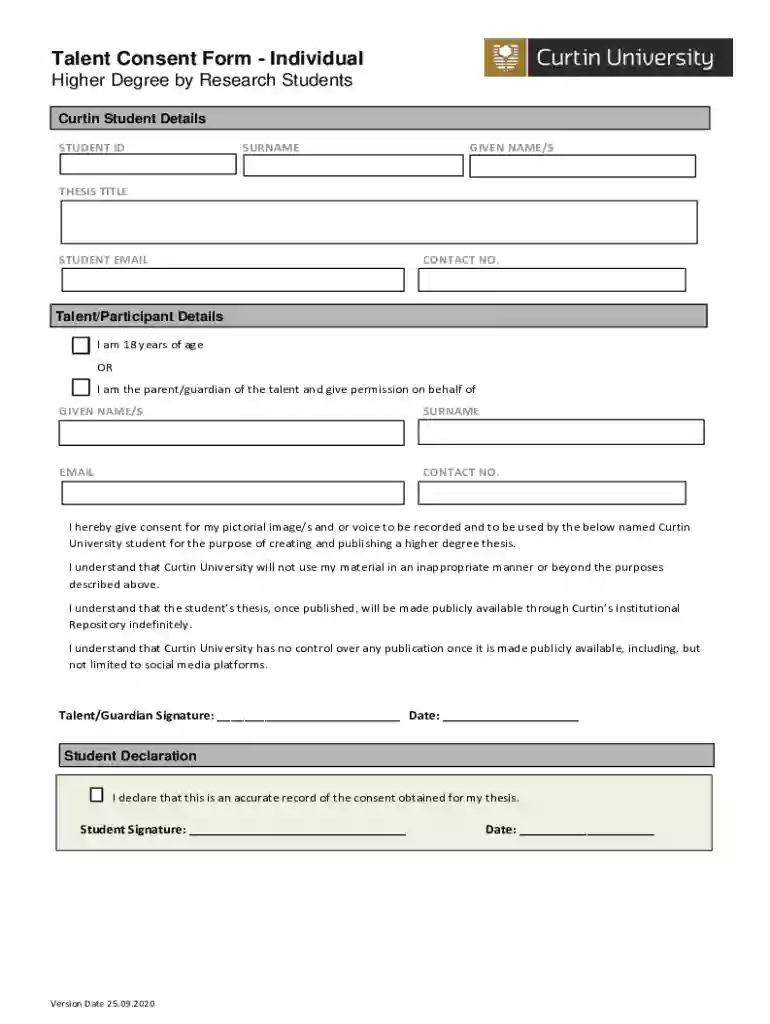
The "Talent Consent Form - Curtin University, Perth, Australia" is a legal document used primarily within the academic domain, particularly by higher degree by research students at Curtin University. This form serves a dual purpose of permitting and recording an individual's consent to be captured via image or voice for educational or academic-related purposes. The form establishes a clear agreement regarding the rights and responsibilities of both the consenting individual and the institution, ensuring lawful and ethical usage of personal likeness in academic materials, which may become publicly accessible as part of published work.
Understanding the components of the Talent Consent Form is essential for both the participants and the users. The following elements are generally included in the form:
Properly utilizing the Talent Consent Form involves several steps to ensure compliance and understanding:
This form is primarily utilized by:


The use of the Talent Consent Form aligns with legal and ethical standards by:
Completing the form involves a series of procedural steps:
In practice, the Talent Consent Form might be applied in scenarios such as:
While primarily based on Australian rules, the form should consider:
By addressing these aspects, the Talent Consent Form comprehensively ensures legal and ethical compliance while facilitating academic and research activities at Curtin University.
We've got more versions of the talent release form template australia form. Select the right talent release form template australia version from the list and start editing it straight away!
| Versions | Form popularity | Fillable & printable |
|---|---|---|
| 2020 | 4.4 Satisfied (33 Votes) |
Sure, it is possible with DocHub. This reliable and compliant online service has a phone-based signing option. After you log in to your DocHub account and import your Talent Consent Form - Curtin University, Perth, Australia to our editor, fill out all necessary fields and use the Sign tool on the top barf. Click on Create your signature and select Phone from the available options. Here, you scan a QR code using your smartphone and draw your signature on your phone screen, as you usually do when signing physical papers. If you access DocHub right from your mobile device, you can electronically sign your paperwork by drawing your electronic signature, adding its photo, or simply with a typed name.
If you store your documents in Google Drive, there is no need to download your Talent Consent Form - Curtin University, Perth, Australia on your computer and upload it back to our editor. A significantly simpler way is to install a browser extension created by DocHub to simplify this flow. The extension allows editing PDFs right in your browser. Alternatively, you can integrate your DocHub and Gmail accounts for more efficient editing.
At DocHub, your data security is our priority. We follow HIPAA, SOC2, GDPR, and other standards, so you can work on your documents with confidence.
by TR ACKLAND 2007 Cited by 130 All participants read and signed a consent form before measurement and Company, the University of Western Australia,. Curtin University of Technology.Read more
by JP Veale 2025 This study investigated whether a history of ACLR before the Australian Football League (AFL) Draft Combine influenced draft outcomes and second ACL injuryRead more
This thesis explores the notion of a human right to higher education (HRHE) as it is articulated under public international law, and examines progressRead more


