




01. Edit your form online
Type text, add images, blackout confidential details, add comments, highlights and more.

Type text, add images, blackout confidential details, add comments, highlights and more.

Draw your signature, type it, upload its image, or use your mobile device as a signature pad.

Send it via email, link, or fax. You can also download it, export it or print it out.
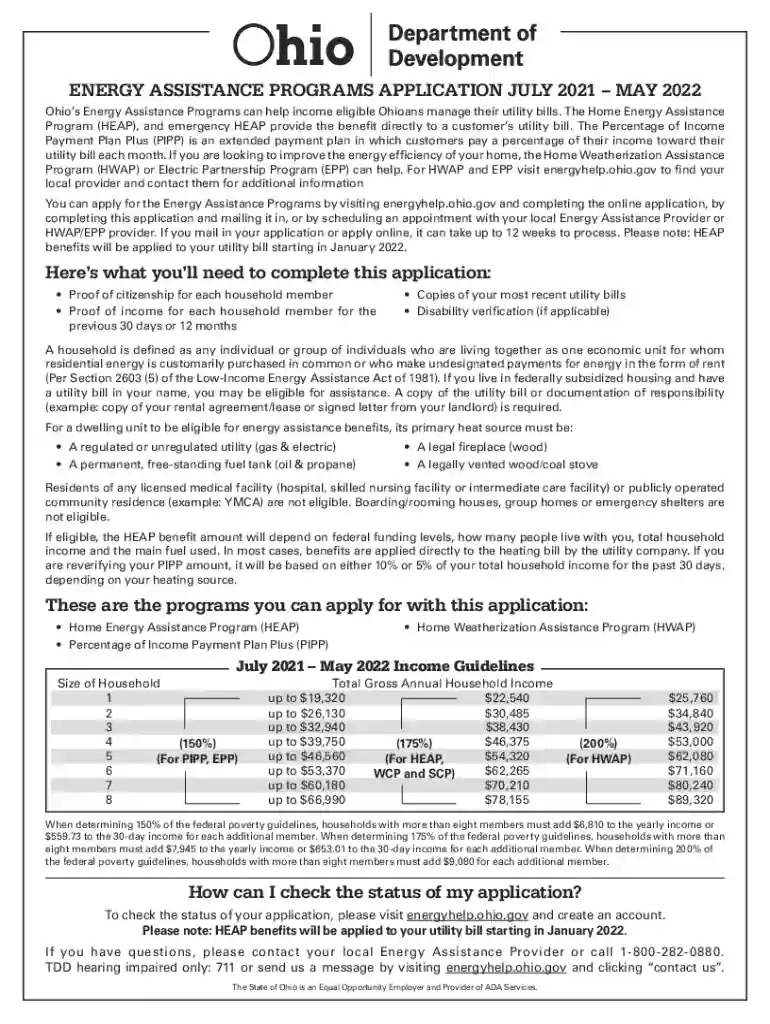
The Energy Assistance Programs - Ohio are designed to support income-eligible residents in managing their utility bills. These programs aim to alleviate financial burdens associated with heating and cooling costs by providing direct financial support and facilitating affordable payment plans. Main components of these programs include the Home Energy Assistance Program (HEAP), which offers financial assistance based on income levels, and the Percentage of Income Payment Plan Plus (PIPP), which enables residents to pay a consistent percentage of their monthly income toward their utility bills. Additionally, weatherization assistance is offered to improve energy efficiency in homes, reducing overall energy costs.
Eligibility for the Energy Assistance Programs - Ohio is determined largely by household income. To qualify for HEAP or PIPP, applicants must typically fall within certain income thresholds established annually by federal poverty guidelines. Special consideration is often given to households with elderly members, children, or individuals with disabilities. It's important to have proof of income, residency, and utility costs to complete the application process successfully. Some programs may also require proof of citizenship or legal residency status as part of their eligibility criteria.


Gather Required Documents: Before beginning the application, ensure you have all necessary documentation, including proof of income, utility bills, and identification.
Choose Application Method: Decide whether to apply online, by mail, or in person at an authorized agency. Each method may have slightly different procedural requirements.
Submit Application: Complete the application form accurately, providing all requested information and attachments. Online applications may provide instant confirmation, while mail or in-person submissions might involve a processing period.
Follow Up: After submission, check the status of your application regularly. Contact the relevant agency if you experience delays or require further assistance.
Await Approval: Once approved, you'll receive notification detailing the benefits for which you qualify. Review the approval letter carefully to understand any next steps or compliance requirements.
HEAP (Home Energy Assistance Program): A federal program providing financial relief for heating and cooling costs.
PIPP (Percentage of Income Payment Plan Plus): A billing system where eligible residents pay a fixed percentage of their income each month for utilities.
Weatherization Assistance: Services designed to improve home energy efficiency, reducing total energy usage and costs.
Federal Poverty Guidelines: Annual income levels published by the Department of Health and Human Services, used to determine eligibility for various assistance programs.
Income Verification: Documentation required to show earned and unearned income for program eligibility assessment.
Applicants must provide a comprehensive list of documents, including but not limited to, recent utility bills, identification, and proof of income (such as pay stubs or Social Security statements). Submissions can be processed through various methods:
While the Energy Assistance Programs are federally funded, each state, including Ohio, administers them with specific guidelines that affect eligibility, benefits, and processes. For example, Ohio may offer specific waivers or additional benefits during extreme weather conditions or during particular economic challenges. Adequate awareness and understanding of these state-specific nuances can maximize the assistance received and ensure compliance with local regulations.
Accurate and truthful information is vital when applying for energy assistance programs. Misrepresentation of income or household composition, whether intentional or accidental, can lead to application denial or the requirement to repay received benefits. In severe cases, further legal action may be initiated for fraud. Ensuring meticulous documentation and double-checking all reported information is critical to prevent such scenarios.
Consider a single-parent household with two children and a limited income. Utilizing HEAP could directly reduce their heating bill in winter, while enrollment in PIPP can spread payments evenly across the year, preventing budget spikes during peak usage months. In a different scenario, an elderly couple on social security might benefit from weatherization services, decreasing their overall energy consumption and utility costs effectively over time. These examples illustrate the tangible impact these programs can have on eligible Ohio residents.
We've got more versions of the Energy Assistance Programs - Ohio form. Select the right Energy Assistance Programs - Ohio version from the list and start editing it straight away!
At DocHub, your data security is our priority. We follow HIPAA, SOC2, GDPR, and other standards, so you can work on your documents with confidence.


