




01. Edit your form online
Type text, add images, blackout confidential details, add comments, highlights and more.

Type text, add images, blackout confidential details, add comments, highlights and more.

Draw your signature, type it, upload its image, or use your mobile device as a signature pad.

Send it via email, link, or fax. You can also download it, export it or print it out.
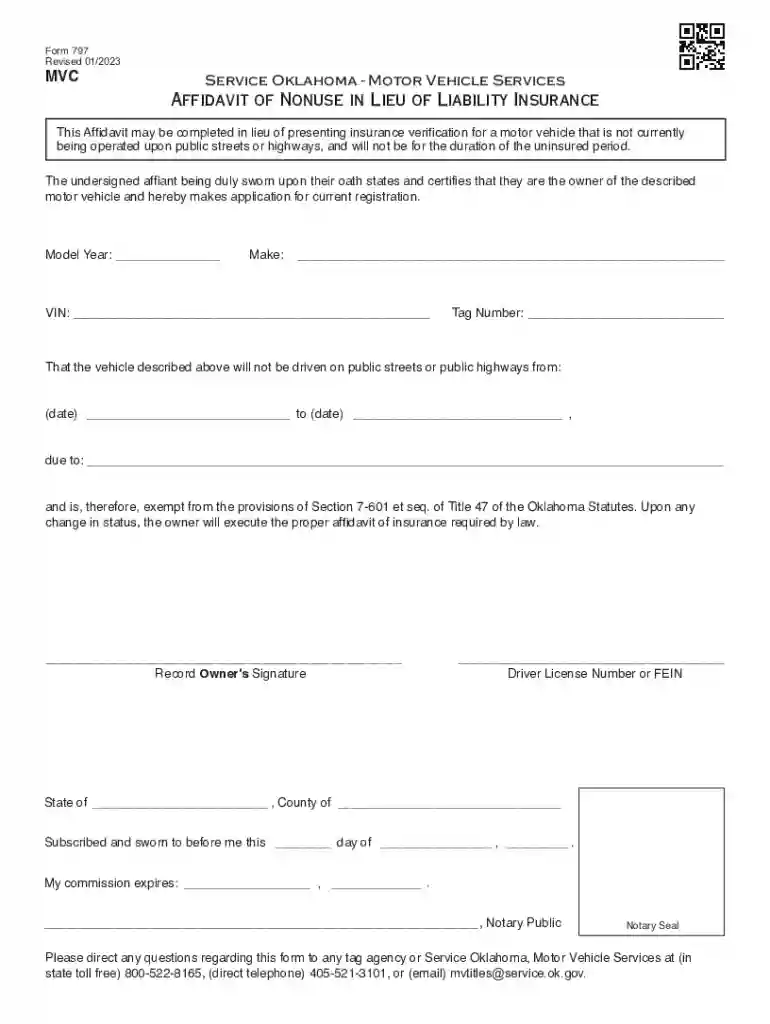
OTC Form 797, commonly referred to as the "Affidavit of Nonuse in Lieu of Liability Insurance," is a legal document used in Oklahoma to certify that a specific motor vehicle will not be operated on public roads. By filing this form, vehicle owners can avoid the requirement for liability insurance during the specified period of nonuse. This affidavit is typically utilized when a vehicle is temporarily out of service or in storage, allowing the owner to suspend insurance coverage without penalty.
To effectively use OTC Form 797, vehicle owners must carefully fill out the form to ensure all required information is correct and complete. The process involves:
Detailed Information Entry: Include the vehicle’s identification details like make, model, year, and Vehicle Identification Number (VIN).
Period Specification: Clearly specify the period during which the vehicle will not be in use, ensuring it aligns with the intended exemption period.
Notarization Requirement: The form must be notarized to validate the affidavit, so planning for a notary appointment is essential.
Submission: After completion and notarization, the form should be submitted to the Oklahoma Tax Commission (OTC).
Obtaining the OTC Form 797 is a straightforward process:
Online Access: Visit the official website of the Oklahoma Tax Commission to download the form directly. Ensure you have a reliable PDF reader to view and print the document.
In-Person Collection: Forms are also available at local tag agencies where additional guidance may be available from staff.
Request via Mail: Contact the Oklahoma Tax Commission’s customer service to request a form by mail if digital access is inconvenient.
Completing the OTC Form 797 involves several key steps:
Reading Instructions: Begin by thoroughly reading all instructions provided with the form to understand requirements and specific fields.
Fill In Owner Information: Write down the vehicle owner’s full name, address, and contact details accurately.
Vehicle Details Entry: Enter the specific information about the vehicle, such as the make, model, and VIN.
Nonuse Period Declaration: Clearly state the period during which the vehicle will not be used.
Notarization Compliance: Take the form to a certified notary public for official notarization to authenticate the affidavit.
Submission: Submit the completed form to the appropriate OTC office.
Utilizing the OTC Form 797 can lead to significant benefits, such as:
Cost Savings: Temporarily suspending liability insurance eliminates unnecessary costs while a vehicle is not in use.
Legal Compliance: Prevents the risk of penalties or fines related to uninsured vehicles by officially declaring the nonuse period.
Practical for Infrequent Use: Ideal for vehicles kept in storage or used seasonally, offering flexibility and financial efficiency.
Familiarizing with the key terms associated with the OTC Form 797 can aid in its accurate completion:
Affidavit: A written statement confirmed by oath or affirmation, used as evidence of the truth of the vehicle’s nonuse.
Liability Insurance: Financial protection that covers accidents and damage caused while operating the vehicle.
Notarization: The official process of certifying the form by a notary public to confirm its legitimacy.
Legal use of the OTC Form 797 is critical for:
Ensuring Compliance: Make sure the affidavit accurately reflects the vehicle’s nonuse to comply with Oklahoma vehicle laws.
Exemption Duration: Users must be aware that continued non-coverage of liability insurance while the vehicle is in use violates legal statutes.
Official Documentation: Recognized as a legal document, it must be filled with honesty and in accordance with state laws to retain its validity.
Understanding the core components of the OTC Form 797 helps in accurate submissions:
Owner and Vehicle Information: Precise entry of details confirming the owner’s identity and the specific vehicle involved.
Nonuse Period: Definitive dates during which the vehicle is not intended for use, substantiating the exemption claim.
Notarized Signature: A notarized signature from the owner affirming the authenticity and commitment to the affidavit’s terms.
We've got more versions of the OTC Form 797 "Affidavit of Nonuse in Lieu of Liability Insurance" form. Select the right OTC Form 797 "Affidavit of Nonuse in Lieu of Liability Insurance" version from the list and start editing it straight away!
Managing your forms with DocHub this way is very straightforward once you have downloaded its extension for Google Chrome. Navigate to the Chrome Web Store and install DocHub - Sign PDF from Gmail to obtain it. Give our tool access to your Google account, and then open an email containing OTC Form 797 "Affidavit of Nonuse in Lieu of Liability Insurance" as an attachment and point to the file with your cursor - the DocHub extension key will automatically appear there. Click on it to open your form in our editor. Make any necessary modifications, complete the blanks, and click Sign to create your legally-binding electronic signature.
Apart from a comprehensive toolset for editing PDFs on mobile phones, DocHub enables you to sign your OTC Form 797 "Affidavit of Nonuse in Lieu of Liability Insurance" along the way. Open our editor in your browser, make changes using DocHub’s toolset, and complete your editing by eSigning the completed form.
At DocHub, your data security is our priority. We follow HIPAA, SOC2, GDPR, and other standards, so you can work on your documents with confidence.
(3) Proof of current liability insurance. An Affidavit of Non-Use In Lieu of Liability Insurance (SOK Form 797) is not acceptable. (k) The LicensedRead more
Affidavit of Nonuse in Lieu of Liability Insurance. This Affidavit may be completed in lieu of presenting insurance verification for a motor vehicle that isRead more


