




01. Edit your vtg10 online
Type text, add images, blackout confidential details, add comments, highlights and more.

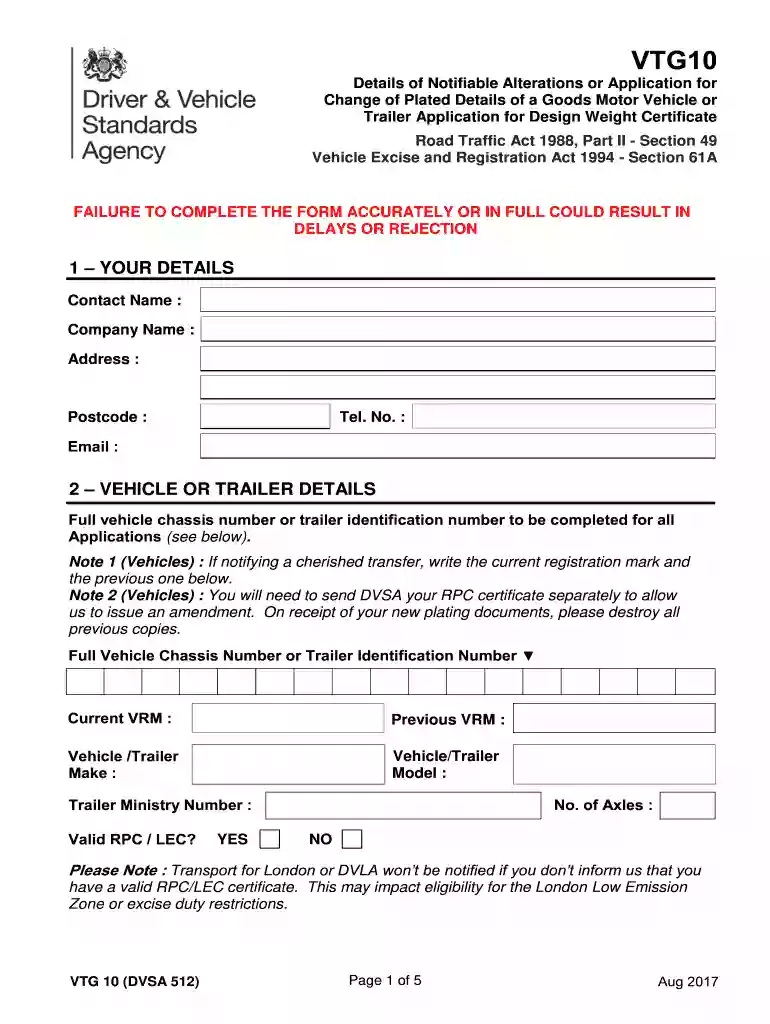
Type text, add images, blackout confidential details, add comments, highlights and more.

Draw your signature, type it, upload its image, or use your mobile device as a signature pad.

Send vtg10 form via email, link, or fax. You can also download it, export it or print it out.
The VTG10 form serves as a crucial document for notifying relevant authorities of any changes to the plated details of a goods motor vehicle or trailer. This application is mandated by the Road Traffic Act 1988 and the Vehicle Excise and Registration Act 1994, thereby ensuring compliance with legal requirements. Accurate completion of the VTG10 application form is essential to prevent delays or the potential rejection of the application.
When completing the VTG10 application form, specific details must be provided to facilitate the processing of the application. Key information includes:
Filling out the VTG10 application form accurately is crucial. Inaccurate or incomplete information may lead to delays in processing. Other possible consequences include:
Understanding the primary components of the VTG10 application process aids in successful submissions. Notable elements include:
The VTG10 form is primarily utilized by vehicle owners and operators. It is commonly used by:
There may be fees associated with submitting the VTG10 application form, which can vary based on:
Check current cost structures with the appropriate governing body to ensure accurate budgeting.
The VTG10 application form may have associated documents that serve related purposes. For instance:
When filling out the VTG10 form, keep these pointers in mind to ensure compliance and a smooth application experience:
In conclusion, the VTG10 application form facilitates necessary changes to motor vehicle details, and thorough completion is essential for compliance and efficiency in processing.
We've got more versions of the vtg10 form. Select the right vtg10 version from the list and start editing it straight away!
If you often work with documents kept in your Google Drive, DocHub is an excellent solution for you to easily and quickly complete, edit, and sign them. This editor integrates properly with Google apps, so you can export your vgt10 form from your Google Drive to the editor without the need of downloading and re-uploading it. Right-click on your file, choose Open With → DocHub PDF Sign and Edit. In our editor, add and assign Signature Fields for all parties involved, then click on the Menu option above → Send → decide on how you want to share your paperwork.
Document editing with DocHub is equally convenient on desktop and mobile devices. You only need an internet browser to revise your vtg10 application form on Android. Open our site and sign in to access the tools you require. Add your document and introduce your intended modifications. After that, you can keep your form in your document storage or send it out right away.
At DocHub, your data security is our priority. We follow HIPAA, SOC2, GDPR, and other standards, so you can work on your documents with confidence.
Transformer VTG2000 - 13 pcs , Transformer SVC-1000, Transformer -VTG10, Transformer VT 1600 -10 pcs ; The used items are sold in AS-IS condition with noRead more
This may indicate dilatant hardening as an arresting mechanism of slow slip. Fracture orientations and localized slip in deformed sample VTG 10.Read more


