




01. Edit your form online
Type text, add images, blackout confidential details, add comments, highlights and more.

Type text, add images, blackout confidential details, add comments, highlights and more.

Draw your signature, type it, upload its image, or use your mobile device as a signature pad.

Send it via email, link, or fax. You can also download it, export it or print it out.
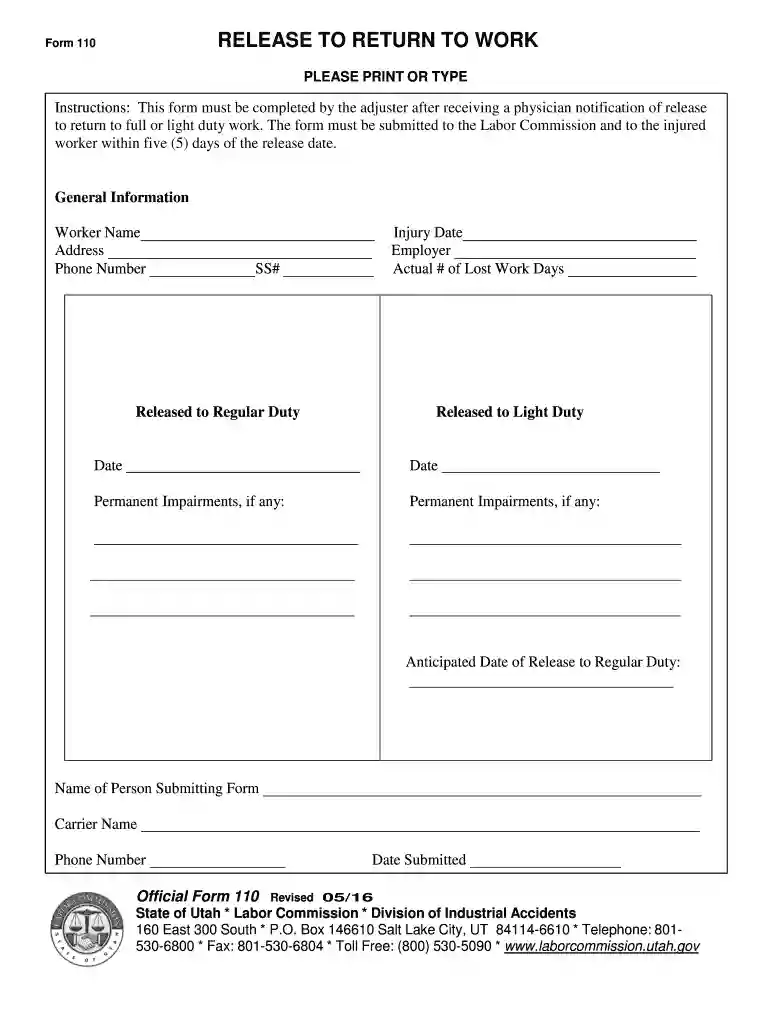
The "Utah Release Work" form, known as Form 110, is used primarily by insurance adjusters in Utah to officially document when an injured worker is cleared to return to work. This form can indicate whether the worker is returning to full or light duty. The documentation ensures that all parties are informed of the worker's status and any ongoing limitations. It is a legal requirement and must be submitted to the Utah Labor Commission, as well as the worker involved, no later than five days after the release date. This timeline helps to ensure transparency and compliance with state regulations regarding worker re-entry into the job market.
Acquiring the "Utah Release Work" form is straightforward. It can be downloaded directly from the Utah Labor Commission's website. Alternatively, it is possible to request the form from a supervising insurance company or legal advisor.
Completing Form 110 involves a step-by-step process to accurately report all necessary information.
Understanding the key components of Form 110 is critical for accurate completion. Key elements include diagnoses, work restrictions, and the worker’s capacity to perform specific job functions.
Form 110 is a legally binding document that must comply with specific Utah state laws governing worker's compensation and labor regulations.
The form is mainly used by insurance adjusters, employers, and legal representatives involved in worker’s compensation claims for job-related injuries in Utah.


Utah has specific stipulations about the "Release Work" form that distinguish it from other states.
Practical examples illustrate the form’s utility across varied scenarios.
Analyzing these scenarios can highlight the form's role in facilitating a structured return-to-work strategy.
We've got more versions of the utah release work form. Select the right utah release work version from the list and start editing it straight away!
At DocHub, your data security is our priority. We follow HIPAA, SOC2, GDPR, and other standards, so you can work on your documents with confidence.
An employee may take a 15 minute compensated break period for every four hours worked. Break periods may not be accumulated to accommodate a shorter work dayRead more
The Utah County Sheriffs Office Work Diversion program provides inmates the opportunity to serve their court ordered sentence performing community workRead more
They filter the lake water through cellulose filters, collect the algae-bound cellulose in presses, and release the cleaned water back into the lake. work


