





Definition & Meaning
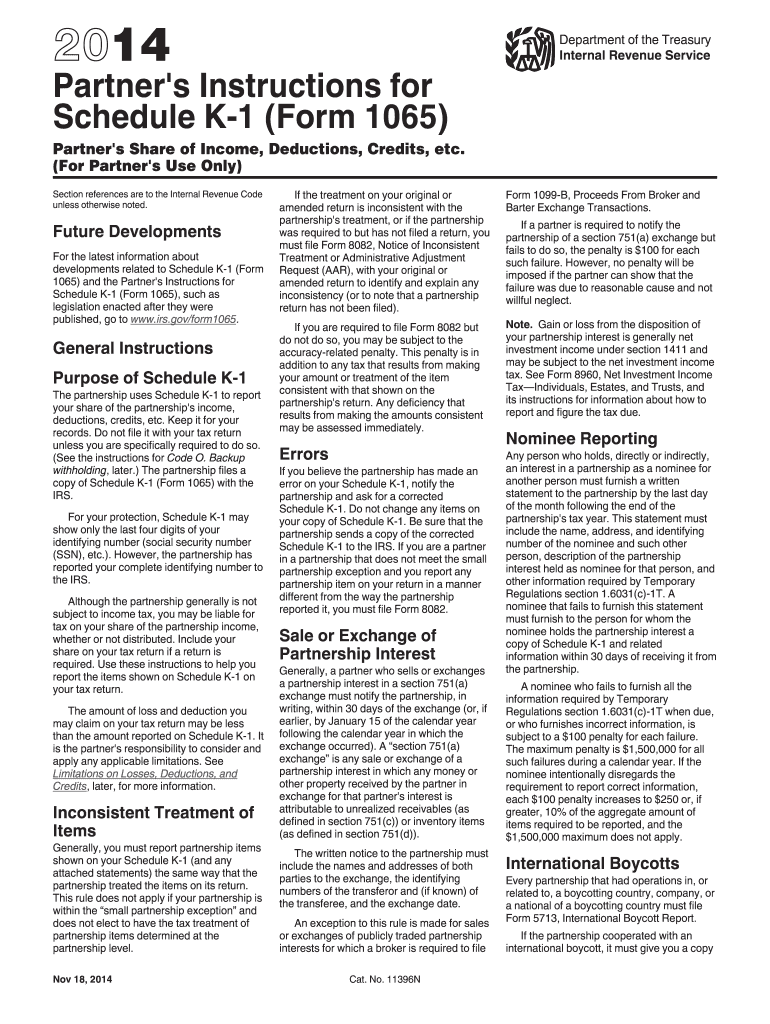
The "partner instruction 2014 form" refers to the guidelines provided to help partners in a partnership understand how to complete Schedule K-1 (Form 1065). This document is crucial because it details a partner's share of the partnership’s income, deductions, credits, and other items for the tax year. The Schedule K-1 form serves to report each partner’s share of these financials, and the instructions clarify reporting requirements, assist with the calculation of distributive share amounts, and highlight areas where specific tax codes and regulations apply.
Steps to Complete the Partner Instruction 2014 Form
-
Gather Necessary Information: Begin by collecting all relevant financial data from the partnership, including total income, expenses, deductions, and credits.
-
Complete Income Allocation: Allocate the partnership's income according to each partner's agreed-upon share. This allocation must align with the partnership agreement.
-
Calculate and Report Deductions: Identify allowable deductions and apply these to each partner’s share. Make sure all deductions are documented and compliant with IRS rules.
-
Assign Credits: Credits must be correctly attributed to partners based on individual eligibility and the partnership’s guidelines.
-
Review Limitations on Losses: If losses exist, understand the limitations on claiming these losses, as they vary based on the partner's basis in the partnership.
-
Check for Inconsistent Treatment: Ensure items are consistent across various forms, avoiding discrepancies that could lead to IRS inquiries.
Key Elements of the Partner Instruction 2014 Form
-
Purpose of the Form: To report each partner's share of the partnership’s income, deductions, and credits.
-
Sections for Reporting: Different sections cover various types of income (ordinary income, interest, dividends) and deductions.
-
Special Rules: Recognition of special rules for passive activities, at-risk limitations, and other specific tax situations.
-
Instructions for Each Line Item: Detailed instructions for filling out each line item on the Schedule K-1.
Important Terms Related to the Partner Instruction 2014 Form
-
Distributive Share: The portion of income, gain, loss, deduction, or credit allocated to a partner according to the partnership agreement.
-
Basis Rules: These rules determine the maximum amount a partner can report for losses and the tax implications of distributions.
-
Passive Activities: Activities that a partner does not materially participate in and how they impact loss reporting.
Legal Use of the Partner Instruction 2014 Form
-
Compliance: Ensures that partners are compliant with federal tax reporting obligations.
-
Partnership Agreement: Must align with the terms and conditions set forth in the partnership agreement concerning shares.
-
Documentation: Provides a legally recognized method of reporting and documenting distributions for tax purposes.
IRS Guidelines
-
Tax Filing Requirements: The Schedule K-1 should be filed along with the partnership’s Form 1065.
-
Submission Deadlines: Usually due on March 15 for calendar-year partnerships, with extensions available.
-
Record Keeping: Maintain records for at least three years to support the reported information.
Who Typically Uses the Partner Instruction 2014 Form
-
Partners in Partnerships: Any individual or entity that holds an interest in a domestic or foreign partnership.
-
Accountants and Tax Preparers: Professionals who assist partners with tax compliance and reporting.
-
Business Owners: Individuals involved in managing and reporting business interests within partnerships.

Penalties for Non-Compliance
-
Failure to File: Penalties may apply if the partnership fails to file Form 1065 or provide Schedule K-1 to the partners.
-
Incorrect Reporting: Substantial penalties for inaccuracies or failure to report income correctly.
-
Late Filings: Penalties accrue for schedules filed past the due date unless an extension is granted.
Who Issues the Form
- Internal Revenue Service (IRS): The IRS issues both Form 1065 and the instructions for Schedule K-1, ensuring standardized compliance for partnerships.
Software Compatibility
-
Tax Software: Utilize compatible software like TurboTax or QuickBooks to automate calculations and ensure accurate entries.
-
Integration Capabilities: These platforms often integrate with business accounting systems to import financial data efficiently.




