




01. Edit your lic 9151 online
Type text, add images, blackout confidential details, add comments, highlights and more.

Type text, add images, blackout confidential details, add comments, highlights and more.

Draw your signature, type it, upload its image, or use your mobile device as a signature pad.

Send lic9151 via email, link, or fax. You can also download it, export it or print it out.
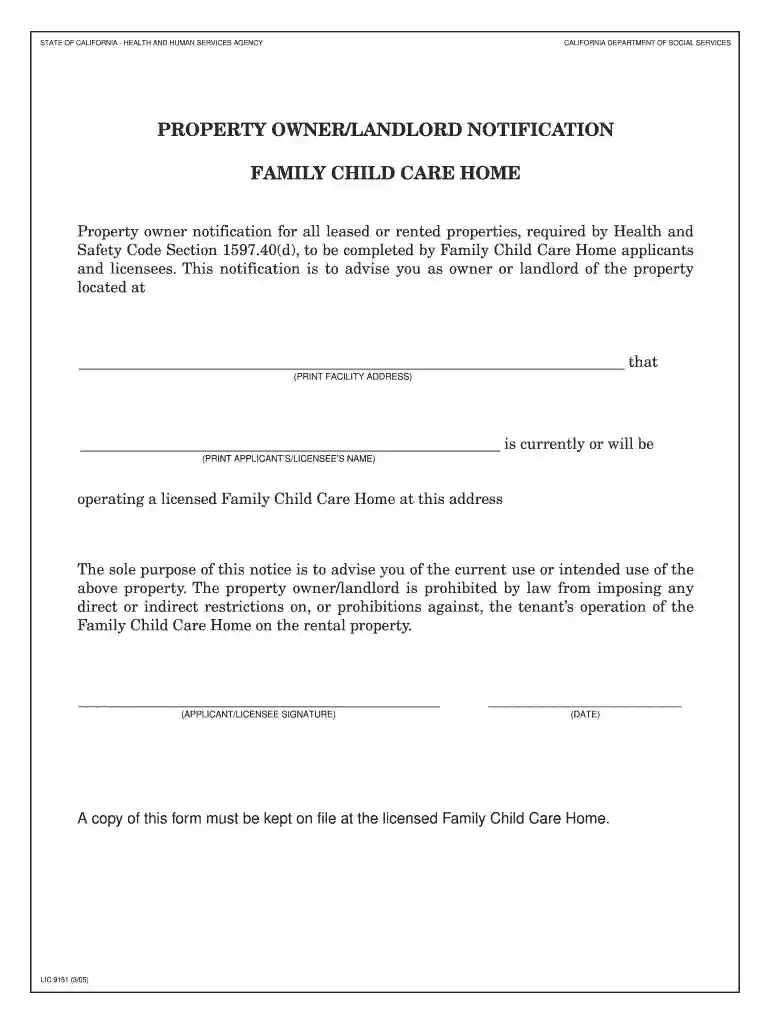
The lic 9151 form, issued by the California Department of Social Services, is a crucial document for Family Child Care Home applicants and licensees. It serves as a notification to property owners or landlords about the operation of a licensed Family Child Care Home at a specific address. This form is vital in ensuring that the rights and responsibilities of all parties involved are clear and legally protected.
Download the Form: Access the lic 9151 form through the California Department of Social Services website or request a paper copy if needed.
Fill Out Personal and Property Details: Enter the full name and address of the Family Child Care Home applicant. Provide detailed information about the property, including the address where the child care home will be operated.
Notification to Property Owner: Clearly notify the property owner about the intended use of the property as a Family Child Care Home. Include any specific terms agreed upon with the property owner.
Applicant's Declaration: Complete the applicant's declaration section by signing and dating the form to affirm the accuracy of the details provided.
Submit the Form: Submit the completed form to the California Department of Social Services and provide a copy to the property owner for their records.
The lic 9151 form plays a pivotal role in legal matters concerning Family Child Care Homes. By informing landlords of the operational intentions, it mitigates potential disputes related to property use. It's imperative to understand that landlords cannot impose restrictions that inhibit the operation of a licensed child care home, reinforcing the tenant's legal rights.
Applicant Information: Includes the full name and contact details of the Family Child Care Home applicant.
Property Details: Covers the address and relevant specifics of the property in question.
Notification Details: A formal statement informing the property owner about the child care operations.
Signatures: Signature sections for both the applicant and acknowledgment from the property owner.
Date of Notification: Indicates when the landlord was informed, which is crucial for record-keeping.
Using the lic 9151 form offers numerous benefits, including:
Clarity: Establishes clear communication between the child care provider and the property owner.
Legal Protection: Ensures both parties understand their rights and obligations, reducing the risk of future legal conflicts.
Compliance: Helps maintain compliance with state regulations regarding Family Child Care Homes.
Family Child Care Home: A licensed residential facility providing child care for small groups of children.
Licensee: A person authorized to operate a Family Child Care Home.
Property Owner: The individual or entity that owns the property where the child care home is operated.
California has specific rules for operating Family Child Care Homes that the lic 9151 form helps address:
Regulation Compliance: Operators must adhere to state child care regulations, which the lic 9151 form reinforces by notifying the property owner.
No Restriction Clause: Property owners are legally barred from placing restrictions that prevent the operation of the child care facility, as stated in state legislation.
Failure to properly complete and submit the lic 9151 form can result in significant consequences:
Legal Repercussions: Not informing a property owner as required can lead to legal disputes.
License Revocation: Non-compliance may result in the revocation of the Family Child Care Home license.
Fines and Sanctions: Financial penalties can be imposed for failing to comply with statutory obligations.
By understanding and correctly utilizing the lic 9151 form, Family Child Care Home providers can protect their legal rights and ensure smooth operations.
We've got more versions of the lic 9151 form. Select the right lic 9151 version from the list and start editing it straight away!
Managing your documentation with DocHub this way is extremely straightforward after you have downloaded its extension for Google Chrome. Navigate to the Chrome Web Store and install DocHub - Sign PDF from Gmail to obtain it. Give our tool access to your Google account, and then open an email with the lic 9151 attached and point to the file with your cursor - the DocHub extension key will automatically appear there. Click on it to open your file in our editor. Make any essential modifications, complete the blanks, and click Sign to create your legally-binding eSignature.
If you need to edit your lic 9151 on the internet easily, it does not matter what browser you use. DocHub’s simple editing instruments are accessible using any internet browser. Simply open the appropriate tab in the editor, add your document, and fill it out without stress.
At DocHub, your data security is our priority. We follow HIPAA, SOC2, GDPR, and other standards, so you can work on your documents with confidence.
Class Number: 9151 Instructor: Franklin, Sarah Component: Lecture Type: In Person Units: 1.0 - 9.0 Wait List: No Seats Available: 37.
Maintain a copy of this completed form on file at the licensed Family Child Care Home. LIC 9151 (8/14)Read more


