




01. Edit your form online
Type text, add images, blackout confidential details, add comments, highlights and more.

Type text, add images, blackout confidential details, add comments, highlights and more.

Draw your signature, type it, upload its image, or use your mobile device as a signature pad.

Send it via email, link, or fax. You can also download it, export it or print it out.
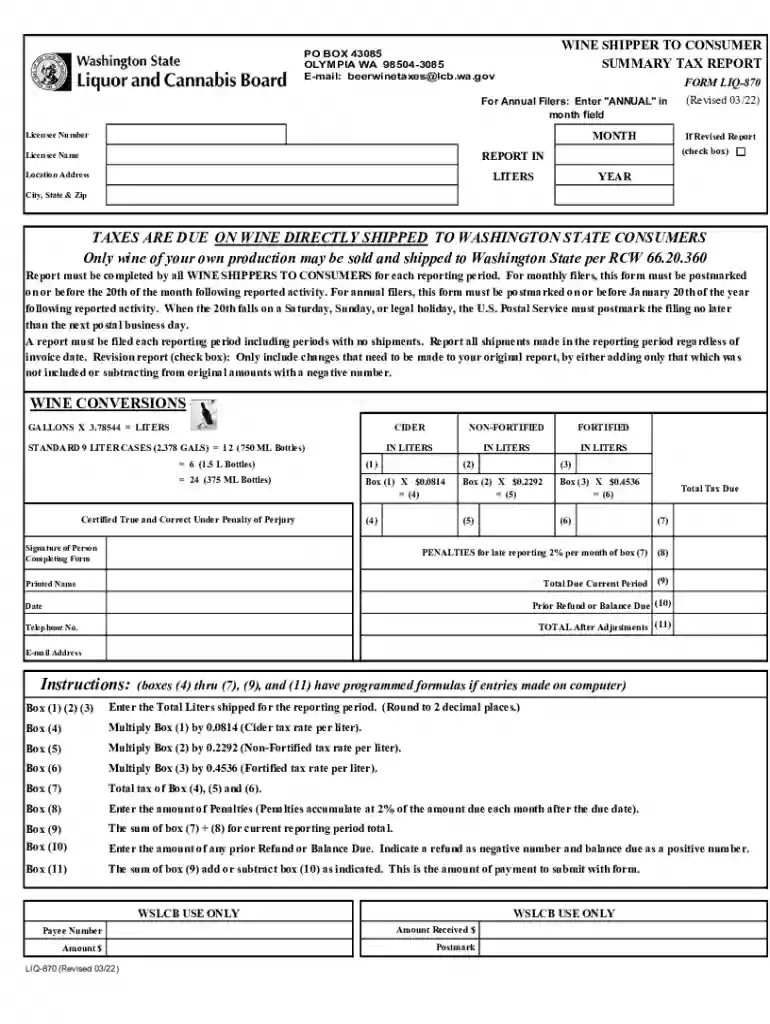
The "Wine Shipper To Consumer Summary Tax Report" is a tax document required by wine shippers operating in Washington State that enables them to report shipments made directly to consumers. The form is essential for ensuring compliance with state regulations governing alcohol sales and distribution. It encompasses details on the type and volume of wine shipped, which helps authorities in tax assessments and regulation enforcement. The form is required for wine producers licensed to sell directly to consumers and mandates that only self-produced wine be included in these reports.
Understanding specific terminology is crucial for completing the form accurately.
These terms provide clarity and context, ensuring that shippers accurately adhere to requirements laid out in the form.
Completing the "Wine Shipper To Consumer Summary Tax Report” involves several key steps:
Each step ensures that shippers remain in compliance with Washington State regulations and avoid potential penalties.
Adhering to filing deadlines is critical. In Washington State, wine shippers must submit monthly reports by the 20th of the following month for shipments made. The annual report consolidating all monthly data is required by January 31st of the subsequent year. Missing these deadlines can incur penalties, emphasizing the importance of timely submissions.
Failing to comply with reporting requirements can result in significant penalties. These can include monetary fines, revocation of shipping licenses, and additional audits by state tax authorities. It's crucial for wine shippers to adhere strictly to all reporting requirements to avoid these repercussions.
To complete the form, wine shippers need to gather:
These documents provide the basis for accurate completion and submission of the form.
The form comprises various sections that must be completed with attention to detail:
Ensuring each section is completed accurately and thoroughly is essential for compliance.
The completed form can be submitted through several channels:
Choosing the right submission method ensures prompt processing and compliance with state mandates.
The form serves as a legal document evidencing compliance with tax obligations and consumer shipment regulations. It underscores the responsibility of wine producers in following Washington State laws and ensures that consumer relations are governed by appropriate legal frameworks.
For electronic completion and submission, compatibility with software like DocHub facilitates an efficient process. These tools aid in filling out the form digitally and maintain compliance with formatting and electronic signature requirements stipulated under the ESIGN Act.
The form is relevant to a range of business entities involved in wine shipping:
Understanding the nuances of business type ensures that the form is completed in alignment with entity-specific requirements.
Typically, the form is utilized by wine producers who engage directly with consumers, including private vineyards, small-scale wineries, and large wine corporations. Utilizing the form ensures these businesses meet official tax reporting and distribution standards in Washington State.
Overall, the comprehensive completion of the "Wine Shipper To Consumer Summary Tax Report" ensures compliance with state regulations, supports transparent business practices, and sustains healthy consumer relations.


We've got more versions of the forms.justia.comwashingtonstatewideJustia :: Wine Shipper To Consumer Summary Tax Report ... form. Select the right forms.justia.comwashingtonstatewideJustia :: Wine Shipper To Consumer Summary Tax Report ... version from the list and start editing it straight away!
Most eSignature services require users to have a paid subscription. With DocHub, there are two ways for you to add an electronic signature to your forms.justia.comwashingtonstatewideJustia :: Wine Shipper To Consumer Summary Tax Report ... at no cost:
The second option, however, has restrictions on the number of signatures, sign requests, emails, and forms for editing available per month. You can check for full information here.
With DocHub, there are several convenient methods to edit your forms.justia.comwashingtonstatewideJustia :: Wine Shipper To Consumer Summary Tax Report ... online. You can drag and drop the form and modify it directly at the DocHub website or use our browser extension to fill out your form immediately. Additionally, you can modify your PDF on your smartphone, as DocHub is compatible with all the available mobile platforms.
At DocHub, your data security is our priority. We follow HIPAA, SOC2, GDPR, and other standards, so you can work on your documents with confidence.


