




01. Edit your form online
Type text, add images, blackout confidential details, add comments, highlights and more.

Type text, add images, blackout confidential details, add comments, highlights and more.

Draw your signature, type it, upload its image, or use your mobile device as a signature pad.

Send it via email, link, or fax. You can also download it, export it or print it out.
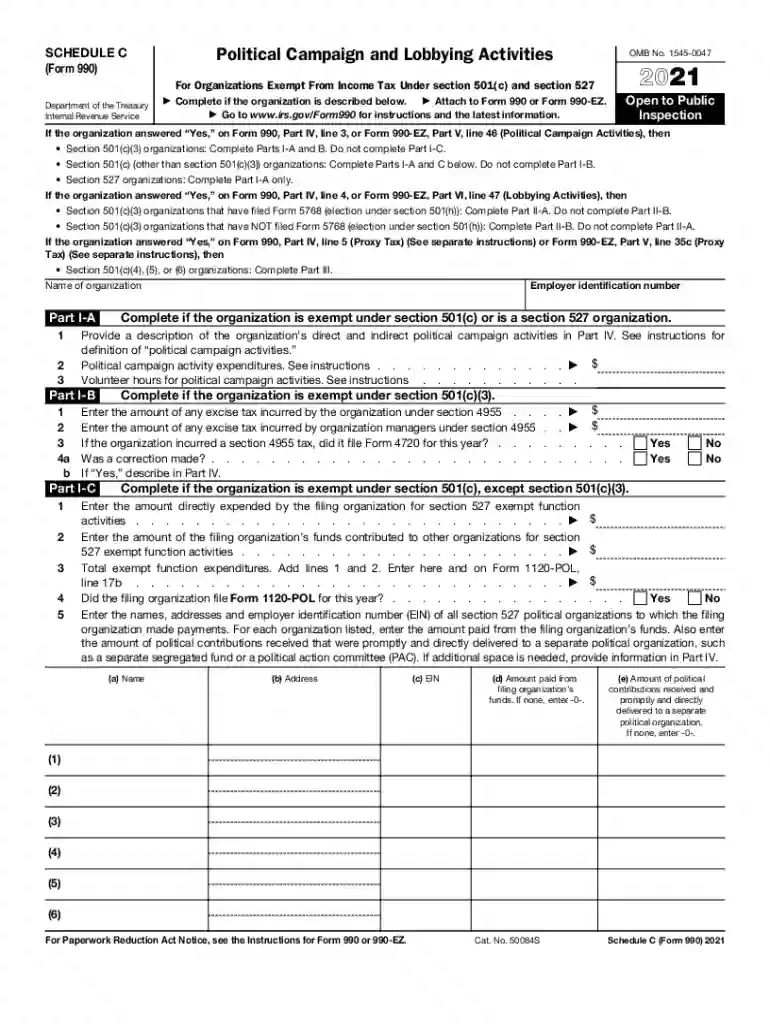
Schedule C of Form 990 is a document required for organizations exempt from income tax under sections 501(c) and 527. This form is specifically designed to report political campaign and lobbying activities. It serves as a critical compliance tool, ensuring that organizations disclose their political expenditures and lobbying activities in accordance with IRS regulations. The form comprises sections detailing direct and indirect political campaigns, lobbying expenditures, and the organization’s adherence to related tax codes.
Schedule C is essential for maintaining transparency in political and lobbying activities. Organizations must accurately report all political expenditures and lobbying efforts, including both direct and indirect activities. Failure to comply with Schedule C requirements may result in penalties, revocation of tax-exempt status, or increased scrutiny from the IRS.
Completing Schedule C of Form 990 involves several structured steps to ensure accurate reporting:
Gather Required Information: Collect data on all political campaign activities and lobbying expenditures for the tax year. This includes any direct spending or contributions made towards political causes.
Fill Out Part I: Document the organization’s political campaign activities, detailing contributions, expenditures, and more. This section requires a breakdown of direct support for or opposition to political candidates.
Complete Part II: Provide comprehensive details on lobbying activities. Report expenditures related to lobbying at the local, state, and federal levels, including any indirect lobbying efforts through coalitions.
Address Specific Requirements: Depending on the organization type, additional information may be needed in Parts III and IV, which focus on disinfecting taxes and compliance with Section 501(h), among other specifications.
Review and Submit: After completing the form, verify all entries for accuracy and completeness before submission. Retain copies for organizational records.
Schedule C is primarily utilized by tax-exempt organizations that engage in political or lobbying activities. This includes:
The IRS mandates that tax-exempt organizations maintain transparency through comprehensive reporting on Schedule C. Organizations must be diligent in their record-keeping practices to ensure compliance with codes and regulations governing political activities. The IRS employs specific criteria to evaluate compliance, and organizations failing to adhere may face audits or enforcement actions.
Filing Schedule C necessitates the assembly of supporting documentation that corroborates reported expenditures and activities:
Organizations not compliant with Schedule C reporting requirements may incur significant penalties. These include:
We've got more versions of the 990 schedule c form. Select the right 990 schedule c version from the list and start editing it straight away!
| Versions | Form popularity | Fillable & printable |
|---|---|---|
| 2025 | 4.4 Satisfied (41 Votes) | |
| 2024 | 4.9 Satisfied (55 Votes) | |
| 2023 | 4.9 Satisfied (35 Votes) | |
| 2022 | 4.5 Satisfied (28 Votes) | |
| 2021 | 4.8 Satisfied (200 Votes) | |
| 2020 | 4.4 Satisfied (131 Votes) | |
| 2019 | 4.1 Satisfied (32 Votes) | |
| 2018 | 4.4 Satisfied (352 Votes) | |
| 2017 | 4.4 Satisfied (236 Votes) | |
| 2016 | 4.4 Satisfied (52 Votes) | |
| 2015 | 4.4 Satisfied (64 Votes) | |
| 2013 | 4 Satisfied (45 Votes) | |
| 2010 | 4.3 Satisfied (49 Votes) |
Electronic signatures are an excellent replacement for traditional signing, as they save time, effort, and costs people spend on printing, scanning, and paper delivery. You can electronically sign your 990 schedule c utilizing a trustworthy and powerful online document processing tool like DocHub. It complies with main eSignature policies (ESIGN and UETA), so all documents approved there are legally binding and have the same validity as manually signed ones.
If you store your paperwork in Google Drive, there is no need to download your 990 schedule c on your computer and upload it back to our editor. A significantly simpler way is to install a browser extension created by DocHub to streamline this flow. The extension allows editing PDFs right in your browser. Alternatively, you can integrate your DocHub and Gmail accounts for more efficient editing.
At DocHub, your data security is our priority. We follow HIPAA, SOC2, GDPR, and other standards, so you can work on your documents with confidence.
These organizations must use Schedule C (Form 990) to furnish additional information on political campaign activities or lobbying activities, as those terms areRead more
May 2, 2025 If Yes, Form 990 and Schedule R may need to be completed instead of If Yes, complete Schedule C, Part I . . . . . . . . . . . . . 46.Read more


