




01. Edit your which line may be left blank in the header section of schedule c online
Type text, add images, blackout confidential details, add comments, highlights and more.

Type text, add images, blackout confidential details, add comments, highlights and more.

Draw your signature, type it, upload its image, or use your mobile device as a signature pad.

Send 2021 form 990 instructions via email, link, or fax. You can also download it, export it or print it out.
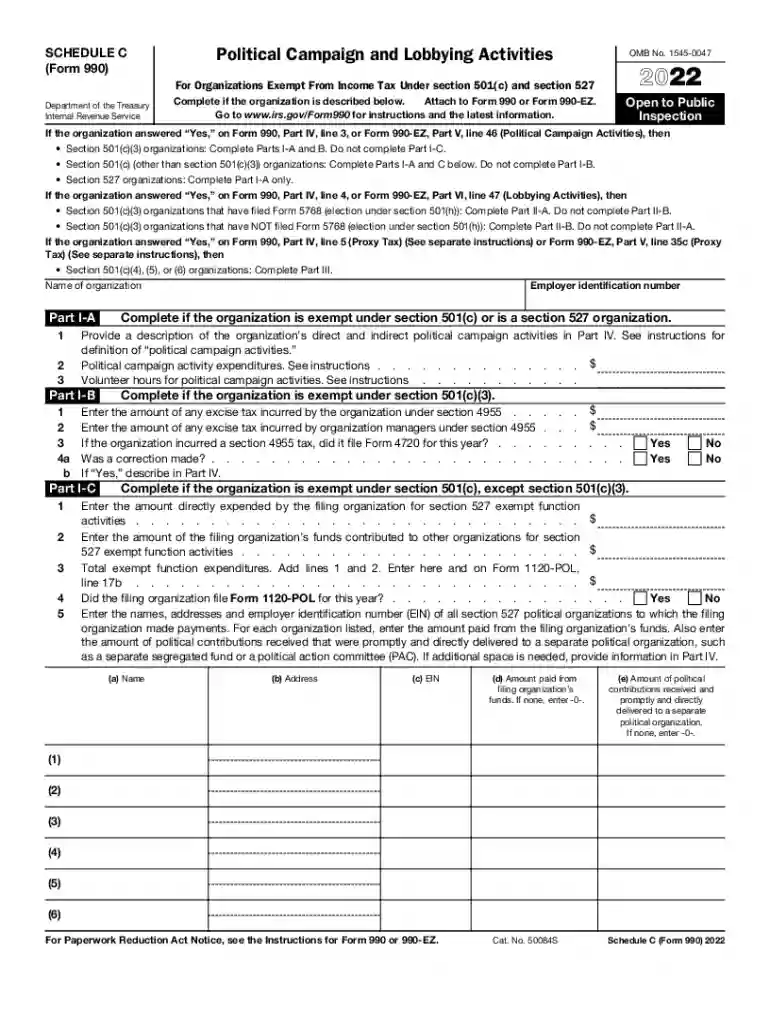
Schedule C (Form 990) is a critical document for tax-exempt organizations in the U.S. operating under sections 501(c) and 527. It assists these organizations in detailing their political campaign and lobbying activities to the Internal Revenue Service (IRS). The document's main purpose is to ensure transparency in political and lobbying expenditures, as well as compliance with tax regulations. Specifically, organizations must report expenditures related to political campaigns and lobbying efforts and provide supplemental information according to their tax-exempt status.
The Instructions for Schedule C guide organizations through the completion process, highlighting which parts of the form are relevant based on the entity's status. Each section of the instructions provides detailed guidance on reporting requirements and helps ensure accuracy and completeness. Organizations can follow these steps:
Following the instructions carefully helps avoid errors that could lead to rejections or the need for amendments.
Completing Schedule C involves several detailed steps to facilitate compliance:
It's imperative to adhere strictly to the instructions to ensure each section is completed correctly.
Understanding key terms related to Schedule C is vital for accurate reporting:
These definitions help clarify what needs to be reported and can guide the completion process.
The IRS publishes guidelines to aid organizations in completing Schedule C:
Guidelines ensure that organizations meet all legal obligations and maintain their tax-exempt status.
Compliance with deadlines for filing Schedule C is crucial. Typically, the form is due on the 15th day of the fifth month after the close of the organization's fiscal year. Late submissions can result in penalties, emphasizing the importance of staying organized and preparing documentation well in advance.
Failure to file Schedule C correctly or in a timely manner can lead to significant penalties. These might include financial sanctions or loss of tax-exempt status. Organizations must be vigilant in understanding their requirements and utilizing their resources effectively to mitigate the risk of penalties.
The legal landscape necessitates that organizations adhere strictly to the Schedule C instructions to stay compliant with federal regulations. These instructions serve as the IRS's official guidance and must be followed to ensure legal protection. Misinterpretation or misapplication of these instructions can have serious legal consequences for any non-profit organization involved in political or lobbying activities.
We've got more versions of the which line may be left blank in the header section of schedule c form. Select the right which line may be left blank in the header section of schedule c version from the list and start editing it straight away!
| Versions | Form popularity | Fillable & printable |
|---|---|---|
| 2025 | 4.4 Satisfied (41 Votes) | |
| 2024 | 4.9 Satisfied (55 Votes) | |
| 2023 | 4.9 Satisfied (35 Votes) | |
| 2022 | 4.5 Satisfied (28 Votes) | |
| 2021 | 4.8 Satisfied (200 Votes) | |
| 2020 | 4.4 Satisfied (131 Votes) | |
| 2019 | 4.1 Satisfied (32 Votes) | |
| 2018 | 4.4 Satisfied (352 Votes) | |
| 2017 | 4.4 Satisfied (236 Votes) | |
| 2016 | 4.4 Satisfied (52 Votes) | |
| 2015 | 4.4 Satisfied (64 Votes) | |
| 2013 | 4 Satisfied (45 Votes) | |
| 2010 | 4.3 Satisfied (49 Votes) |
At DocHub, your data security is our priority. We follow HIPAA, SOC2, GDPR, and other standards, so you can work on your documents with confidence.
Form 990, Part III - 4 Program Service Accomplishments (See the Instructions). (Code. 4,005,185 including grants of $. ) (Expenses $. ) (Revenue $. 3,320,587).Read more
Schedule C (Form 990) is used by: Section 501(c) organizations, and Section 527 organizations.


