




01. Edit your form online
Type text, add images, blackout confidential details, add comments, highlights and more.

Type text, add images, blackout confidential details, add comments, highlights and more.

Draw your signature, type it, upload its image, or use your mobile device as a signature pad.

Send it via email, link, or fax. You can also download it, export it or print it out.
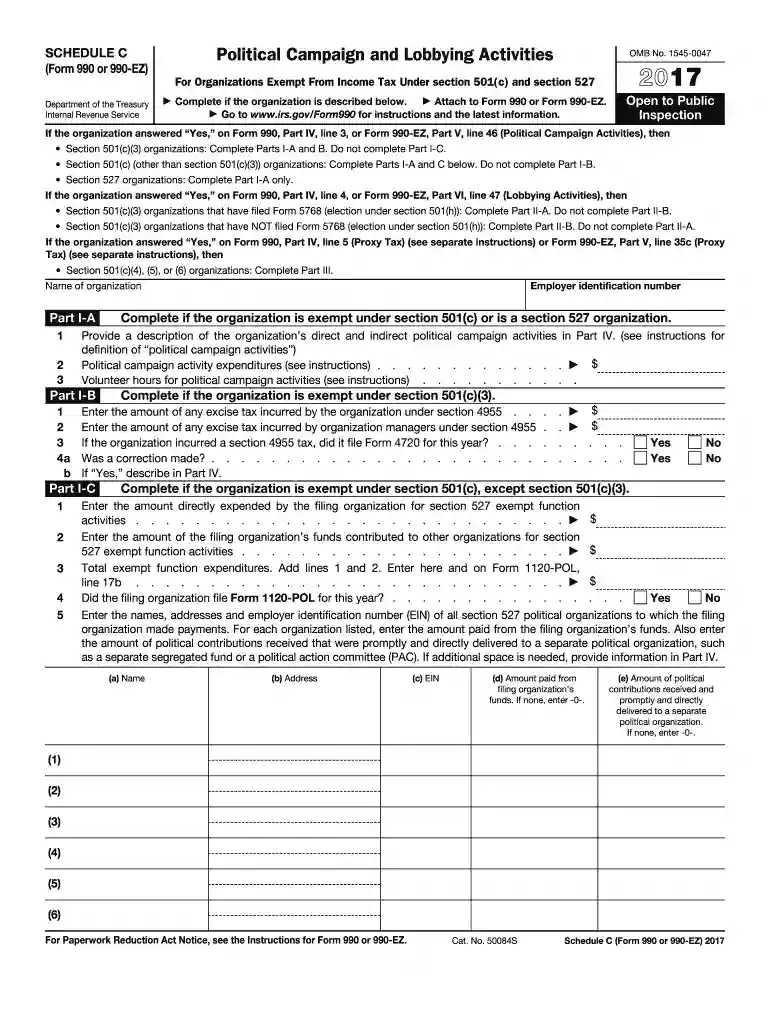
The 990-EZ Schedule C form is a companion to Form 990-EZ, used by organizations exempt from income tax under sections 501(c) and 527 of the Internal Revenue Code. This form is essential for non-profit organizations that need to report their political campaign and lobbying activities. It captures detailed information about various expenditures, volunteer hours involved in political activities, and compliance with legal requirements set forth by the IRS. Understanding its definition aids organizations in correctly interpreting legal obligations and ensuring transparency and compliance with tax regulations.
Completing the 990-EZ Schedule C requires a systematic approach:
Gather Relevant Information:
Fill Out Political Campaign Expenditures:
Detail Lobbying Activities:
Compliance Verification:
Double-Check Entries:
The IRS provides specific guidelines for filling out and submitting the 990-EZ Schedule C form:
Adhering to IRS guidelines helps organizations maintain compliance and avoid any legal or financial repercussions.
Meeting filing deadlines is crucial for compliance:
Meeting these deadlines is essential to conserve your organization's tax-exempt status.
Organizations that typically file the 990-EZ Schedule C include:
Knowing your organization's filing obligations helps ensure compliance and protects its tax-exempt status.


The IRS is responsible for issuing the 990-EZ Schedule C form. They ensure that tax-exempt entities adhere to federal tax code requirements, particularly concerning political and lobbying activities. Staying updated with IRS publications helps organizations remain compliant and ensure timely and accurate filing of required forms.
The legal framework surrounding Schedule C ensures organizations:
Staying informed about legal uses prevents misunderstandings and regulatory penalties.
Failure to comply with IRS requirements for the 990-EZ Schedule C can result in:
Ensuring compliance mitigates these risks, safeguarding the organization’s operations and reputation.
We've got more versions of the 990 ez c form. Select the right 990 ez c version from the list and start editing it straight away!
| Versions | Form popularity | Fillable & printable |
|---|---|---|
| 2025 | 4.4 Satisfied (41 Votes) | |
| 2024 | 4.9 Satisfied (55 Votes) | |
| 2023 | 4.9 Satisfied (35 Votes) | |
| 2022 | 4.5 Satisfied (28 Votes) | |
| 2021 | 4.8 Satisfied (200 Votes) | |
| 2020 | 4.4 Satisfied (131 Votes) | |
| 2019 | 4.1 Satisfied (32 Votes) | |
| 2018 | 4.4 Satisfied (352 Votes) | |
| 2017 | 4.4 Satisfied (236 Votes) | |
| 2016 | 4.4 Satisfied (52 Votes) | |
| 2015 | 4.4 Satisfied (64 Votes) | |
| 2013 | 4 Satisfied (45 Votes) | |
| 2010 | 4.3 Satisfied (49 Votes) |
At DocHub, your data security is our priority. We follow HIPAA, SOC2, GDPR, and other standards, so you can work on your documents with confidence.
Complete if the organization is a section 501(c)(3) organization or a section 4947(a)(1) nonexempt charitable trust. Attach to Form 990 or Form 990-EZ. Go toRead more
May 2, 2025 In a clear and concise manner, describe the services provided, the number of persons benefited, and other relevant information for each programRead more
Apr 21, 2021 (990/990-EZ/990-N). ▫. (990-PF, 990-T). ▫. 5 States 35%. ▫. California = 172,406. ▫. Ohio = 99,972. ▫. Texas = 99,743. ▫. New York = 98,680. ▫.Read more


