




01. Edit your form online
Type text, add images, blackout confidential details, add comments, highlights and more.

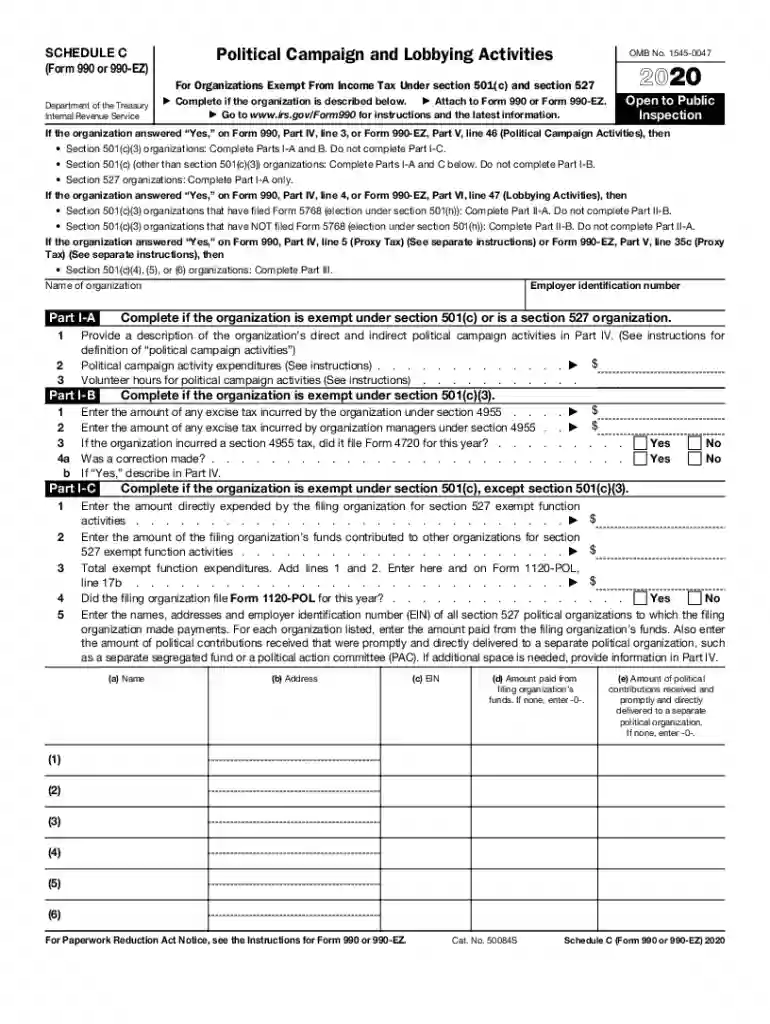
Type text, add images, blackout confidential details, add comments, highlights and more.

Draw your signature, type it, upload its image, or use your mobile device as a signature pad.

Send it via email, link, or fax. You can also download it, export it or print it out.
The Form 990-EZ, or simply the 990 part EZ form, is the Short Form Return of Organization Exempt From Income Tax. It is utilized by non-profit organizations in the U.S. to report their financial information, activities, governance, and compliance with federal tax requirements. This form is primarily used by smaller tax-exempt organizations, those with gross receipts less than $200,000 and total assets below $500,000 at the end of their tax year. Filing this form helps maintain transparency and accountability for these organizations, allowing the IRS and the public to monitor compliance with tax regulations.
Gather Essential Documents: Before beginning the form, ensure you have all necessary records, including financial statements, details of revenue and expenses, details of any paid employees or contractors, and information on organizational activities.
Fill Out Identification Information: This includes the organization's name, address, employer identification number, and tax year.
Report Organization's Revenue: Itemize all sources of income, such as donations, grants, and any unrelated business income.
Detail Expenses: Provide a breakdown of operating expenses, including salaries, office supplies, and fundraising costs.
Describe Organizational Activities: Summarize mission-related programs and services offered by the organization during the tax year.
File Electronically or Mail the Form: The IRS encourages electronic filing through authorized e-file providers, but paper submissions via mail are still accepted.
The 990-EZ form is most commonly used by small to mid-sized tax-exempt organizations including:
These organizations benefit from the streamlined documentation required by Form 990-EZ, which is less extensive than the standard Form 990.


Gross Receipts: The total amounts received by the organization from all sources during its annual accounting period, without subtracting any costs or expenses.
Tax-Exempt Status: Recognition by the IRS that an organization is exempt from paying federal income taxes. This is typically applicable for non-profit organizations that operate for religious, charitable, scientific, or educational purposes.
Schedule A: A supplement to the form that provides additional information about an organization's public charity status and public support.
For organizations using a calendar year as their fiscal year, the Form 990-EZ must be filed by May 15th each year. However, if using a different fiscal year, the form is due four months and fifteen days after the end of the fiscal year. Extensions for filing the form can often be requested, allowing an additional six months if needed.
The IRS provides comprehensive guidelines for completing the 990-EZ form. Key points include ensuring accurate and honest reporting of financial activities, maintaining a record of all documentation for at least three years, and addressing all required sections to avoid penalties or rejection of the submission. The IRS also mandates disclosure of any potential conflicts of interest within the organization.
The 990 part EZ form can be submitted digitally or through the traditional paper method. Digital submission is typically faster and more efficient, especially when using IRS-approved e-file software, which also reduces errors by validating information in real-time. Conversely, paper versions require manual completion and mailing, which may be preferred by organizations without reliable internet access.
Failure to file the Form 990-EZ by the due date without an extension can result in financial penalties for the organization. The penalty typically increases based on the duration of the delay and the organization's gross receipts. Continuous non-compliance may lead to the revocation of the tax-exempt status, emphasizing the importance of timely and accurate filing.
We've got more versions of the 990 part ez form form. Select the right 990 part ez form version from the list and start editing it straight away!
| Versions | Form popularity | Fillable & printable |
|---|---|---|
| 2025 | 4.4 Satisfied (41 Votes) | |
| 2024 | 4.9 Satisfied (55 Votes) | |
| 2023 | 4.9 Satisfied (35 Votes) | |
| 2022 | 4.5 Satisfied (28 Votes) | |
| 2021 | 4.8 Satisfied (200 Votes) | |
| 2020 | 4.4 Satisfied (131 Votes) | |
| 2019 | 4.1 Satisfied (32 Votes) | |
| 2018 | 4.4 Satisfied (352 Votes) | |
| 2017 | 4.4 Satisfied (236 Votes) | |
| 2016 | 4.4 Satisfied (52 Votes) | |
| 2015 | 4.4 Satisfied (64 Votes) | |
| 2013 | 4 Satisfied (45 Votes) | |
| 2010 | 4.3 Satisfied (49 Votes) |
At DocHub, your data security is our priority. We follow HIPAA, SOC2, GDPR, and other standards, so you can work on your documents with confidence.
May 2, 2025 In a clear and concise manner, describe the services provided, the number of persons benefited, and other relevant information for each programRead more
Check ▷ if the organizations gross receipts are normally not more than $25,000. The organization need not file a return with the IRS; but if the organization.Read more


