
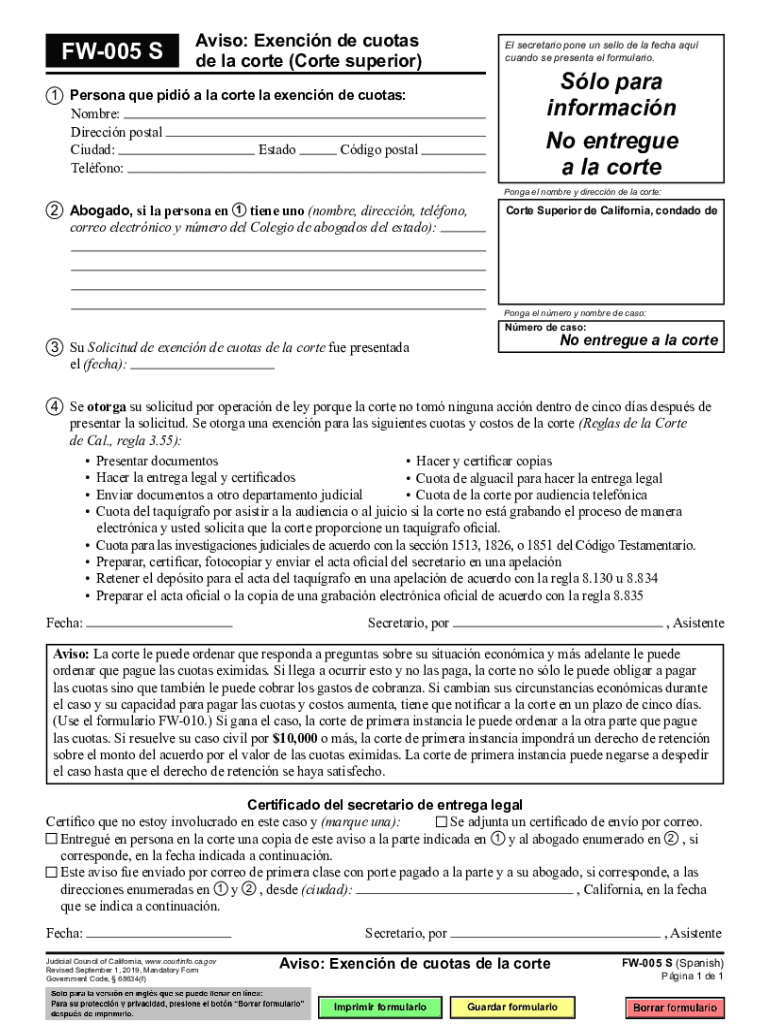







Definition & Purpose of the GV-630 S Form
The GV-630 S form, officially known as "Orden sobre la solicitud para dar por terminada una," is a legal document used within California's court system. The primary purpose is to facilitate the process of concluding or terminating a specific legal action, which may involve a request to cease certain proceedings or to make modifications to an existing court order.
Key Functions
- Termination Orders: The form is commonly used for requesting the termination of court orders or legal proceedings.
- Modification of Legal Actions: Parties involved might seek to modify current legal obligations.
- Legal Clarity: Provides a formal avenue for petitioners to clearly express their intentions to the court.
Practical Examples
- A party who has achieved a settlement might use this form to end the associated case.
- Individuals seeking to alter the terms of a restraining order can utilize the GV-630 S for modifications.
How to Use the GV-630 S Form
The GV-630 S form must be filled out meticulously to ensure that the intent is legally clear and acceptable. Understanding its structure and required information is crucial for an effective submission.
Steps for Completion
- Identification Details: Begin by filling out the parties' personal information, including names and case numbers.
- Statement of Purpose: Clearly articulate the reason for requesting the order termination or modification.
- Supporting Evidence: Attach necessary documentation supporting the claim or reason for termination.
- Signature and Date: Ensure the document is signed and dated correctly; notarization may be required in some circumstances.
Considerations
- Double-check for accuracy in all personal and case details.
- Consult with legal counsel if any legal ambiguities arise.
How to Obtain the GV-630 S Form
Acquiring the GV-630 S form can be achieved through various channels in California, catering to different preferences and needs.
Available Methods
- Online: Downloadable from the official California courts website, providing an easy and convenient option.
- Clerk's Office: Available at court clerk's offices for those who prefer physical copies.
- Legal Assistance Centers: Some centers offer assistance in filling out and obtaining the form.
Required Documentation
Be prepared with personal identification and any court case identifiers when obtaining the form, especially if in-person assistance is needed.
Steps to Complete the GV-630 S Form
Completing the GV-630 S form involves a detailed, step-by-step approach to ensure all necessary information is captured accurately.
Detailed Steps
- Review Instructions: Start by reading through any instructions provided with the form.
- Fill Out Personal Information: Input the petitioner's and respondent's contact information accurately.
- Outline the Specific Request: Clarify the intended request for termination or modification.
- Justification and Evidence: Provide a logical reasoning backed by evidence for the requested order.
- Attach Additional Documents: Include any supporting documents such as previous court orders or agreements.
- Consult if Needed: Seek legal advice to ensure compliance with California’s procedural requirements.
- Final Check and Submission: Verify all entries before submitting either online or at a court office.
Edge Cases
- Incomplete information may lead to delays; ensure all sections are filled.
- Legal nuances can complicate straightforward requests; professional legal help is often advised.
Legal Significance of the GV-630 S Form
The GV-630 S form holds considerable legal weight in California's legal system, impacting various legal processes and outcomes.
Legal Applications
- Termination of Obligations: Serves as a formal request to end obligations under existing orders.
- Modifications: Enables legally sanctioned adjustments to current legal obligations or protections.
- Court Review: Submissions require judicial examination, ensuring the valid and fair application.
Practical Scenarios
- Individuals seeking to remove restraining orders upon reconciliation.
- Parties wishing to update support obligations due to changed circumstances.
Important Terms Related to GV-630 S Form
Understanding the terminologies associated with the GV-630 S form aids in comprehending its application and process stages.
Key Terms
- Petitioner: The individual or entity requesting the order’s termination or modification.
- Respondent: The party responding to such requests, often required to provide input.
- Jurisdiction: The specific legal authority within which the form operates, vital for form validity.
Usage Context
- These terms often appear in legal proceedings and documentation, hence familiarity helps stakeholders understand their roles and obligations.
Key Elements of the GV-630 S Form
The GV-630 S consists of several crucial parts that must be correctly filled and understood for proper processing.
Essential Components
- Identification Section: This part involves names, case numbers, and court identifiers.
- Request and Explanation: Short but comprehensive explanation of the intended legal action.
- Attachments: Includes evidence and any existing orders related to the case.
- Signatures: Confirms the validity and intent of the petitioner, indicating acceptance of conditions and responsibilities.
Detailed Breakdown
- Each part of the form has a defined purpose, ensuring that the requesting party's intent is understood and legally sound.
- Maintaining accuracy by cross-referencing all fields with original records helps eliminate potential errors.
State-Specific Rules for GV-630 S Form
California has unique rules governing the filing and processing of the GV-630 S form, reflecting state-specific legal standards and requirements.
Notable Regulations
- Filing Fees: Certain filings may require payments; fee waivers might be available for eligible individuals.
- Submission Timelines: Deadlines are enforced strictly; missed deadlines can invalidate requests.
- Court Procedures: Specific instructions for electronic or paper submissions must be followed.
Compliance Strategies
- Regularly consult the California judicial website or legal advisors for updates on relevant rules.
- Avoid common errors by preparing all documentation well in advance of submission deadlines.
By following these structured guidelines and utilizing the detailed information provided, navigating the GV-630 S form process becomes more streamlined and comprehensible, ensuring compliance with California's legal requirements.




