



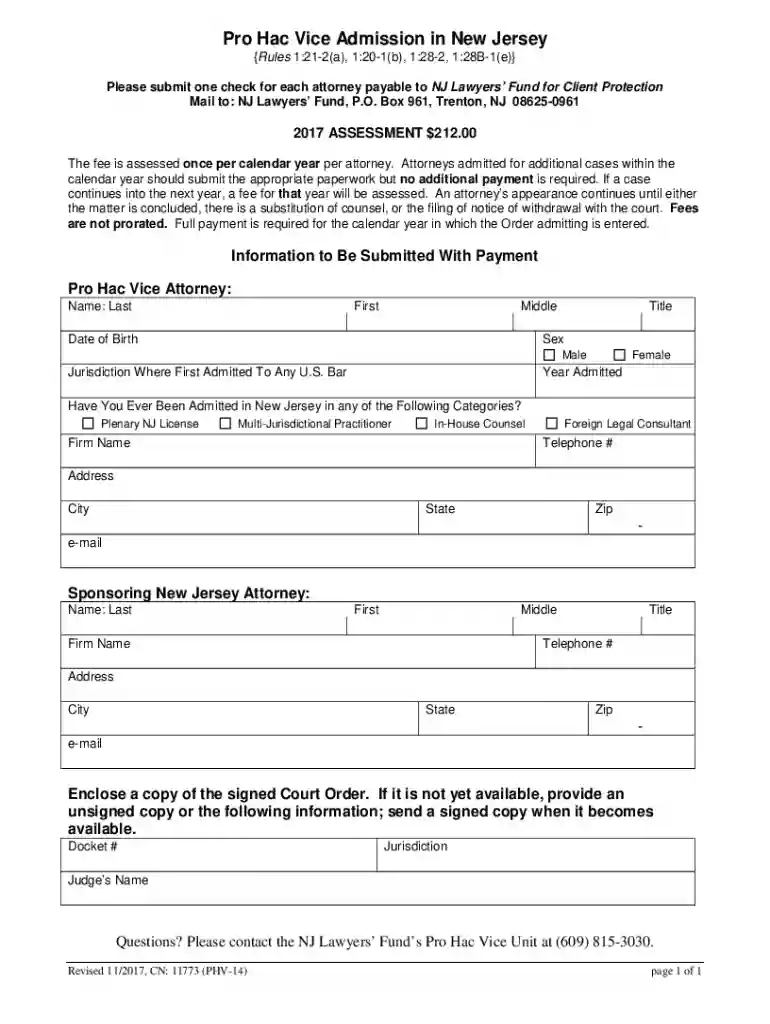
01. Edit your nj pro hac vice admission online
Type text, add images, blackout confidential details, add comments, highlights and more.

Type text, add images, blackout confidential details, add comments, highlights and more.

Draw your signature, type it, upload its image, or use your mobile device as a signature pad.

Send nj pro hac vice via email, link, or fax. You can also download it, export it or print it out.
NJ Pro Hac Vice admission enables attorneys who are not licensed in New Jersey to participate in specific cases within the state courts. This legal provision allows out-of-state lawyers to appear in New Jersey cases provided they meet certain criteria and pay the necessary fees. The term "pro hac vice" originates from Latin, meaning "for this occasion," signifying the temporary nature of the admission. It is a useful tool for law firms handling multijurisdictional cases, ensuring their clients have access to attorneys familiar with their cases, even when jurisdictional boundaries present challenges.
To utilize NJ Pro Hac Vice admission, attorneys must follow specific application procedures. It involves submitting a motion to the court where the case is pending, typically prepared by the New Jersey attorney sponsoring the out-of-state lawyer. The motion includes details about the attorney’s qualifications, past disciplinary actions, if any, and acknowledgment of New Jersey’s rules governing attorney conduct. Once the motion is granted, the attorney can participate in the case but must adhere to the court's limitations on the scope and duration of their involvement.
Each of these steps requires attention to detail to ensure compliance with New Jersey's legal standards and to facilitate a smooth admission process.
Utilizing NJ Pro Hac Vice admission is beneficial for attorneys representing clients in New Jersey cases but residing outside the state. It ensures that clients receive representation from lawyers with whom they are already familiar, promoting continuity and understanding. Pro Hac Vice admission is particularly valuable for complex cases involving specialized legal knowledge that the chosen attorney possesses. Furthermore, it strengthens collaboration between in-state and out-of-state legal teams, as both can contribute insights and strategies tailored to the specific legal context of the case.
With NJ Pro Hac Vice admission, attorneys are authorized to perform legal functions as if they were licensed in New Jersey for the specific case. This includes participating in court proceedings, filing documents, and interacting with the judiciary on behalf of their clients. However, the admission is case-specific, and attorneys must ensure adherence to New Jersey’s professional conduct rules throughout their involvement. Violations can lead to revocation of the admission or disciplinary actions, highlighting the importance of maintaining strict compliance with all legal and ethical standards.
New Jersey enforces particular rules for Pro Hac Vice admission that differ from other states. Prospective attorneys must demonstrate good standing in their home jurisdiction and a lack of prior disciplinary actions. Additionally, attorneys are typically limited in the number of cases they can take on Pro Hac Vice basis simultaneously to ensure local representation is prioritized. Understanding these nuances is crucial for navigating the application process successfully and maintaining eligibility for future admissions.
Real-world applications of NJ Pro Hac Vice admission include high-profile litigation cases where clients choose attorneys from their home state with expertise in specific legal areas. For instance, multi-state corporate disputes, federal cases with elements tied to New Jersey law, and class-action lawsuits often involve Pro Hac Vice admissions. Such instances demonstrate the utility of this provision in enabling a cooperative and knowledgeable legal team, especially in cases that benefit from cohesive strategies that span multiple jurisdictions.
We've got more versions of the nj pro hac vice admission form. Select the right nj pro hac vice admission version from the list and start editing it straight away!
| Versions | Form popularity | Fillable & printable |
|---|---|---|
| 2017 | 4.8 Satisfied (112 Votes) |
At DocHub, your data security is our priority. We follow HIPAA, SOC2, GDPR, and other standards, so you can work on your documents with confidence.


