




01. Edit your jd cv 67 online
Type text, add images, blackout confidential details, add comments, highlights and more.

Type text, add images, blackout confidential details, add comments, highlights and more.

Draw your signature, type it, upload its image, or use your mobile device as a signature pad.

Send it via email, link, or fax. You can also download it, export it or print it out.
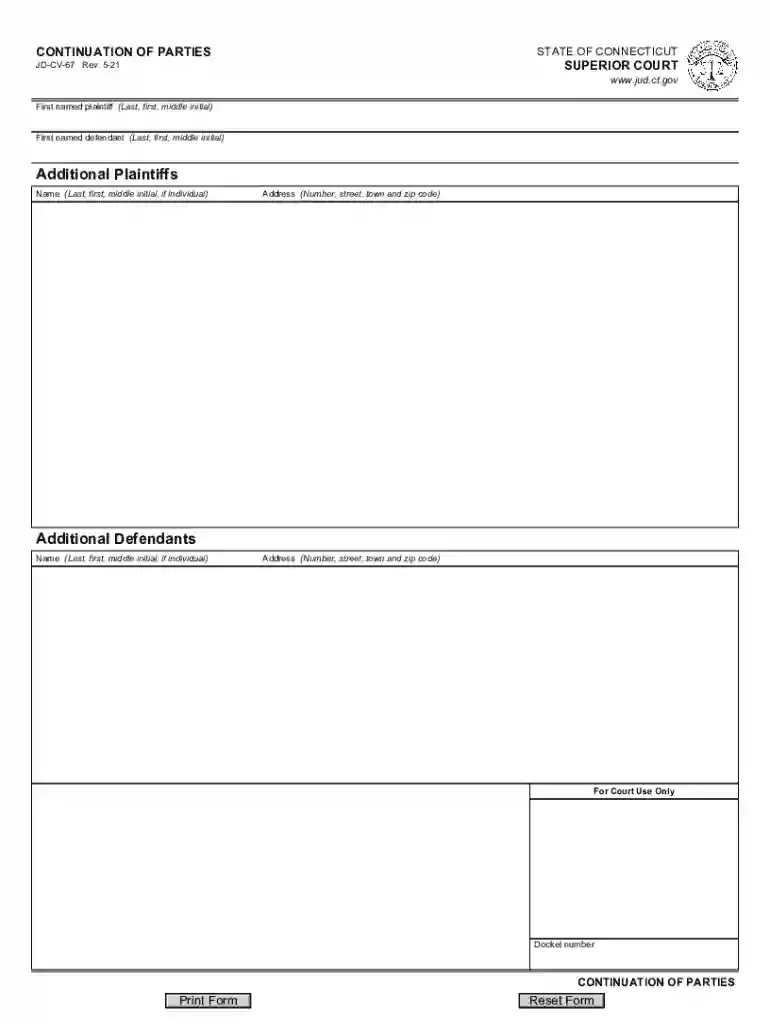
The Connecticut Superior Court form JD CV 67, titled 'Continuation of Parties,' is a legal document used in civil cases to document additional parties involved in the case. This form becomes necessary when the standard form does not provide enough space to list all plaintiffs, defendants, or other pertinent parties. By including all relevant parties, the form ensures that each individual's rights are represented and considered in the court proceedings.
You can access the JD CV 67 form through the Connecticut Judicial Branch's official website. This ensures you are downloading the most recent and accurate version of the form.
Filling out the JD CV 67 form correctly is crucial for its acceptance in court proceedings.
The JD CV 67 form is utilized predominantly in civil cases by individuals or entities involved in lawsuits within the Connecticut Superior Court system.



Understanding the critical components of the JD CV 67 can help in properly completing the form.
Connecticut has particular rules and practices when it comes to filing the JD CV 67 form as part of its civil procedure.
The continuation form JD CV 67 is recognized under state law as a valid legal document for lawsuits.
In modern court systems, navigating between digital and paper versions of the JD CV 67 can influence the efficiency of your filing process.
Real-world application of the JD CV 67 enhances understanding of its importance in legal proceedings.
We've got more versions of the jd cv 67 form. Select the right jd cv 67 version from the list and start editing it straight away!
At DocHub, your data security is our priority. We follow HIPAA, SOC2, GDPR, and other standards, so you can work on your documents with confidence.
JD-CV-67 Rev. 4-26. For Court Use Only. Docket number. Address (Number, street, town and zip code). Name (Last, first, middle initial, if individual). Reset.Read more
67, and that students may then enroll in schools and programs that would otherwise be inaccessible due to Title IV ineligibility,


