






Definition & Meaning
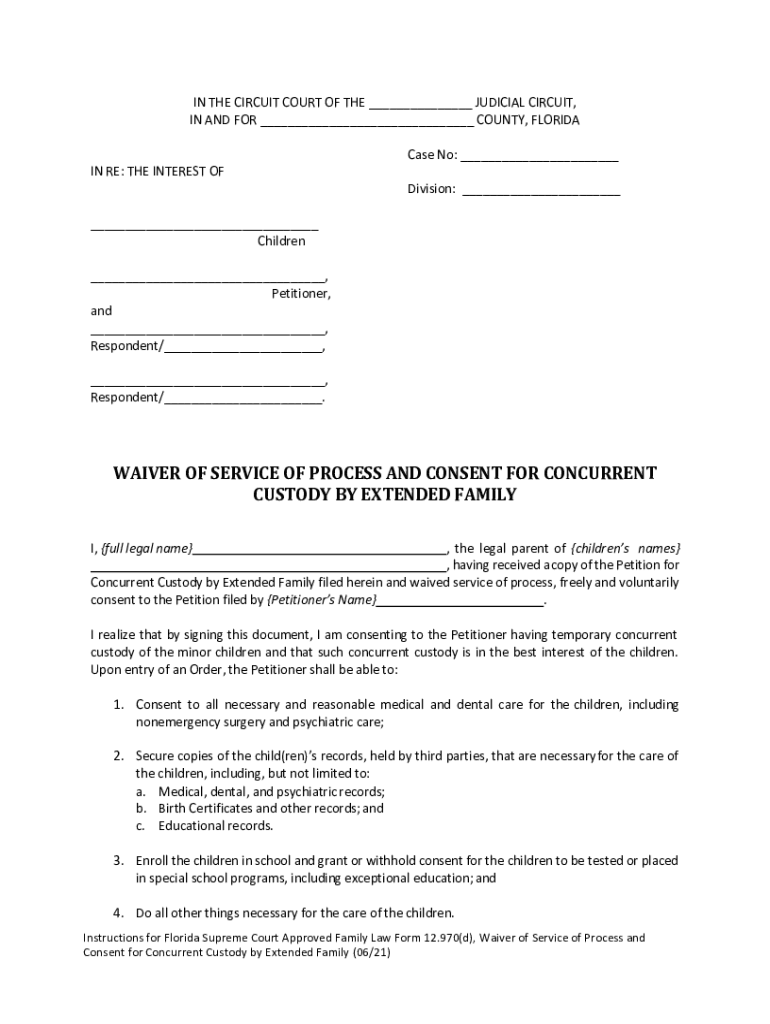
The Florida Waiver of Service Form, officially known as Family Law Form 12.970(d), is a critical legal document within the state of Florida. It allows parents to waive their right to be formally served with legal paperwork regarding the concurrent custody of their minor children by extended family members. This waiver permits an extended family member, such as a grandparent or sibling, to obtain custodial rights without the traditional service of process procedures. The form defines 'extended family member' and outlines the rights and responsibilities granted to them, including authority over medical care and educational decisions for the child.
How to Use the Florida Waiver Service Form
Using the Florida Waiver of Service Form involves several precise steps. First, a parent or legal guardian should thoroughly read and understand the form's implications, particularly how it affects legal custody arrangements. It's advisable to consult with a legal professional to ensure comprehension of all terms and conditions. Parents must then complete the form, providing essential details such as the names of the child, the waiving parent, and the family member assuming custody. It's crucial to follow the guidelines for accurately completing and submitting the form to avoid any legal issues or misunderstandings.
How to Obtain the Florida Waiver Service Form
Obtaining Form 12.970(d) is straightforward. The form is available online through the Florida State Courts website and can be downloaded as a PDF. Alternatively, individuals can visit a local family law court to request a physical copy. It's essential to verify that all necessary documents required alongside the form, such as identification and proof of relationship, are gathered before submission. This preparation ensures that the waiver process is not delayed due to missing documentation.
Steps to Complete the Florida Waiver Service Form
Completing the Florida Waiver Service Form requires attention to detail:
- Read the Form Instructions: Begin by carefully reading the instructions provided with the form to understand necessary details.
- Fill Personal Information: Enter the parent's full name, the child's full name, and the extended family member's details who will assume custody.
- Agree to Terms: Indicate consent to the terms by signing the form in front of a notary public or an officer authorized to administer oaths.
- Review for Accuracy: Double-check all provided information to ensure it is complete and accurate, minimizing errors that could delay processing.
- Submit Form: File the completed form with the appropriate family law court or as directed in the instructions.
Key Elements of the Florida Waiver Service Form
This waiver form includes several key components critical for the legal process:
- Identification of the Child: Full legal name, date of birth, and current living situation.
- Details of the Custodian: The name and relationship of the extended family member to the child.
- Consent of the Parent: Acknowledgment that the parent understands and agrees to the rights being waived.
- Signature and Notarization: Completion with required signatures and notarization ensures legal validity.
- Acknowledgment of Rights: Detailed description of the rights being transferred and any conditions or limitations.
Legal Use of the Florida Waiver Service Form
The legal context of the Waiver of Service Form is vital to understand. This form is used to expedite the process of transferring custodial rights without a formal service of process. It is legally binding and recognized by Florida courts as sufficient permission for custody transfer once properly executed. It covers specific situations where immediate action might be necessary for the child's welfare, such as access to medical care or educational placement.
State-Specific Rules for the Florida Waiver Service Form
Florida requires adherence to certain rules and regulations specifically associated with the waiver form:
- Residency Requirements: The form is only applicable within the state of Florida and must be used by residents.
- Eligibility of Extended Family: Only individuals classified as 'extended family members' per Florida statutes are eligible to assume custody.
- Notarization Requirement: The form must be notarized in Florida to ensure its legality.
Important Terms Related to Florida Waiver Service Form
Familiarity with specific legal terms can aid in accurately completing the form:
- Service of Process: A legal procedure required to notify a party of legal action.
- Concurrent Custody: Sharing custodial responsibilities with a non-parent family member.
- Extended Family Member: Defined by law as a relative through blood or marriage authorized to receive custody rights.
- Waiver: A voluntary relinquishment of a known right; in this context, the right to be served legally with process.