Patient Information - Department of Neurology 2026

Get Form
Patient Information - Department of Neurology Preview on Page 1

Here's how it works

01. Edit your form online
Type text, add images, blackout confidential details, add comments, highlights and more.

02. Sign it in a few clicks
Draw your signature, type it, upload its image, or use your mobile device as a signature pad.

03. Share your form with others
Send it via email, link, or fax. You can also download it, export it or print it out.

How to use or fill out Patient Information - Department of Neurology with our platform

Form edit decoration
9.5
Ease of Setup
DocHub User Ratings on G2
9.0
Ease of Use
DocHub User Ratings on G2
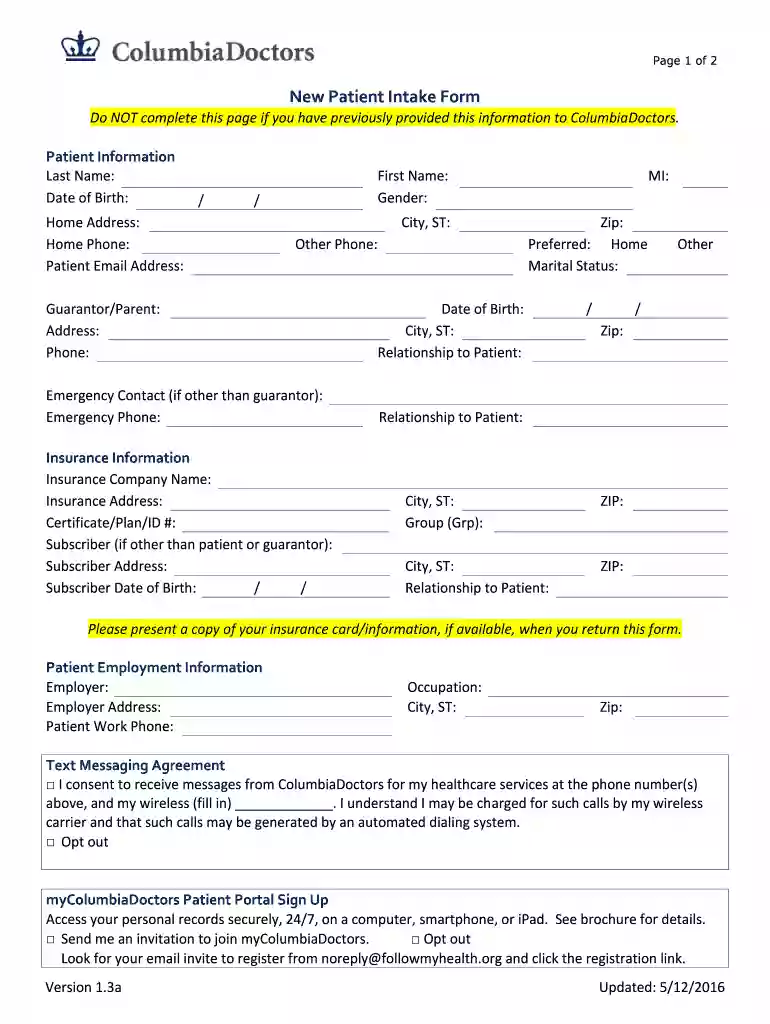
  1. Click ‘Get Form’ to open the Patient Information form in the editor.
  2. Begin by entering your Last Name and First Name in the designated fields. Ensure that you also fill in your Date of Birth accurately.
  3. Provide your Home Address, including City, State, and Zip Code. Include your Home Phone and any other contact numbers.
  4. Fill out the Guarantor/Parent section if applicable, including their relationship to you and their contact information.
  5. In the Insurance Information section, enter details about your insurance company, including the Certificate/Plan/ID number and Subscriber information.
  6. Complete the Patient Employment Information section with your Employer's name, address, and occupation.
  7. Review all sections for accuracy before signing at the bottom of the form. Ensure you understand the financial obligations outlined.

Start filling out your Patient Information form today for free using our platform!

See more Patient Information - Department of Neurology versions

We've got more versions of the Patient Information - Department of Neurology form. Select the right Patient Information - Department of Neurology version from the list and start editing it straight away!
Versions Form popularity Fillable & printable
2019 4.9 Satisfied (40 Votes)
2016 4.1 Satisfied (54 Votes)
be ready to get more

Complete this form in 5 minutes or less

Get form

Got questions?

We have answers to the most popular questions from our customers. If you can't find an answer to your question, please contact us.
Contact us
Neurologists are specialists who treat diseases of the brain and spinal cord, peripheral nerves and muscles. Neurological conditions include epilepsy, stroke, multiple sclerosis (MS) and Parkinsons disease. Dr. Nhu Bruce, neurologist at Houston Methodist, also commonly sees patients for: Uncontrolled headaches.
A doctor who specializes in neurology is called a neurologist. The neurologist treats disorders that affect the brain, spinal cord, and nerves, such as: Cerebrovascular disease, such as stroke. Demyelinating diseases of the central nervous system, such as multiple sclerosis.
Mayo Clinic in Rochester, Minnesota, Mayo Clinic in Phoenix/Scottsdale, Arizona, and Mayo Clinic in Jacksonville, Florida, rank among the Best Hospitals for neurology and neurosurgery in the U.S. News World Report Best Hospitals rankings.
Neurologists are specialists who treat diseases of the brain and spinal cord, peripheral nerves and muscles. Neurological conditions include epilepsy, stroke, multiple sclerosis (MS) and Parkinsons disease.
There are many aspects of this exam, including an assessment of motor and sensory skills, balance and coordination, mental status (the patients level of awareness and interaction with the environment), reflexes, and functioning of the nerves.

Security and compliance

At DocHub, your data security is our priority. We follow HIPAA, SOC2, GDPR, and other standards, so you can work on your documents with confidence.

Learn more
ccpa2
pci-dss
gdpr-compliance
hipaa
soc-compliance

People also ask

The Neuro-ICU is a 24 bed facility that is operated by a team of board certified physicians and nurses. The Neuro-ICU cares for patients with all types of neurosurgical and neurological injuries, including stroke, brain hemorrhage, trauma and tumors.
Some of the most common are epilepsy, Alzheimers and other dementias, strokes, migraine and other headaches, multiple sclerosis, Parkinsons disease, neurological infections, brain tumors, traumatic conditions of the nervous system such as head injuries and disorders caused by malnutrition.

Related links