




01. Edit your form online
Type text, add images, blackout confidential details, add comments, highlights and more.

Type text, add images, blackout confidential details, add comments, highlights and more.

Draw your signature, type it, upload its image, or use your mobile device as a signature pad.

Send it via email, link, or fax. You can also download it, export it or print it out.
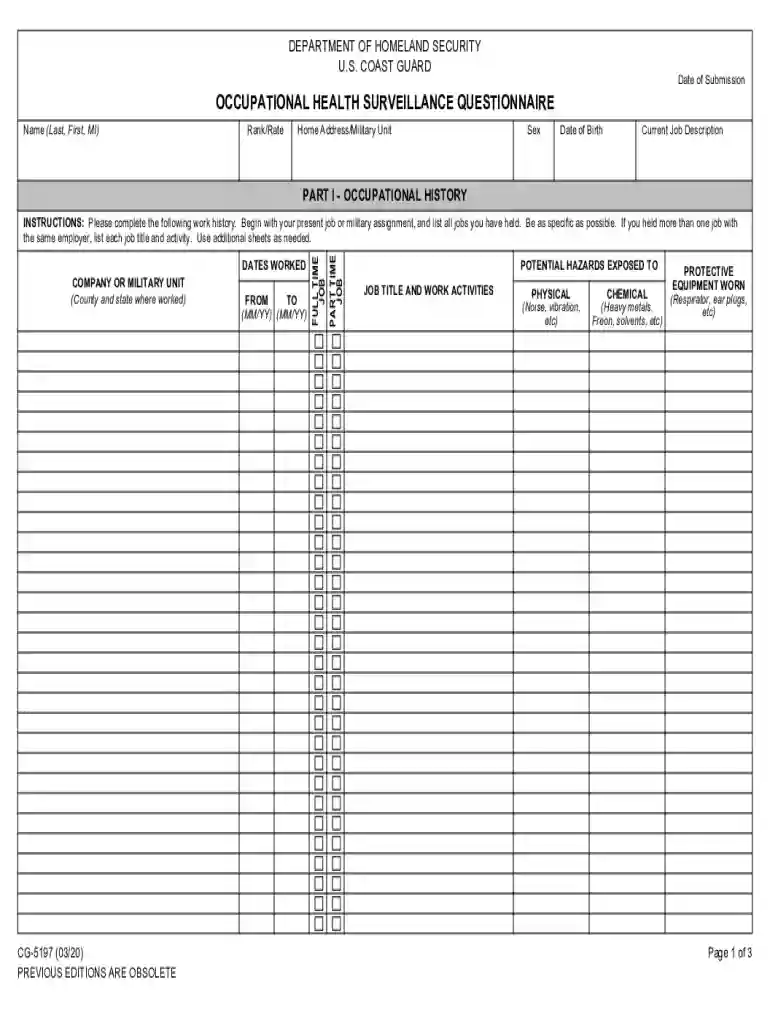
The "CG-5197" form, also known as the Occupational Health Surveillance Questionnaire from the U.S. Coast Guard, is an essential document designed to gather vital personal and occupational health information of Coast Guard personnel. The crucial purpose of this form is to monitor any potential health risks by collecting detailed data on personal, occupational history, and any exposure to potential hazards. Through this systematic approach, the U.S. Coast Guard ensures that appropriate healthcare and safety measures are consistently in place for their personnel.
Gather Personal and Occupational Information:
Identify Potential Hazards:
Document Health Symptoms:
Review and Certify the Form:
Coast Guard personnel should utilize the CG-5197 form for ongoing health assessments. By providing comprehensive and accurate details regarding occupational exposure and related health symptoms, personnel can ensure their health records are up-to-date and reflective of actual conditions. This aids in proactive health surveillance and supports the prompt implementation of safety measures when potential health risks are identified.
The CG-5197 form holds critical importance in safeguarding the health of Coast Guard personnel. By documenting exposure to occupational hazards, the form facilitates the identification and mitigation of potential health risks. This process not only preserves the well-being of individual members but also enhances overall operational readiness across the service. Proper use of the form prepares both individuals and the organization to address health issues effectively and comprehensively.
Personal Information Block:
Occupational History Section:
Exposure Records:
Symptom Reporting:
The CG-5197 form is legally used to comply with health and safety regulations applicable to military personnel. Ensuring complete and accurate information is imperative, as this form contributes to developing health policies and safeguarding individual health rights. Non-compliance or inaccuracies could jeopardize health program effectiveness and lead to disciplinary measures.
Primarily, the CG-5197 form is used by Coast Guard personnel, including those who have roles associated with health risk factors. It acts as a surveillance tool for health management professionals within the Coast Guard to maintain continuous health records and implement necessary health interventions timely.


Personnel can access and submit the CG-5197 form electronically through platforms compatible with various document management systems, like DocHub. Utilizing digital platforms ensures secure handling and facilitates easy updating, submission, and storage of the form. Such platforms support seamless document management for both individuals and the overseeing health departments.
Personal Identification Documentation:
Occupational Exposure Records:
Medical Records:
This comprehensive approach to understanding the CG-5197 form's usage, completion steps, relevance, and associated requirements will equip Coast Guard personnel to engage effectively with its submission and maintenance.
We've got more versions of the cg5197 form. Select the right cg5197 version from the list and start editing it straight away!
Of course, you’ll find many different apps for this on the web. However, if you need to eSign your cg5197 without installing additional software, DocHub is the optimum choice you can make. This powerful editor works on mobile devices just as on desktops. Open our editor in any internet browser, register or log in to your account, and start managing your forms.
With a swift editing platform like DocHub, you do not need anything but a browser and internet connection to modify your cg5197 online quickly. Upload your document or get the appropriate form in DocHub’s catalog, open our editor with a single click, and finish it digitally. To revise your forms anytime, register a free profile with DocHub.
At DocHub, your data security is our priority. We follow HIPAA, SOC2, GDPR, and other standards, so you can work on your documents with confidence.


