




01. Edit your form online
Type text, add images, blackout confidential details, add comments, highlights and more.

Type text, add images, blackout confidential details, add comments, highlights and more.

Draw your signature, type it, upload its image, or use your mobile device as a signature pad.

Send it via email, link, or fax. You can also download it, export it or print it out.
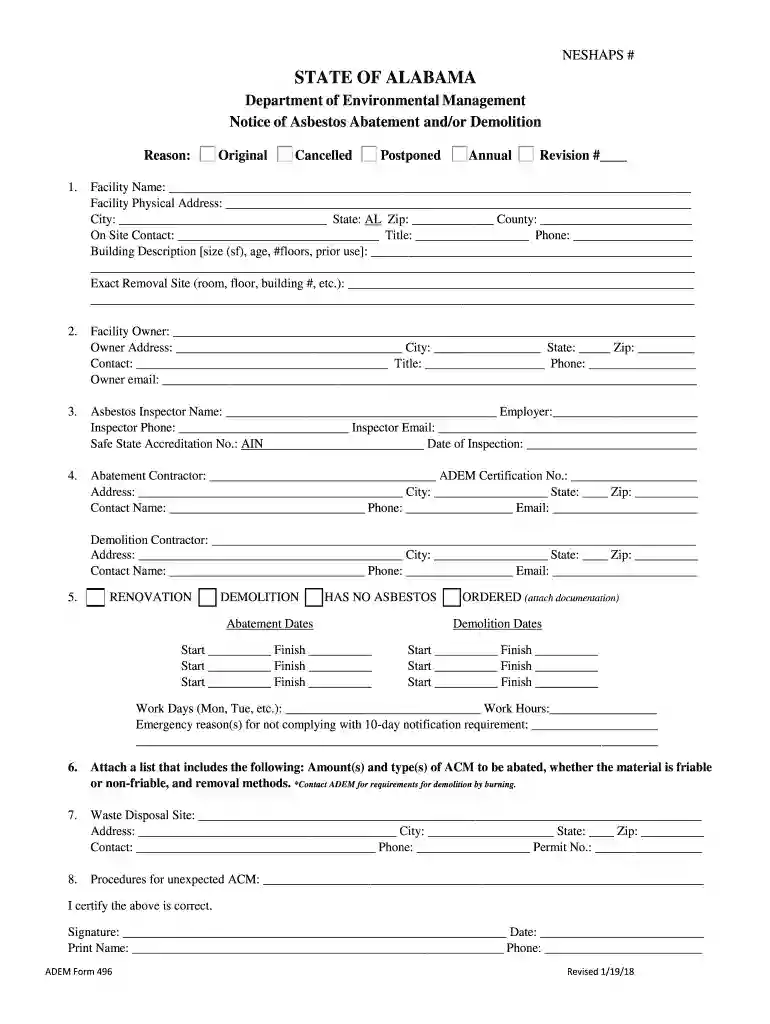
The asbestos notification form in Alabama serves as a critical document for managing asbestos abatement and demolition activities. It is mandated by the Alabama Department of Environmental Management (ADEM) to ensure compliance with state and federal asbestos regulations. This form is required to notify ADEM about the intended disturbance of Regulated Asbestos-Containing Materials (RACM) or demolition activities, providing essential details about the facility, owners, and contractors involved. By clearly defining the purpose, this form helps mitigate the risks associated with asbestos exposure during construction, renovation, and demolition projects.
To effectively use the asbestos notification form in Alabama, it's important to understand the steps involved in its completion. This process begins with a thorough inspection of the site to determine the presence of RACM. Property owners or contractors must then accurately fill out the form by including details such as the project location, the type of work being performed, and the estimated start and completion dates. Additionally, details of the inspection, including the inspector's qualifications and findings, should be included. This information ensures accurate reporting and compliance with state regulations.
The asbestos notification form can be obtained directly from the Alabama Department of Environmental Management's website. ADEM provides downloadable forms in PDF format, ensuring easy accessibility for property owners, contractors, and other stakeholders involved in projects dealing with RACM or demolition activities. The availability of the form online simplifies the process, allowing users to print and fill out the necessary details at their convenience.
Conduct a Site Inspection: Before completing the form, a certified inspector should evaluate the area to check for RACM.
Gather Required Information: Collect all necessary details, such as owner information, project location, and contractor details.
Fill in Project Details: Specify the nature of the work, whether it involves abatement or demolition, and provide a timeline for the work.
Document Inspection Findings: Include the inspector's analysis and conclusion about the presence of asbestos materials.
Verify and Submit: Double-check all entered information for accuracy before submitting the form to ADEM.
Completing these steps ensures the form is comprehensive and compliant with regulatory requirements.
Adhering to asbestos regulations by using the asbestos notification form is crucial for several reasons. First, it protects public health by minimizing the risk of asbestos exposure during demolition or abatement projects. Second, it maintains environmental safety by ensuring all RACM is handled and disposed of correctly. Finally, compliance prevents legal and financial penalties associated with non-compliance, safeguarding the responsible parties from potential regulatory actions.
These elements are essential to ensure the form is complete and provides ADEM with the necessary information to oversee asbestos management effectively.
Alabama has specific rules that govern the handling and removal of asbestos materials. Notably, residential properties with fewer than four units may be exempt under certain conditions. However, commercial properties and larger residential complexes must adhere strictly to notification and handling procedures as outlined by ADEM. These rules are in place to ensure comprehensive safety measures are followed during the removal and management of asbestos-containing materials.
An example of using the asbestos notification form could involve a commercial redevelopment project where old roofing material known to contain asbestos needs removal. Before beginning demolition, the contractor submits a completed notification form to ADEM, outlining the scope of work and confirming proper asbestos inspection. This allows ADEM to monitor the project and ensure all safety protocols are adhered to, ultimately preventing asbestos exposure to workers and the public.
Failure to submit the asbestos notification form or comply with regulations can result in significant penalties. This includes fines and potential legal action by the Alabama Department of Environmental Management. Non-compliance not only poses health risks but can also lead to project delays and increased costs due to the rectification of any regulatory breaches. Thus, ensuring all asbestos-related projects adhere to the outlined procedures is critical in mitigating these risks.
We've got more versions of the asbestos alabama form. Select the right asbestos alabama version from the list and start editing it straight away!
If you frequently deal with documents kept in your Google Drive, DocHub is an excellent option for you to easily and quickly fill out, modify, and approve them. This editor integrates well with Google apps, so you can export your asbestos alabama from your Google Drive to the editor without downloading and re-uploading it. Right-click on your file, choose Open With → DocHub PDF Sign and Edit. In our editor, add and assign Signature Fields for all parties involved, then click on the Menu button above → Send → select how you want to share your paperwork.
With DocHub, you have several convenient methods to edit your asbestos alabama online. You can drag and drop the form and modify it straight at the DocHub website or use our browser extension to fill out your form immediately. On top of that, you can modify your PDF on your smartphone, as DocHub is compatible with all the accessible mobile platforms.
At DocHub, your data security is our priority. We follow HIPAA, SOC2, GDPR, and other standards, so you can work on your documents with confidence.
Individuals seeking accreditation by Safe State to engage in asbestos abatement and asbestos-related activities in Alabama
All regulated structures must be surveyed by an Alabama Accredited Asbestos Inspector before renovation or demolition or burning for training.Read more
A National Asbestos-Exposure Registry of Veterans are suffering from asbestos-related illnesses due to past military exposure, Headquartered in Birmingham,


