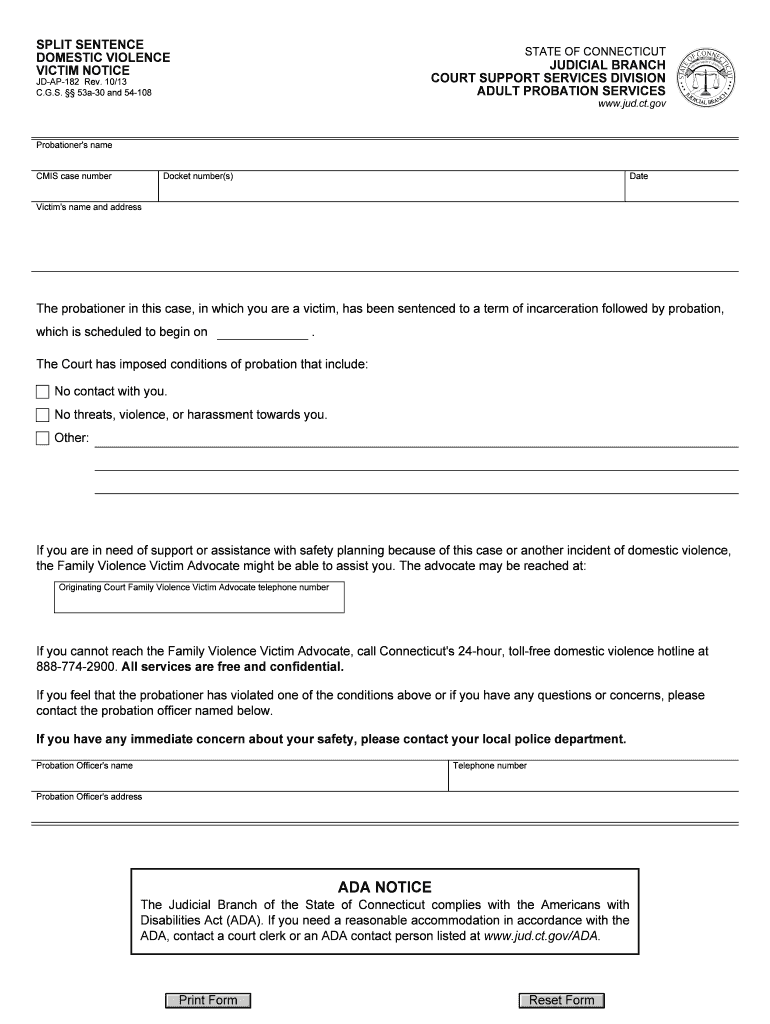
Ct violence form 2026

Get Form
ct violence form Preview on Page 1

Here's how it works

01. Edit your form online
Type text, add images, blackout confidential details, add comments, highlights and more.
02. Sign it in a few clicks
Draw your signature, type it, upload its image, or use your mobile device as a signature pad.
03. Share your form with others
Send it via email, link, or fax. You can also download it, export it or print it out.

How to use or fill out ct violence form with our platform

Form edit decoration
9.5
Ease of Setup
DocHub User Ratings on G2
9.0
Ease of Use
DocHub User Ratings on G2
  1. Click ‘Get Form’ to open the ct violence form in the editor.
  2. Begin by entering the probationer's name and CMIS case number in the designated fields. This information is crucial for identifying the specific case.
  3. Next, fill in the docket number(s) and date at the top of the form. Ensure these details are accurate to avoid any processing delays.
  4. In the section for the victim's name and address, provide your complete information. This ensures that you receive all necessary notifications regarding your case.
  5. Review the conditions of probation listed on the form. Make sure you understand them fully, as they include important safety measures.
  6. If you require assistance, note down the contact information for the Family Violence Victim Advocate provided on the form. This resource can offer support tailored to your needs.
  7. Finally, save your completed form using our platform’s export feature, ensuring you have a copy for your records.

Start filling out your ct violence form today for free using our platform!

See more ct violence form versions

We've got more versions of the ct violence form form. Select the right ct violence form version from the list and start editing it straight away!
Versions Form popularity Fillable & printable
2019 4.8 Satisfied (81 Votes)
2013 4.4 Satisfied (328 Votes)
be ready to get more

Complete this form in 5 minutes or less

Get form

Got questions?

We have answers to the most popular questions from our customers. If you can't find an answer to your question, please contact us.
Contact us
Tell the judge why you need a restraining order and for how long you need it. Show the judge any evidence you brought. Also tell the judge if the other person has disobeyed the temporary restraining order. You can ask for an order that lasts up to one year, but you must prove that you need it.
Different Types of Violence Physical Abuse: Hitting, slapping, shoving, grabbing, pinching, biting, hair pulling, etc. Sexual Abuse: Coercing or attempting to coerce any sexual contact or behavior without consent. Emotional Abuse: Undermining an individuals sense of self-worth and/or self-esteem.
If you need help filing a family restraining order, please call the Domestic Violence Hotline at 1-888-774-2900. To apply for a Civil Protection Order, you have to fill out the following 2 forms: Application for Civil Protection Order (JD-CV-143) Affidavit Civil Protection Order (JD-CV-144)
There are three types of orders of protection that can provide victims with legal protections to support their safetyemergency protective orders, temporary restraining orders, and permanent restraining orders.
You do not have to pay court fees to file the Application. Note: The person who fills out the Application is called the Applicant. The person that the Application is filed against is called the Respondent. The Application and Affidavit will be reviewed by a Judge.

Security and compliance

At DocHub, your data security is our priority. We follow HIPAA, SOC2, GDPR, and other standards, so you can work on your documents with confidence.

Learn more
ccpa2
pci-dss
gdpr-compliance
hipaa
soc-compliance

People also ask

46b-38a Family violence prevention and response states that Family violence means an incident resulting in physical harm, bodily injury or assault, or an act of threatened violence that constitutes fear of imminent physical harm, bodily injury or assault, including, but not limited to, stalking or a pattern of
Family violence is not a separate criminal offense. Those who engage in violence against a spouse or family member can be charged with a misdemeanor or a felony depending on the facts of the case. Examples of the crimes the accused can be charged with include assault, kidnapping, and sexual assault.
Finally, the most severe type of protective order in Connecticut is a full no-contact order, which requires the cessation of all contact between the defendant and the protected party or parties.

Related links