



01. Edit your naming covalent compounds worksheet pdf online
Type text, add images, blackout confidential details, add comments, highlights and more.

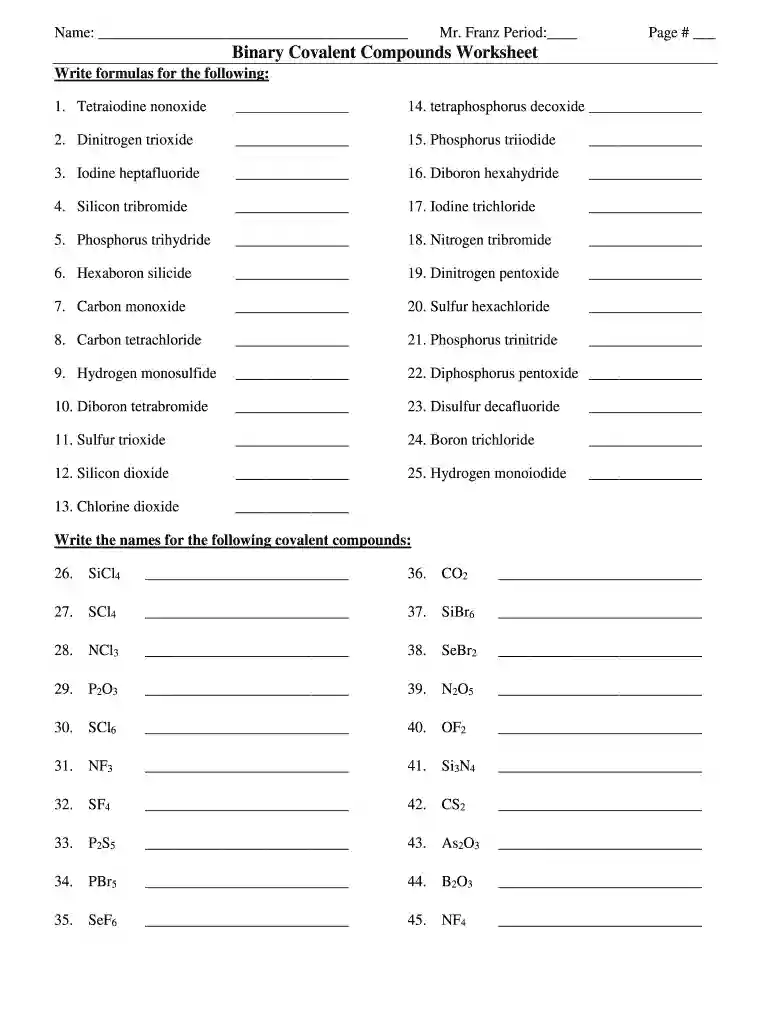
Type text, add images, blackout confidential details, add comments, highlights and more.
Draw your signature, type it, upload its image, or use your mobile device as a signature pad.

Send covalent nomenclature worksheet via email, link, or fax. You can also download it, export it or print it out.
A binary covalent compounds worksheet is an educational tool that focuses on the study of chemical compounds formed from two nonmetal elements. This worksheet serves as a resource for students to practice writing chemical formulas and naming binary covalent compounds. It typically includes exercises that challenge learners to convert between compound names and their corresponding formulas while also identifying the nature of the bonds involved—whether ionic or covalent.
The fundamental concept of binary covalent compounds revolves around the sharing of electrons between nonmetals. For instance, in the molecule carbon dioxide (CO₂), carbon and oxygen share electrons to form a stable compound. This differs from ionic compounds, where electrons are transferred from one atom to another. Understanding this distinction is crucial for students and forms part of the content often included in worksheets aimed at enhancing knowledge of chemical nomenclature.
To effectively utilize the binary covalent compounds worksheet, follow these steps:
Read Instructions Carefully: Each worksheet typically includes clear instructions on what is required, such as naming compounds, writing formulas, or identifying bond types.
Complete Naming Exercises: If the worksheet includes naming exercises, students should practice converting given formulas into names, for example, H₂O as water or CO as carbon monoxide.
Work on Formula Writing: For section focusing on formula writing, students start with names like dichlorine monoxide (Cl₂O) and translate that into a chemical formula.
Identify Bond Types: Some worksheets may require students to classify compounds as ionic or covalent, based on their chemical structure.
Self-Check with Provided Answers: Many worksheets include an answer key at the back or as a separate document, enabling students to verify their answers for accuracy.
Using a binary covalent compounds worksheet is an effective way to reinforce and enhance understanding of chemical nomenclature and bonding concepts.
When seeking a binary covalent compounds worksheet, several options are available:
Educational Websites: Many educational platforms, including teacher resource sites, provide downloadable versions of worksheets. Searching for "binary covalent compounds worksheet PDF" can yield results.
Textbook Resources: Textbooks on chemistry often contain worksheets or exercises at the end of chapters pertaining to covalent compounds. These are valuable for structured learning.
Teacher Provisions: In classroom settings, educators frequently create custom worksheets for students, tailored to their specific curriculum needs.
Online Communities: Educational forums and communities may offer shared worksheets among teachers and students, which can be an excellent source for varied exercises.
The diversity of sources allows students to find materials that suit their learning style and educational requirements.
Completing a binary covalent compounds worksheet involves several systematic steps to ensure thorough understanding and accuracy:
Gather Necessary Materials: Ensure you have the worksheet, a calculator if necessary, a periodic table for reference, and writing utensils.
Read All Questions: Go through the worksheet to understand the types of questions included and the required tasks.
Begin with Naming Exercises: Start with sections focused on naming compounds, using the systematic naming rules for binary covalent compounds.
Translate Names to Formulas: For each given name, write the corresponding chemical formula by correctly identifying the elemental symbols and their respective prefixes (like mono-, di-, or tri-).
Review Bonding Types: Work through sections that ask you to identify whether compounds are ionic or covalent, using knowledge of electronegativity and compound structures.
Double-Check Your Work: Once completed, review your answers against the answer key provided to identify any errors and understand the reasoning behind correct answers.
By following these steps, students can effectively complete the binary covalent compounds worksheet and reinforce their learning.
Utilizing a binary covalent compounds worksheet is significant for various reasons:
Concept Reinforcement: Practice through worksheets helps reinforce learned concepts such as the naming and formula-writing processes.
Skill Development: These worksheets develop important skills, including the ability to critically analyze chemical compounds and predict their properties based on their structure.
Preparation for Advanced Topics: Mastery of binary covalent compounds paves the way for understanding more complex chemistry topics, including reactions and molecular geometry.
Assessment Tool: For educators, worksheets are an effective assessment tool to evaluate student comprehension and identify areas needing further instruction.
Overall, a binary covalent compounds worksheet represents a valuable educational resource that enhances both teaching and learning in chemistry.
The primary users of a binary covalent compounds worksheet include:
Students: High school and college students studying chemistry are the main audience, as they need to practice naming and writing formulas for covalent compounds.
Teachers: Educators utilize these worksheets to supplement their teaching materials, facilitating structured learning and assessment.
Tutors: Those providing private tutoring in chemistry adopt these worksheets to focus student efforts on specific areas of difficulty.
Homeschoolers: Individuals engaged in homeschooling may incorporate such worksheets into their curriculum to assist in teaching chemical nomenclature and bonding concepts.
The usability of binary covalent compounds worksheets across different educational settings underscores their significance in chemistry education.
Key aspects often included in a binary covalent compounds worksheet are:
Exercises for Naming Compounds: Sections that ask students to convert chemical formulas into compound names using systematic naming rules.
Sections for Writing Formulas: Challenges that require students to derive chemical formulas from given compound names.
Identification of Covalent vs. Ionic Bonds: Activities focused on distinguishing between covalent and ionic compounds based on their formulas and names.
Answer Key/Guidance: Many worksheets provide an answer key to assist students in checking their work and understanding correct solutions.
These elements collectively enhance the educational experience by providing comprehensive engagement with the content.
We've got more versions of the naming covalent compounds worksheet pdf form. Select the right naming covalent compounds worksheet pdf version from the list and start editing it straight away!
| Versions | Form popularity | Fillable & printable |
|---|---|---|
| 2016 | 4.9 Satisfied (55 Votes) |
Electronic signatures are an excellent alternative to traditional signing, as they save time, effort, and costs people spend on printing, scanning, and paper delivery. You can eSign your naming covalent compounds worksheet using a reliable and powerful online document management services like DocHub. It complies with primary eSignature regulations (ESIGN and UETA), so all forms approved there are legally binding and have the same validity as physically signed ones.
If you use Chrome, there are two easy ways to modify your naming covalent compounds online. First, visit the DocHub website, add your document, and modify it using our toolbar. You can also set up our Chrome extension and modify any document by dragging and dropping it in your browser tab.
At DocHub, your data security is our priority. We follow HIPAA, SOC2, GDPR, and other standards, so you can work on your documents with confidence.
A binary covalent compound is composed of two different nonmetal elements. For example, a molecule of chlorine trifluoride, ClF3 contains 1 atom of chlorine
Naming Binary Ionic Compounds Worksheet. Mastering Chemical Nomenclature: A Guide to Naming Binary confusing the naming of ionic versus covalent compounds or


