




Here's how it works

01. Edit your form online
Type text, add images, blackout confidential details, add comments, highlights and more.

02. Sign it in a few clicks
Draw your signature, type it, upload its image, or use your mobile device as a signature pad.

03. Share your form with others
Send it via email, link, or fax. You can also download it, export it or print it out.
How to use or fill out hearing screening form with our platform

- Click ‘Get Form’ to open the hearing screening form in the editor.
- Begin by entering your child’s name in the designated field at the top of the form.
- Next, fill in the grade of your child and the screening date to ensure accurate record-keeping.
- Assess room noise levels by selecting one of the options: Good, Fair, or Poor.
- For each frequency listed (1000 Hz, 2000 Hz, 4000 Hz), indicate whether your child passed or was referred for further testing by checking the appropriate box under both right and left ear columns.
- In the comments section, provide any additional notes or observations regarding your child's hearing screening experience.
Start using our platform today to easily complete and manage your hearing screening forms for free!
Fill out hearing screening form online
It's free
It's free
See more hearing screening form versions
We've got more versions of the hearing screening form form. Select the right hearing screening form version from the list and start editing it straight away!
Got questions?
We have answers to the most popular questions from our customers. If you can't find an answer to your question, please contact us.
Contact us
What happens during a hearing screening?
Otoacoustic emissions test (OAE) Your audiologist will put a small earphone in your ear. The earphone sends sound into your ear and measures the sounds that come back. Your test results show up on a monitor.
What is a hearing screening?
A hearing screening is a quick test to see how well you hear different sounds. You either pass or fail the screening. If you pass and have no other hearing concerns, then you can continue with regularly scheduled hearing screenings.
What is the 1 3 6 rule for hearing screening?
Employers must make audiometric testing available at no cost to all employees who are exposed to an action level of 85 dB or above, measured as an 8-hour TWA. The audiometric testing program followup should indicate whether the employers hearing conservation program is preventing hearing loss.
What is the difference between a hearing test and a hearing evaluation?
Hearing tests may be done: To check, or screen, babies and young children for hearing problems that might affect their ability to learn, speak, or understand language. Experts recommend that all newborns be screened for hearing loss . Many states require newborn hearing tests for all babies born in hospitals.
What is the difference between a hearing test and a hearing screening?
Have you ever wondered what the difference is between a hearing screening and a hearing evaluation? Screenings are preliminary tests used to determine whether a patient has a hearing loss. Think of it as a pass/fail exam: If the results indicate a hearing loss, a more detailed evaluation is required.
Security and compliance
At DocHub, your data security is our priority. We follow HIPAA, SOC2, GDPR, and other standards, so you can work on your documents with confidence.
Learn more


Related forms

Form IT-203-TM-ATT-B Schedule B
The document is a form (IT-203-TM-ATT-B) used for reporting nonresident members participating in a Yonkers group return. ...

Fillable Online Form IT-607 Claim for Excelsior Jobs
The document is a tax form (IT-607) from the Department of Taxation and Finance for claiming the Excelsior Jobs Program ...

Uk animal health certificate
The document is an animal health certificate for the non-commercial movement of dogs, cats, or ferrets from a territory ...
Grant-Application-Form-over-500-202104
The document is a grant application form for Birchington Parish Council, intended for organizations seeking funding over ...
Finance assistance form
The document is an application form for financial assistance from Finance PEI, outlining the necessary instructions, bus ...
AAFC AAC9436-E PROJECT SUMMARY FORM
The document is a Project Summary Form for the AgriScience Program's Projects Component, intended for applicants to prov ...
BHIHC Naturopathic Intake Form (includes consent)
The document is a Health History Intake Form for patients seeking naturopathic health care at Burnaby Heights Integrativ ...
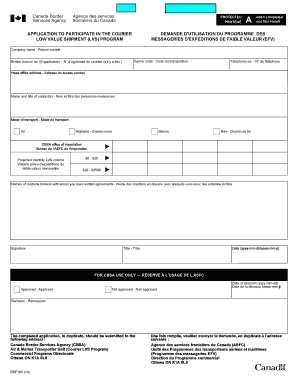
BSF164 (PDF, 20 K0) - Agence des services frontaliers du Canada
The document is an application form for participation in the Courier Low Value Shipment (LVS) Program by the Canada Bord ...


