




01. Edit your su 415 online
Type text, add images, blackout confidential details, add comments, highlights and more.

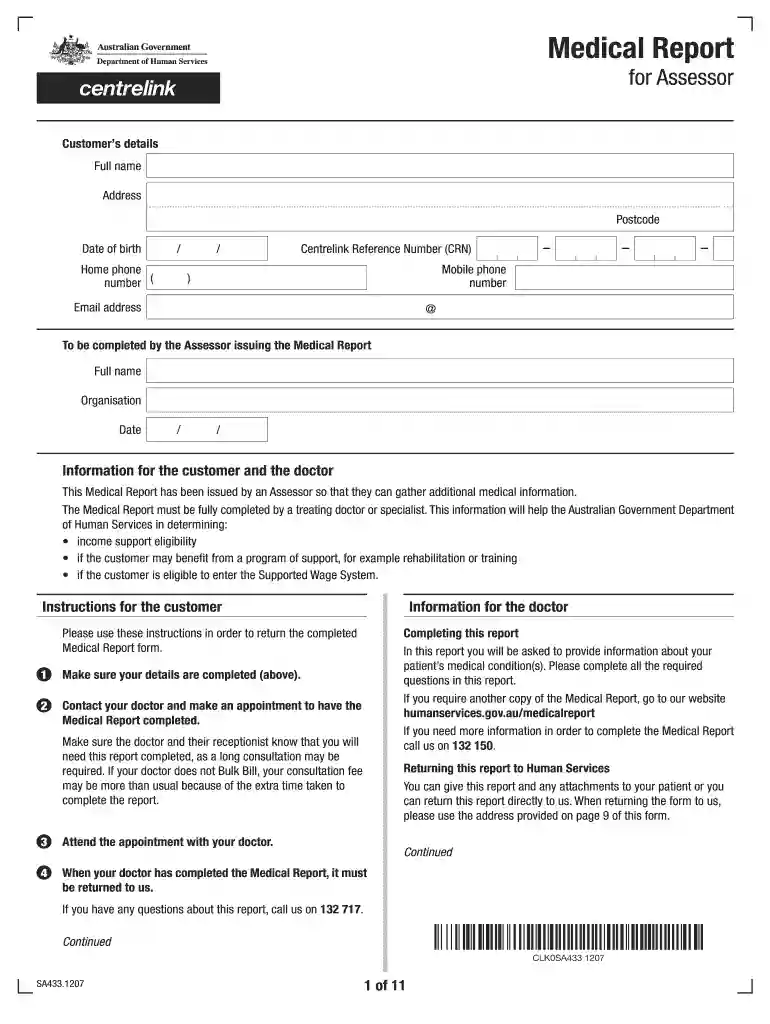
Type text, add images, blackout confidential details, add comments, highlights and more.

Draw your signature, type it, upload its image, or use your mobile device as a signature pad.

Send su415 form via email, link, or fax. You can also download it, export it or print it out.
The SU415 form is a critical document issued by the Australian Government Department of Human Services, primarily used for collecting detailed medical information. This form is designed to gather insights on a patient's medical conditions from their treating doctor or specialist, which assists in evaluating eligibility for income support and various other programs. It includes sections for recording patient details, medical history, current and past treatments, compliance with ongoing treatments, and the impact of medical conditions on the patient's functional abilities. The emphasis on confidentiality and privacy ensures that personal information is treated with the utmost care and security.
Utilizing the SU415 form involves a structured approach to accurately capturing pertinent medical information. It is typically completed by a healthcare professional who is familiar with the patient's medical history. Steps involved include:
Clear and precise input in each section ensures the form fulfills its purpose efficiently.
Completing the SU415 form requires detail-oriented attention to each section. Follow these steps for a thorough submission:
Ensure careful review of each section before submission to minimize errors and omissions.
The SU415 form is primarily used by healthcare providers, including doctors and specialists, responsible for liaising with the Department of Human Services on behalf of patients. It is also frequently engaged by administrative staff involved in managing patient records in healthcare settings. The form is crucial for those assessing patient eligibility for government-provided support services and benefits. Its use is centralized among professionals familiar with medical terminologies and assessment criteria.


The SU415 form encompasses several critical elements that facilitate comprehensive data collection:
Attention to these key elements ensures the form is as informative and effective as possible.
The legal implications of the SU415 form revolve around its role in determining eligibility for government assistance. Proper completion and submission by authorized medical professionals ensure its integrity and compliance with legal standards. The information provided must be accurate and truthful, backed by necessary medical records. Misrepresentation or falsification of data on the form can lead to legal repercussions, affecting both the healthcare provider and the patient involved.
To effectively complete the SU415 form, several documents and records are often required:
Having these documents ready facilitates the accurate and efficient completion of the form.
While the SU415 form is a standard across Australia, there may be specific guidelines or requirements set by different states regarding its implementation. Such variations might include:
Healthcare providers should stay informed about any state-specific rules to ensure compliance when completing the form for interstate patients.
We've got more versions of the su 415 form. Select the right su 415 version from the list and start editing it straight away!
| Versions | Form popularity | Fillable & printable |
|---|---|---|
| 2007 | 4.8 Satisfied (95 Votes) |
Yes, you can use DocHub for signing any business and personal documentation, including your su415 form download. All electronic signatures you generate with our service are legally binding and court-admissible, as DocHub complies with standards required by ESIGN and UETA. Save your completed document with a detailed Audit Trail if needed.
If you edit your su415 with DocHub, you only need a steady internet connection and virtually any web browser installed on your device. No need to set up any third-party software or research tutorials. Just open a tab with DocHub, drag and drop your file, and modify it on the spot.
At DocHub, your data security is our priority. We follow HIPAA, SOC2, GDPR, and other standards, so you can work on your documents with confidence.


Discover water data collected at monitoring location USGS-340145080323001, located in South Carolina and find additional nearby monitoring locations.
We have been delighted to offer sub-internships to fourth year medical students in order to get a first-hand experience in our residency program.Read more


