Statute 2026

Get Form
statute Preview on Page 1

Here's how it works

01. Edit your form online
Type text, add images, blackout confidential details, add comments, highlights and more.

02. Sign it in a few clicks
Draw your signature, type it, upload its image, or use your mobile device as a signature pad.

03. Share your form with others
Send it via email, link, or fax. You can also download it, export it or print it out.

How to Use or Fill Out the Statute with Our Platform

Form edit decoration
9.5
Ease of Setup
DocHub User Ratings on G2
9.0
Ease of Use
DocHub User Ratings on G2
  1. Click ‘Get Form’ to open the statute in the editor.
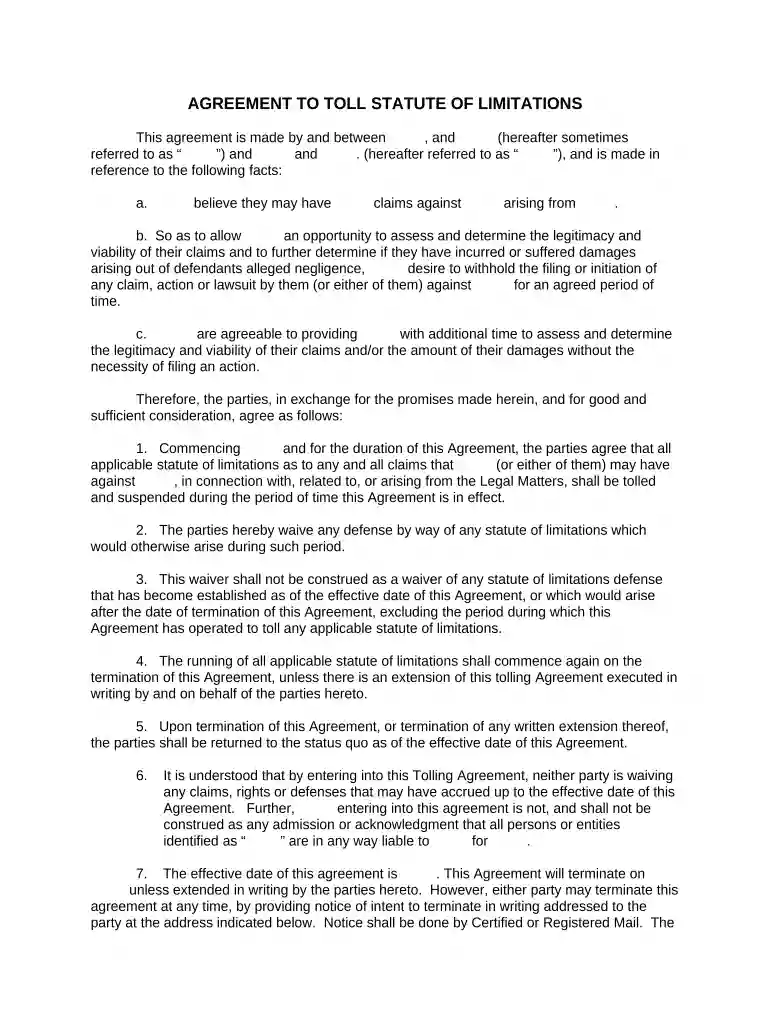
  2. Begin by filling in the names of the parties involved at the top of the document. Ensure that you accurately represent all parties to avoid any legal complications.
  3. In section a, clearly state any claims believed to be against the other party. This is crucial for establishing context.
  4. Section b requires you to specify the agreed period during which claims will be withheld. Be precise about dates to ensure clarity.
  5. Proceed to section 1 and confirm that all applicable statutes of limitations are tolled during this agreement's duration. This is essential for legal protection.
  6. Complete sections regarding waiver and termination conditions, ensuring all parties understand their rights and obligations under this agreement.
  7. Finally, sign and date the document where indicated. If needed, utilize our platform’s signature feature for convenience.

Start using our platform today for free to streamline your document editing and signing process!

be ready to get more

Complete this form in 5 minutes or less

Get form

Got questions?

We have answers to the most popular questions from our customers. If you can't find an answer to your question, please contact us.
Contact us
A statute is a law after it is passed (approved) by a legislative body. The words law, act, code, and statute all mean essentially the same thing. Once a bill becomes a statute, it gets renumbered (usually starting with no. 2 each year), and then republished both in print and online.
Psalm 19:8 In verse 8, statutes means mandates, precepts, rules, deriving from a root that means engraved or permanent. Here, the word is used in a narrower sense than the two previous words, meaning something appointed by authority. Rules or statutes are given to guide.
A definitions section, if present, is usually found at the beginning of a chapter or subchapter. A definition may be used in the statutes to avoid repetition of a long term for example, to indicate that department in a particular section refers to the Department of State Health Services.
An Act of Parliament (also called a statute) is a law made by the UK Parliament. All Acts start as bills introduced in either the Commons or the Lords. When a bill has been agreed by both Houses of Parliament and has been given Royal Assent by the Monarch, it becomes an Act.
A statute is a formal law or rule. Whether its enacted by a government, company, or other organization, a statute is typically written down. Local governments can pass all kinds of statutes, or written laws, to govern their citizens.

Security and compliance

At DocHub, your data security is our priority. We follow HIPAA, SOC2, GDPR, and other standards, so you can work on your documents with confidence.

Learn more

People also ask

The earliest known use of the noun statute is in the Middle English period (11501500). statute, n. meanings, etymology and more | Oxford English Dictionary oed.com dictionary statuten1 oed.com dictionary statuten1

Related links