1 THE OREGON UNIFORM TRUST CODE - Oregon State Bar 2026

Get Form
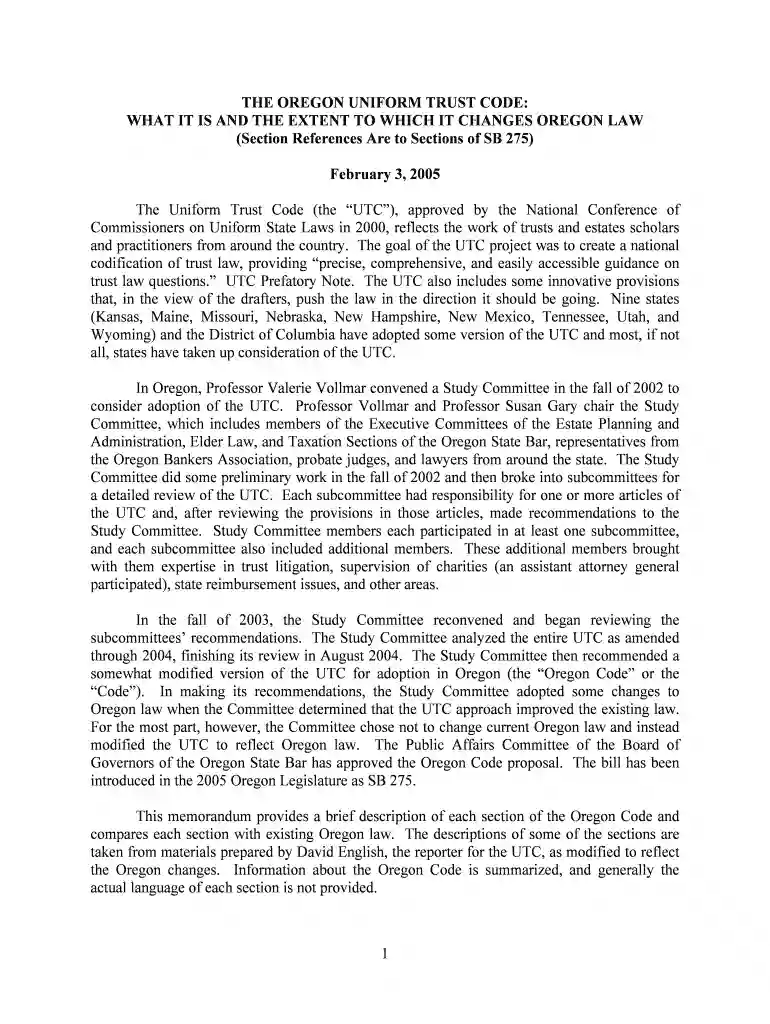
1 THE OREGON UNIFORM TRUST CODE - Oregon State Bar Preview on Page 1

Here's how it works

01. Edit your form online
Type text, add images, blackout confidential details, add comments, highlights and more.

02. Sign it in a few clicks
Draw your signature, type it, upload its image, or use your mobile device as a signature pad.

03. Share your form with others
Send it via email, link, or fax. You can also download it, export it or print it out.

How to use or fill out 1 THE OREGON UNIFORM TRUST CODE - Oregon State Bar with Our Platform

Form edit decoration
9.5
Ease of Setup
DocHub User Ratings on G2
9.0
Ease of Use
DocHub User Ratings on G2
  1. Click ‘Get Form’ to open it in the editor.
  2. Begin by reviewing the General Provisions and Definitions section. Familiarize yourself with key terms such as 'Settlor' and 'Qualified Beneficiary' to understand your rights and responsibilities.
  3. Proceed to fill out the specific sections relevant to your trust. For example, if you are creating a trust, ensure you complete Section 21 regarding Methods of Creating Trust accurately.
  4. Utilize our platform's commenting feature to add notes or questions directly on the document for future reference or discussion with legal counsel.
  5. Once all necessary fields are completed, review your entries for accuracy. Use the built-in tools to highlight any areas that may require further attention or clarification.
  6. Finally, save your document and share it securely with relevant parties using our platform’s sharing options.

Start editing your document today for free and streamline your trust management process!

See more 1 THE OREGON UNIFORM TRUST CODE - Oregon State Bar versions

We've got more versions of the 1 THE OREGON UNIFORM TRUST CODE - Oregon State Bar form. Select the right 1 THE OREGON UNIFORM TRUST CODE - Oregon State Bar version from the list and start editing it straight away!
Versions Form popularity Fillable & printable
2017 4.8 Satisfied (111 Votes)
2011 4.4 Satisfied (325 Votes)
2005 4.8 Satisfied (71 Votes)
be ready to get more

Complete this form in 5 minutes or less

Get form

Got questions?

We have answers to the most popular questions from our customers. If you can't find an answer to your question, please contact us.
Contact us
Who should create a trust versus a will? Individuals who want to distribute their assets during their lifetime or have more control over their estate planning should consider creating a trust, while those who want a simpler and less costly process may opt for a will.
But, jurisdictions like California, New York, Nevada, Texas, Dela- ware and South Dakota remain notable states which continue to resist the adoption of the UTC.
In my mind, if you have less than $1 million in assets and your financial world is pretty simple and straightforward a will gets the job done just fine. One of the most important differences between wills and trusts is the ability to name a guardian for your minor children.
The deceased spouses estate typically funds the B Trust (also known as the Family Trust) up to the Oregon exclusion amount, currently $1 million. This protects the first $1 million from estate tax since taxes are only applied to amounts over the $1 million exclusion.
The law of trusts in Oregon was overhauled, effective January 1, 2006, with the adoption of much of the Uniform Trust Code. Over the past several years, several additional modifications have been made to the Oregon Uniform Trust Code (the OUTC).

Security and compliance

At DocHub, your data security is our priority. We follow HIPAA, SOC2, GDPR, and other standards, so you can work on your documents with confidence.

Learn more
ccpa2
pci-dss
gdpr-compliance
hipaa
soc-compliance

People also ask

Individuals who want to distribute their assets during their lifetime or have more control over their estate planning should consider creating a trust, while those who want a simpler and less costly process may opt for a will.
The Uniform Trust Code, known as the UTC, was drafted in 2000 by the National Conference of Commissioners on Uniform State Laws. It was drafted to collect, unify, and codify trust law. The UTC has been exceptionally influential on trust law throughout the United States.
Assets in a living trust skip probate, allowing your heirs to receive them faster. Privacy: A will becomes public record during the probate process. Trusts remain private, which can be attractive to those who want to protect the identity of their heirs and the details of their property.

Related links