Petition restraining 2026

Get Form
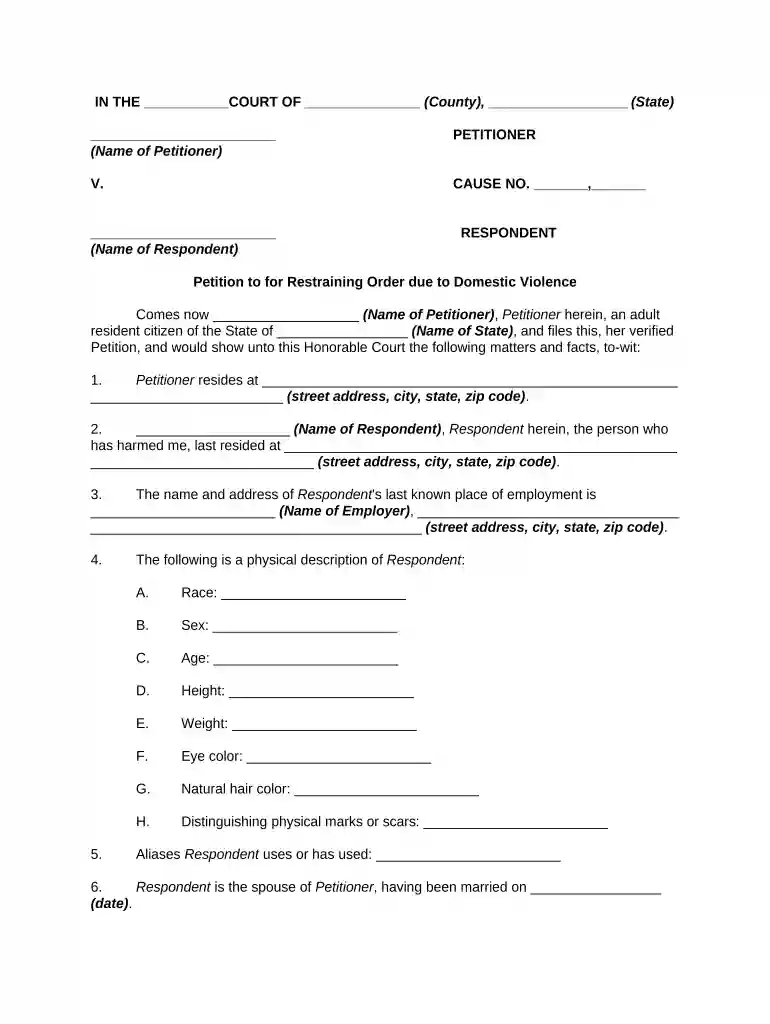
petition restraining Preview on Page 1

Here's how it works

01. Edit your form online
Type text, add images, blackout confidential details, add comments, highlights and more.

02. Sign it in a few clicks
Draw your signature, type it, upload its image, or use your mobile device as a signature pad.

03. Share your form with others
Send it via email, link, or fax. You can also download it, export it or print it out.

How to use or fill out petition restraining with our platform

Form edit decoration
9.5
Ease of Setup
DocHub User Ratings on G2
9.0
Ease of Use
DocHub User Ratings on G2
  1. Click ‘Get Form’ to open the petition restraining document in the editor.
  2. Begin by filling in the court name, county, and state at the top of the form. This establishes the jurisdiction for your petition.
  3. Enter your name as the Petitioner and the name of the Respondent in their respective fields. Ensure accuracy to avoid delays.
  4. Provide your residential address and that of the Respondent. This information is crucial for legal notifications.
  5. Detail any incidents of domestic violence in section 9, including dates and descriptions. Be specific to strengthen your case.
  6. List any minor children involved, along with their names and ages, ensuring you highlight custody concerns.
  7. Complete sections regarding your need for exclusive possession of shared dwelling and reasons for fearing domestic violence.
  8. Review all entries for accuracy before signing at the bottom. Use our platform’s tools to ensure clarity and correctness.

Start using our editor today to complete your petition restraining easily and efficiently!

be ready to get more

Complete this form in 5 minutes or less

Get form

Got questions?

We have answers to the most popular questions from our customers. If you can't find an answer to your question, please contact us.
Contact us
There are several types of restraining orders, but the most common ones that defendants face are: Domestic Violence Restraining Orders (DVRO): This is the most common type of restraining order. It is designed to protect victims of domestic violence by family or household members.
At the final hearing, the burden is on the petitioner to prove by a preponderance of the evidence that facts satisfy whichever statute they are seeking protection under.
Usually the way to begin is by filing a police report that details all instances of unwelcome interactions and/or trespasses and how they made you feel unsafe, threatened, etc. Then, with a copy of this police report, a person can use the Los Angeles court system website to print off emergency protective order forms.
The specific elements you need to prove to get a restraining order vary from state to state, but in general, you need to show: A specific instance or instances of abuse or harassment (such as sexual assault by an intimate partner) The threat of violence or of further abusive behavior or harassment.
Washington Restraining Orders physical harm; bodily injury; assault; making you fear immediate physical harm, bodily injury, or assault; nonconsensual sexual conduct; nonconsensual sexual ; coercive control; unlawful harassment; or.

Security and compliance

At DocHub, your data security is our priority. We follow HIPAA, SOC2, GDPR, and other standards, so you can work on your documents with confidence.

Learn more
ccpa2
pci-dss
gdpr-compliance
hipaa
soc-compliance

People also ask

In situations involving requests for Domestic Violence Restraining Orders, the burden of proof is Preponderance of the Evidence. That means that it has to be more probable than not that the offending conduct occurred.

Related links