




Here's how it works

01. Edit your form online
Type text, add images, blackout confidential details, add comments, highlights and more.

02. Sign it in a few clicks
Draw your signature, type it, upload its image, or use your mobile device as a signature pad.

03. Share your form with others
Send it via email, link, or fax. You can also download it, export it or print it out.
How to use or fill out marc intake with our platform

- Click ‘Get Form’ to open the marc intake in the editor.
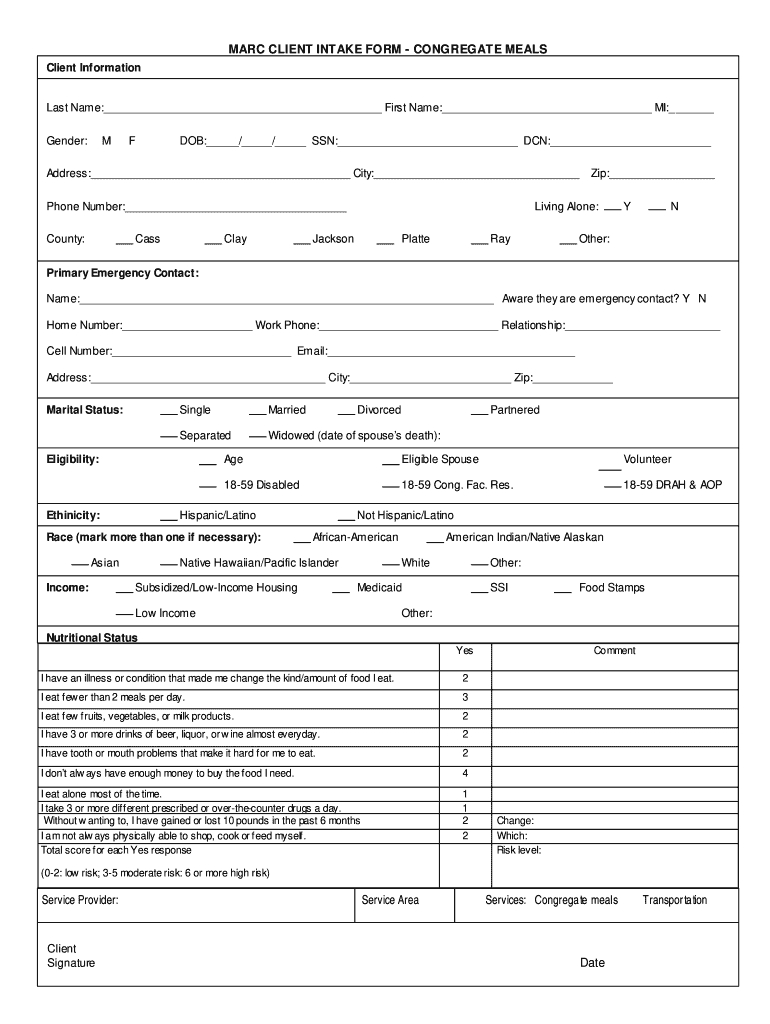
- Begin by entering your last name, first name, and middle initial in the designated fields. Ensure accuracy for proper identification.
- Select your gender and enter your date of birth, Social Security Number (SSN), and Document Control Number (DCN) as required.
- Fill in your address, city, phone number, and zip code. Choose your county from the provided options.
- Indicate whether you live alone by selecting 'Y' for Yes or 'N' for No.
- Provide details for your primary emergency contact, including their name, relationship to you, and contact numbers. Confirm if they are aware of their role as an emergency contact.
- Complete the marital status section by selecting the appropriate option that describes your current situation.
- Fill out eligibility criteria based on ethnicity and income sources. Mark all applicable boxes.
- Assess your nutritional status by answering the questions provided. Tally your score based on 'Yes' responses to determine risk level.
- Finally, sign the form as a client and include the date before submitting it through our platform for processing.
Start filling out your marc intake form today using our platform for free!
Fill out marc intake online
It's free
It's free
Security and compliance
At DocHub, your data security is our priority. We follow HIPAA, SOC2, GDPR, and other standards, so you can work on your documents with confidence.
Learn more


