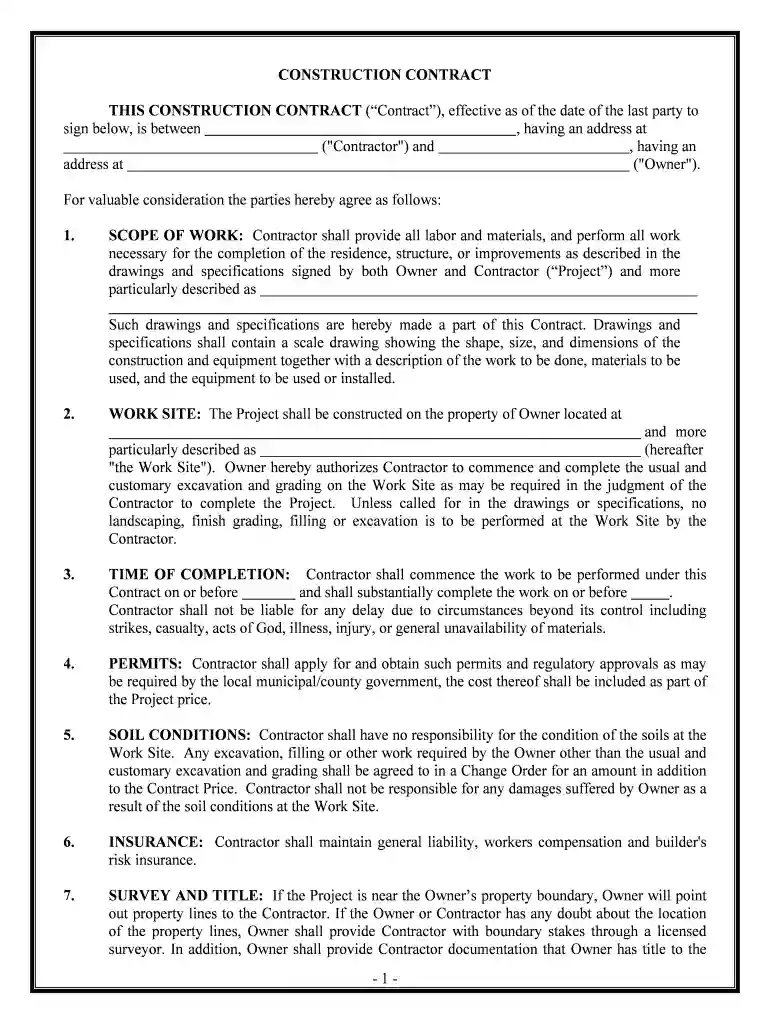
Tennessee Construction Contract Cost Plus or Fixed Fee 2026

Get Form
Tennessee Construction Contract Cost Plus or Fixed Fee Preview on Page 1

Here's how it works

01. Edit your form online
Type text, add images, blackout confidential details, add comments, highlights and more.

02. Sign it in a few clicks
Draw your signature, type it, upload its image, or use your mobile device as a signature pad.

03. Share your form with others
Send it via email, link, or fax. You can also download it, export it or print it out.

How to use or fill out Tennessee Construction Contract Cost Plus or Fixed Fee

Form edit decoration
9.5
Ease of Setup
DocHub User Ratings on G2
9.0
Ease of Use
DocHub User Ratings on G2
  1. Click ‘Get Form’ to open it in the editor.
  2. Begin by filling in the Contractor and Owner details, including names and addresses, in the designated fields.
  3. In the 'SCOPE OF WORK' section, clearly describe the project specifications and attach any necessary drawings.
  4. Specify the 'WORK SITE' address where the project will take place.
  5. Set the 'TIME OF COMPLETION' by entering start and completion dates.
  6. Indicate whether you are using a 'COST PLUS' or 'FIXED FEE' payment structure and fill in the corresponding amounts.
  7. Review all sections for accuracy before signing. Ensure both parties sign and date at the end of the document.

Start editing your Tennessee Construction Contract for free today!

See more Tennessee Construction Contract Cost Plus or Fixed Fee versions

We've got more versions of the Tennessee Construction Contract Cost Plus or Fixed Fee form. Select the right Tennessee Construction Contract Cost Plus or Fixed Fee version from the list and start editing it straight away!
Versions Form popularity Fillable & printable
2020 4.7 Satisfied (47 Votes)
be ready to get more

Complete this form in 5 minutes or less

Get form

Got questions?

We have answers to the most popular questions from our customers. If you can't find an answer to your question, please contact us.
Contact us
A cost-plus contract is a construction agreement that requires reimbursement for project costs as well as a markup that covers the contractors overhead and profit. In other words, the name is a short-hand way of remembering what the contract covers: project costs plus contractor markup.
Benefits of a cost-plus fixed-fee contract They allow you to explore and adjust the scope, unlike firm-fixed-price contracts. CPFF contracts foster better communication between clients and contractors, especially when both parties must work closely to guarantee contract performance.
Here are some of the disadvantages businesses should consider: Risk of cost overruns: Because the client agrees to reimburse all costs, theres a risk that the project will go over budget. If the contractor isnt managing expenses well, the client will end up paying the bill.
Construction project owners may employ this type of contract when they want to get a project moving quickly or when the scope of work is unclear, making it difficult to estimate the total cost. That said, the total price for a cost-plus contract may ultimately be higher than it would be with other contract types.
Most contracts have a cost-plus fee scale of 10-25%. A contractor would use takeoff software to calculate the materials costs, but they wouldnt need to be exact. Some companies use a cost-plus-fixed-fee (CPFF) instead of a percentage.

Security and compliance

At DocHub, your data security is our priority. We follow HIPAA, SOC2, GDPR, and other standards, so you can work on your documents with confidence.

Learn more
ccpa2
pci-dss
gdpr-compliance
hipaa
soc-compliance
be ready to get more

Complete this form in 5 minutes or less

Get form

People also ask

These contracts are commonly used in research, development, and technical service projects, where precise costs are difficult to estimate in advance.
Cost plus construction contracts offer advantages like transparency, flexibility, and reduced contractor risk. They also come with drawbacks, including uncertain pricing, a higher administrative workload, and a greater risk of disputes.
A cost-plus contract reimburses contractors for project costs plus either a percentage or fixed fee, which they take as profit. This type of contract is favored by contractors because of the flexibility they offer. This makes them ideal for projects where the scope is unclear and subject to change.

Related links