Symbiotic relationship worksheet 2026

Get Form
symbiotic relationship worksheet Preview on Page 1

Here's how it works

01. Edit your symbiotic relationship worksheet online
Type text, add images, blackout confidential details, add comments, highlights and more.

02. Sign it in a few clicks
Draw your signature, type it, upload its image, or use your mobile device as a signature pad.

03. Share your form with others
Send symbiotic relationship worksheet pdf via email, link, or fax. You can also download it, export it or print it out.

How to use or fill out the symbiotic relationship worksheet

Form edit decoration
9.5
Ease of Setup
DocHub User Ratings on G2
9.0
Ease of Use
DocHub User Ratings on G2
  1. Click ‘Get Form’ to open the symbiotic relationship worksheet in our editor.
  2. Begin by entering your name and the date at the top of the form. This personalizes your worksheet and helps keep track of your submissions.
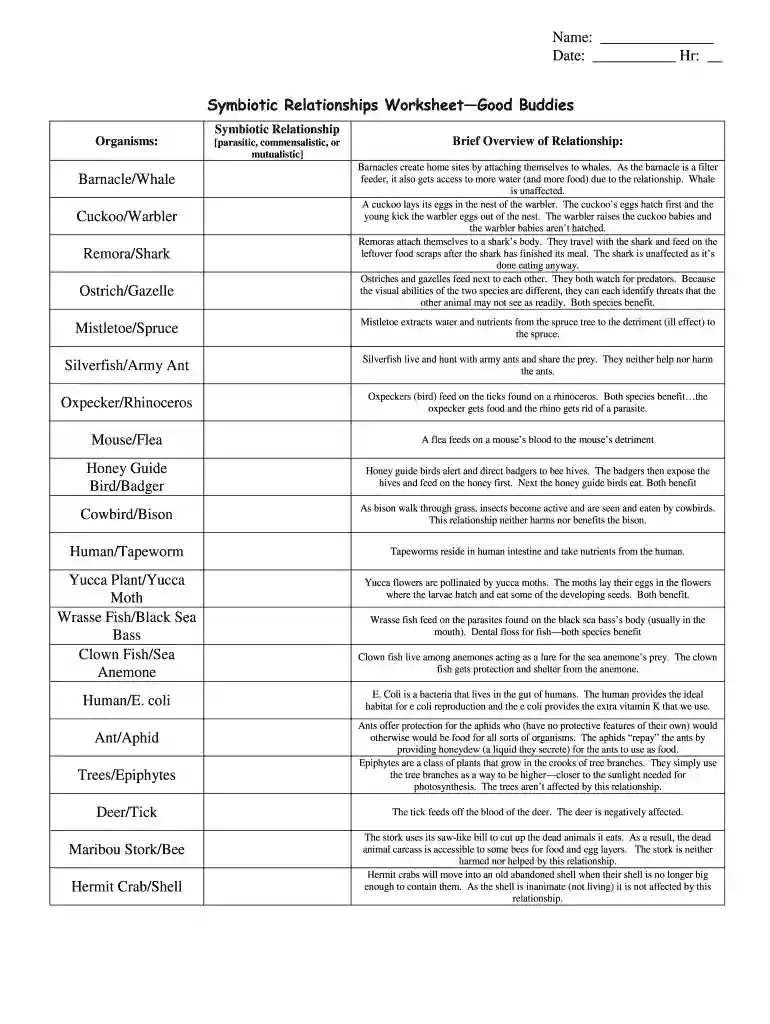
  3. In the 'Symbiotic Relationships' section, identify and list the organisms you are studying. Use the provided examples like Barnacle/Whale or Cuckoo/Warbler as a guide.
  4. For each pair, classify their relationship as parasitic, commensalistic, or mutualistic by selecting from the dropdown options available in our platform.
  5. Next, provide a brief overview of each relationship in the designated text boxes. Summarize how each organism benefits or is affected by their interaction.
  6. Once completed, review your entries for accuracy and clarity before saving or sharing your worksheet directly from our editor.

Start using our platform today to effortlessly complete your symbiotic relationship worksheet for free!

See more symbiotic relationship worksheet versions

We've got more versions of the symbiotic relationship worksheet form. Select the right symbiotic relationship worksheet version from the list and start editing it straight away!
Versions Form popularity Fillable & printable
2011 4.6 Satisfied (56 Votes)
be ready to get more

Complete this form in 5 minutes or less

Get form

Got questions?

We have answers to the most popular questions from our customers. If you can't find an answer to your question, please contact us.
Contact us
Because different species often inhabit the same spaces and shareor compete forthe same resources, they interact in a variety of ways, known collectively as symbiosis. There are four main symbiotic relationships: mutualism, commensalism, parasitism, and competition.
Symbiosis: Commensialism, Mutualism, Parasitism, Neutralism, Competition Predation. No items found. The word symbiosis comes from Greek origin meaning together and living and describes a close interaction or relationship between two different species.
Page 1. ❖ Symbiotic Relationships. Symbiosis is a close relationship between two species in which at least one species benefits. For the other species, the relationship may be positive, negative, or neutral. There are three basic types of symbiosis: mutualism, commensalism, and parasitism.
A symbiotic relationship is an ongoing interaction between organisms of different species. The interaction usually benefits at least one of the organisms and can benefit both. However, in some cases, one or both organisms may be harmed by the relationship, or the interaction may not impact one at all.
Symbiosis is defined as a relationship or interaction between two different organisms that share similar habitat. There are three types of behaviours observed in symbiotic relationships, namely Mutualism, Commensalism and Parasitism.

Security and compliance

At DocHub, your data security is our priority. We follow HIPAA, SOC2, GDPR, and other standards, so you can work on your documents with confidence.

Learn more
ccpa2
pci-dss
gdpr-compliance
hipaa
soc-compliance
be ready to get more

Complete this form in 5 minutes or less

Get form