
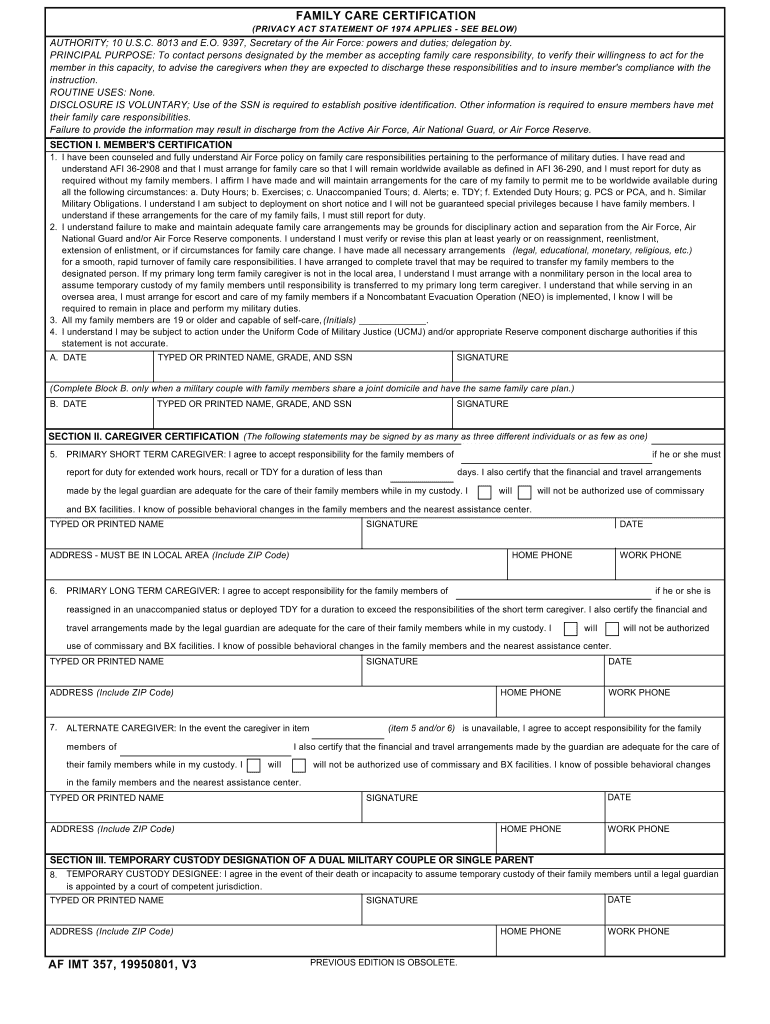







Definition and Purpose of AF Form 357
AF Form 357, also known as the Air Force Family Care Plan, is a vital document that outlines the necessary arrangements for the care of dependents when a military member is required to fulfill official duties. This form is essential for ensuring that service members have a clear plan in place for family care, particularly during deployments, training exercises, or other absences related to their military obligations. The form helps protect the welfare of family members by ensuring that suitable caregiving arrangements are established and documented.
- Key Elements: The AF Form 357 includes sections for member certification, caregiver certification, and temporary custody designation.
- Purpose: It is intended to prevent disruptions in care and to provide peace of mind for service members.
How to Use AF Form 357 Effectively
Using the AF Form 357 involves several steps, which can vary depending on individual circumstances. However, the core process remains the same. First, service members must assess their family's needs, considering any specific requirements for children, elderly parents, or others who depend on them for care.
- Identify Dependents: List all family members who require care during the member's absence.
- Select Caregivers: Choose trusted individuals who will act as caregivers during the member's deployment or absence.
- Fill Out the Form: Complete the form, ensuring that all sections, including caregiver certifications, are properly filled in.
- Submit for Approval: Once completed, the form should be submitted to the appropriate command for approval.
In addition to these steps, it is important to regularly review and update the AF Form 357 to reflect any changes in family dynamics, such as new children or changes in caregiver availability.
Steps to Complete the AF Form 357
Completing the AF Form 357 requires attention to detail to ensure that all necessary information is accurately captured. The following steps provide a structured approach for filling out this form effectively:
- Gather Required Information: Before filling out the form, collect all pertinent information about dependents and caregivers.
- Provide Personal Details: Enter your personal information at the top of the form, including rank, name, and contact details.
- Document Caregiver Information: Specify the name and contact information of the chosen caregiver, and include their relationship to the dependents.
- Sign and Date: After completing the form, sign and date it to confirm the accuracy of the information provided.
- Review Before Submission: Double-check all sections for any missing information or errors to avoid delays in the approval process.
Legal Use of the AF Form 357
Legal implications surrounding the AF Form 357 underscore its importance within the military framework. The form serves not only as a personal planning tool but also fulfills regulatory requirements as outlined in Air Force directives.
- Compliance with Regulations: By maintaining an active AF Form 357, service members meet military regulations that mandate family care planning, thus avoiding potential repercussions.
- Right to Care: The form establishes the legal right of selected caregivers to make decisions on behalf of the dependents in the member's absence.
Understanding these legal nuances is crucial for service members to effectively safeguard their family's well-being while fulfilling their military duties.
Important Terms Related to AF Form 357
Familiarizing oneself with the terminology associated with AF Form 357 is essential for effective communication and understanding of the document's implications. Important terms include:
- Dependent: An individual who relies on the military service member for financial, emotional, or physical support.
- Caregiver: A designated individual responsible for the day-to-day care of dependents during the absence of the service member.
- Certification: The formal acknowledgment by the service member of the accuracy and acceptability of the caregiver's ability to provide care.
By understanding these terms, service members can engage more fully with the form's content and its intended use.
Examples of Using AF Form 357 in Real Scenarios
Practical applications of AF Form 357 highlight its role in supporting military families during various circumstances. Consider the following examples:
- Deployment Scenario: A service member is deployed to a remote location for six months. Before leaving, they complete AF Form 357 to ensure their children are cared for by their sister, who has agreed to take on this responsibility.
- Training Exercises: A member is required to attend a month-long training program. To ensure their elderly parents are adequately cared for, the member uses the form to designate a close friend as their temporary caregiver, allowing for peace of mind.
These examples illustrate how AF Form 357 is employed in diverse situations, demonstrating its vital role in family care planning within the military context.




