




01. Edit your 1040 v form online
Type text, add images, blackout confidential details, add comments, highlights and more.

Type text, add images, blackout confidential details, add comments, highlights and more.

Draw your signature, type it, upload its image, or use your mobile device as a signature pad.

Send 1040v form via email, link, or fax. You can also download it, export it or print it out.
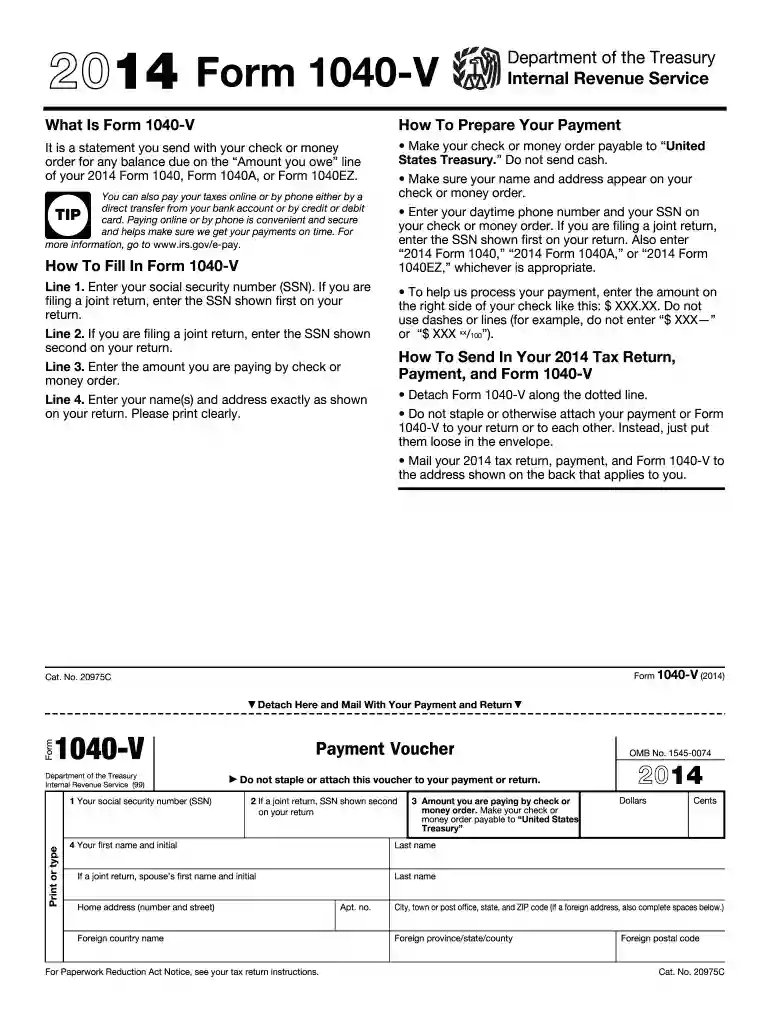
IRS Form 1040-V 2014 is a payment voucher used to submit payments for any outstanding balance on the 2014 tax return, specifically tied to forms like 1040, 1040A, or 1040EZ. It serves as a straightforward way for taxpayers to fulfill their tax payment obligations by providing critical details needed to process payments accurately. The form aids in ensuring that payments are correctly allocated to the taxpayer's account, linking the payment with their specific tax return, and minimizing processing errors.
Using the IRS Form 1040-V 2014 involves several steps to ensure payments are processed correctly:
Completing the IRS Form 1040-V 2014 accurately is crucial:
Understanding the associated terminology aids in correctly completing the form:
The IRS provides guidelines to clarify the use of Form 1040-V 2014:
There are specific penalties for failing to comply with payment obligations:
Various taxpayer situations may affect how Form 1040-V 2014 is used:


Adhering to respective deadlines is essential to avoid interest or penalties:
Taxpayers should disclose accurate personal details:
While Form 1040-V is a federal form, states may have additional requirements:
We've got more versions of the 1040 v form form. Select the right 1040 v form version from the list and start editing it straight away!
| Versions | Form popularity | Fillable & printable |
|---|---|---|
| 2025 | 4.4 Satisfied (30 Votes) | |
| 2024 | 4.3 Satisfied (21 Votes) | |
| 2023 | 4.7 Satisfied (42 Votes) | |
| 2022 | 4.8 Satisfied (43 Votes) | |
| 2021 | 4.7 Satisfied (32 Votes) | |
| 2020 | 4.3 Satisfied (86 Votes) | |
| 2019 | 4.2 Satisfied (62 Votes) | |
| 2018 | 4.2 Satisfied (123 Votes) | |
| 2017 | 4.2 Satisfied (113 Votes) | |
| 2016 | 4.3 Satisfied (186 Votes) | |
| 2015 | 3.9 Satisfied (30 Votes) | |
| 2014 | 4.3 Satisfied (61 Votes) | |
| 2014 | 4.6 Satisfied (48 Votes) | |
| 2013 | 4 Satisfied (22 Votes) | |
| 2012 | 4 Satisfied (26 Votes) |
At DocHub, your data security is our priority. We follow HIPAA, SOC2, GDPR, and other standards, so you can work on your documents with confidence.
Refer to the Form 1040 Instructions to determine if you are required to file a tax return. Even if you do not have to file a tax return, you may be eligible forRead more
It is a statement you send with your check or money order for any balance due on the Amount you owe line of your 2014 Form 1040, Form 1040A, or Form 1040EZ.Read more
Sep 16, 2013 Accordingly, for taxable years beginning in 2014, an employer will be treated as meeting the uniform percentage require- ment if the failure toRead more


