




01. Edit your form online
Type text, add images, blackout confidential details, add comments, highlights and more.

Type text, add images, blackout confidential details, add comments, highlights and more.

Draw your signature, type it, upload its image, or use your mobile device as a signature pad.

Send it via email, link, or fax. You can also download it, export it or print it out.
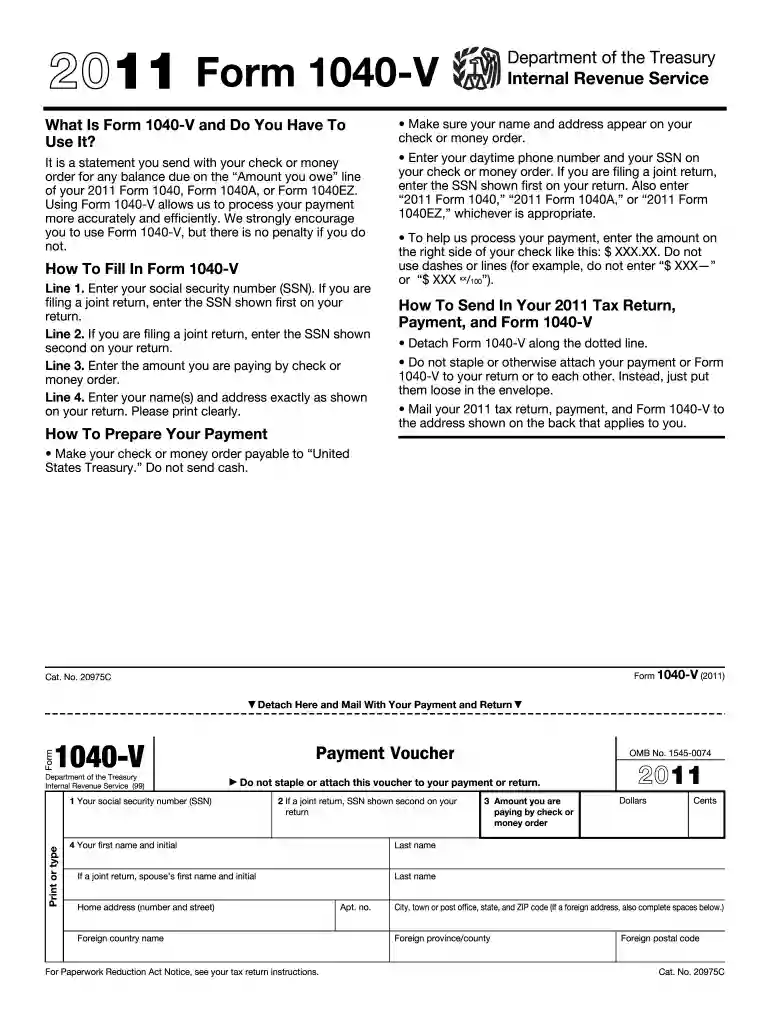
The 2011 Form 1040-V, also known as a payment voucher, serves an essential role in the process of tax payments to the Internal Revenue Service (IRS). Specifically, this form is used when making payments for any outstanding balance on 2011 tax returns, which include forms such as the 1040, 1040A, and 1040EZ. The primary use of the Form 1040-V is to facilitate the accurate processing of payments by the IRS. When you attach this voucher to your payment, it helps ensure that your payment is correctly credited to your account. The form includes key information fields that match your payment with the appropriate tax account, preventing any unnecessary processing delays.
To effectively use the 1040-V form, it's crucial to understand its components and process. After you have calculated your tax return and determined a balance owed to the IRS, the next step is to complete the 1040-V form. Here’s a step-by-step guide for using the form:
Completing the 1040-V form requires attention to detail to avoid common pitfalls. Follow these detailed steps to ensure accuracy:
Familiarizing yourself with specific terminology is helpful for a smooth filing process:
The 1040-V form is predominantly used by taxpayers who, upon completion of their 2011 tax return, determine that a payment is due. This includes individuals from various backgrounds who may fall into categories such as:


Understanding the relevant timelines is critical to avoid late penalties:
Adhering to IRS guidelines ensures compliance and proper processing of your 1040-V form:
When preparing to submit your Form 1040-V:
By carefully following the guidelines and steps for the 2-V form, you can ensure a seamless and efficient tax payment experience with the IRS.
We've got more versions of the 2011 1040 v form form. Select the right 2011 1040 v form version from the list and start editing it straight away!
| Versions | Form popularity | Fillable & printable |
|---|---|---|
| 2025 | 4.4 Satisfied (30 Votes) | |
| 2024 | 4.3 Satisfied (21 Votes) | |
| 2023 | 4.7 Satisfied (42 Votes) | |
| 2022 | 4.8 Satisfied (43 Votes) | |
| 2021 | 4.7 Satisfied (32 Votes) | |
| 2020 | 4.3 Satisfied (86 Votes) | |
| 2019 | 4.2 Satisfied (62 Votes) | |
| 2018 | 4.2 Satisfied (123 Votes) | |
| 2017 | 4.2 Satisfied (113 Votes) | |
| 2016 | 4.3 Satisfied (186 Votes) | |
| 2015 | 3.9 Satisfied (30 Votes) | |
| 2014 | 4.3 Satisfied (61 Votes) | |
| 2014 | 4.6 Satisfied (48 Votes) | |
| 2013 | 4 Satisfied (22 Votes) | |
| 2012 | 4 Satisfied (26 Votes) |
At DocHub, your data security is our priority. We follow HIPAA, SOC2, GDPR, and other standards, so you can work on your documents with confidence.
Make your check or money order payable to the United States Treasury. Write your social security number (SSN) on your check or money order. Dollars.Read more
It is a statement you send with your check or money order for any balance due on the Amount you owe line of your 2011 Form 1040, Form 1040A, or Form 1040EZ.Read more


