




01. Edit your 2017 1040v online
Type text, add images, blackout confidential details, add comments, highlights and more.

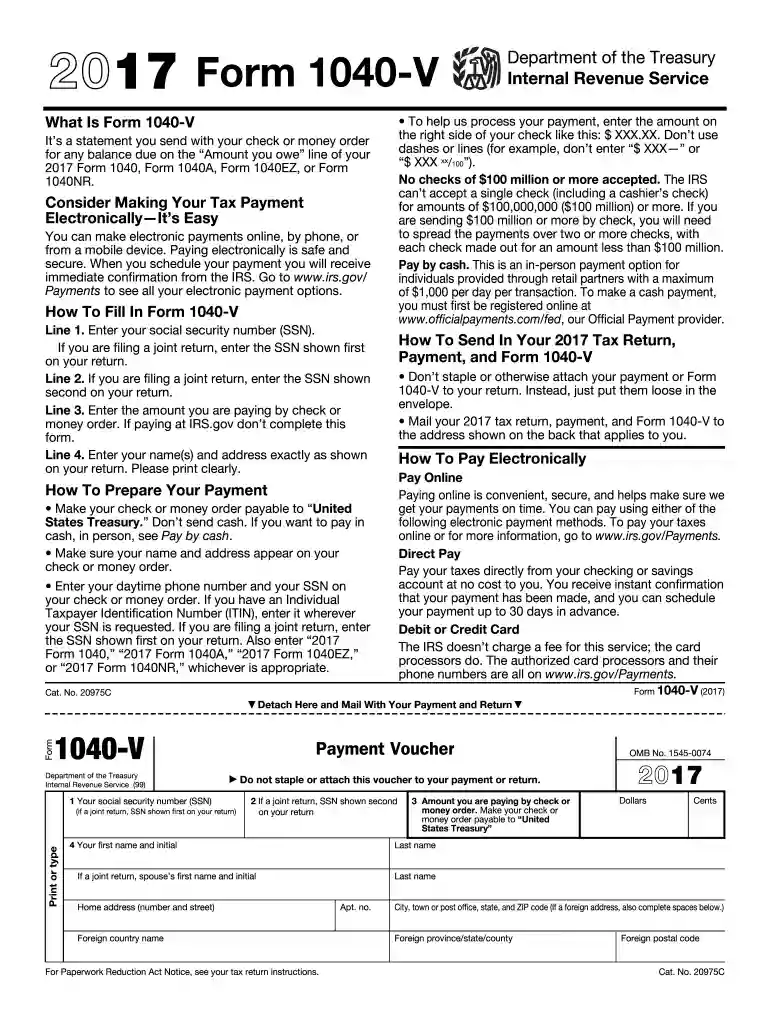
Type text, add images, blackout confidential details, add comments, highlights and more.

Draw your signature, type it, upload its image, or use your mobile device as a signature pad.

Send 2017 1040 v via email, link, or fax. You can also download it, export it or print it out.
The IRS 1040-ES payment voucher for 2017 is a form used by taxpayers in the United States to make estimated tax payments. This form is commonly required for individuals who earn income not subject to withholding, such as self-employment income, rental income, dividends, interest, or capital gains. The 1040-ES form allows taxpayers to properly estimate and remit quarterly tax payments to avoid penalties for underpayment when filing their annual tax returns.
Calculate Estimated Taxes: Use the worksheet provided in the 1040-ES instructions to compute your estimated taxes. This calculation is based on your expected adjusted gross income, taxable income, taxes owed, deductions, and credits for the tax year.
Prepare the Payment Voucher: Fill out the payment voucher with your name, address, Social Security number, and the amount of the estimated tax payment. Ensure that all information is typed or neatly printed to minimize processing errors.
Payment Submission: Attach your check or money order made payable to the "United States Treasury" along with the completed voucher. Ensure the payment is correctly dated, signed, and includes your telephone number.
Mail or Submit Online: Mail the completed voucher along with the payment to the address listed in the 1040-ES instructions specific to your geographical region. Alternatively, use IRS Direct Pay or EFTPS for an electronic submission, ensuring accuracy and faster processing.



These blocks deliver comprehensive insights on the IRS 1040-ES payment voucher, ensuring taxpayers understand its function and proper usage for the 2017 tax year.
We've got more versions of the 2017 1040v form. Select the right 2017 1040v version from the list and start editing it straight away!
| Versions | Form popularity | Fillable & printable |
|---|---|---|
| 2025 | 4.4 Satisfied (30 Votes) | |
| 2024 | 4.3 Satisfied (21 Votes) | |
| 2023 | 4.7 Satisfied (42 Votes) | |
| 2022 | 4.8 Satisfied (43 Votes) | |
| 2021 | 4.7 Satisfied (32 Votes) | |
| 2020 | 4.3 Satisfied (86 Votes) | |
| 2019 | 4.2 Satisfied (62 Votes) | |
| 2018 | 4.2 Satisfied (123 Votes) | |
| 2017 | 4.2 Satisfied (113 Votes) | |
| 2016 | 4.3 Satisfied (186 Votes) | |
| 2015 | 3.9 Satisfied (30 Votes) | |
| 2014 | 4.3 Satisfied (61 Votes) | |
| 2014 | 4.6 Satisfied (48 Votes) | |
| 2013 | 4 Satisfied (22 Votes) | |
| 2012 | 4 Satisfied (26 Votes) |
At DocHub, your data security is our priority. We follow HIPAA, SOC2, GDPR, and other standards, so you can work on your documents with confidence.
Mar 31, 2022 Title of Each Class. Trading Symbol(s). Name of Each Exchange on Which Registered. Ordinary Shares (par value of 0.000625 per share).Read more
Jan 21, 2026 Form 1040-V Payment Voucher to go with Form 1040; 1040 Schedule A 1040-ES. N/A. Internal Revenue Service P. O. Box 931000. LouisvilleRead more
Jan 6, 2017 2017 Estimated Tax. Payment. Voucher 4 OMB No. 1545-0074. File only if you are making a payment of estimated tax by check or money order. MailRead more


