



01. Edit your 2016 1040 v online
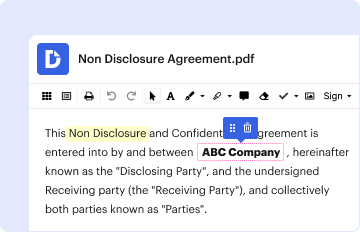
Type text, add images, blackout confidential details, add comments, highlights and more.

Type text, add images, blackout confidential details, add comments, highlights and more.
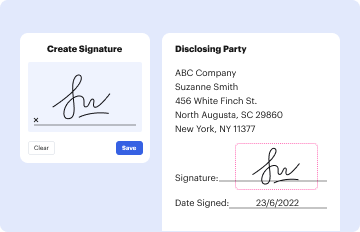
Draw your signature, type it, upload its image, or use your mobile device as a signature pad.

Send 1040 v 2016 via email, link, or fax. You can also download it, export it or print it out.
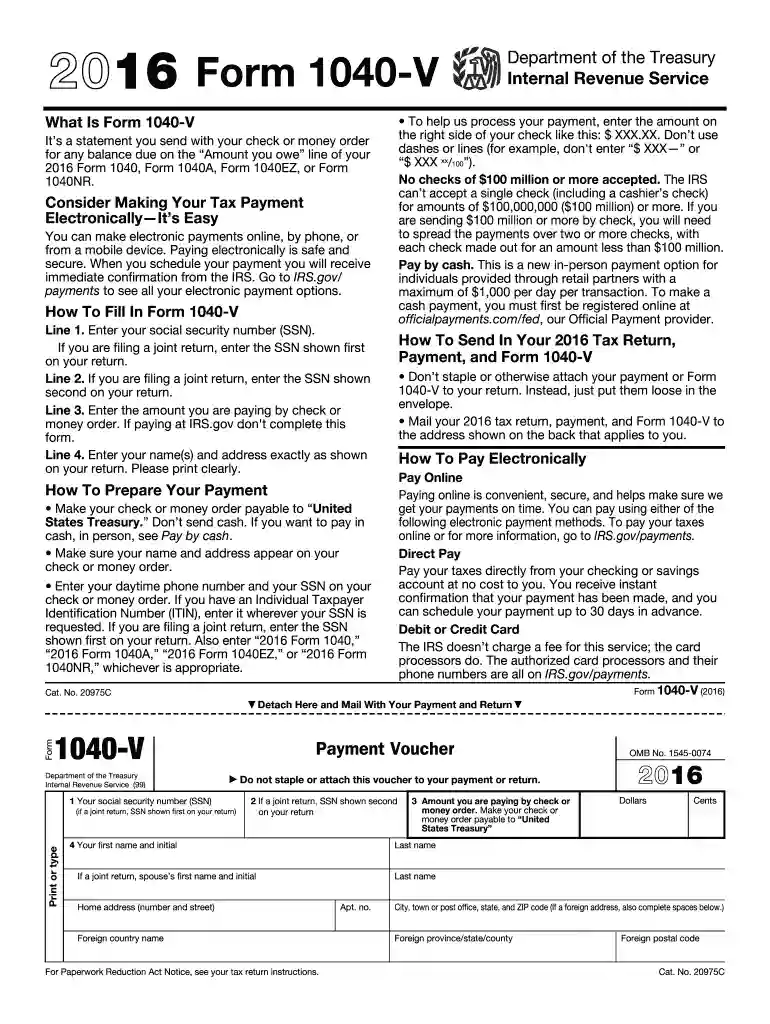
Form 1040-V, for the 2016 tax year, serves as a payment voucher when submitting tax payments to the IRS. This document is utilized for payments accompanying a Form 1040, 1040-A, or 1040-EZ. It primarily facilitates the acknowledgment of payment amounts and social security numbers to ensure accurate allocation of funds.
Acquiring the 2016 Form 1040-V is straightforward. Taxpayers can download the form directly from the IRS website. Alternatively, tax preparation software such as TurboTax or QuickBooks automatically generates the form for users who need it. If you prefer a physical copy, contact the IRS at to have it mailed to your address.
Completing the 1040-V form involves several simple steps to ensure accuracy and prevent payment misplacement:
Enter Your Payment Amount: Clearly specify the tax payment amount, prefacing the figure with a dollar sign.
Fill in Personal Information: Include your name, address, and social security number to identify the payer. Double-check to ensure the information matches your submitted tax form.
Prepare Payment: Choose a method that suits your preference—check, money order, or any electronic options supported by the IRS. Always write your SSN and “2016 Form 1040-V” along with your contact number on the memo line of the check or money order.
Do Not Staple: Place the voucher and payment in the mailbox without stapling or attaching to your tax return. This prevents delays in processing.
Mailing Address for 1040-V: The voucher should be mailed to the specified address for your region, detailed in the accompanying IRS instructions.
When dealing with Form 1040-V, taxpayers should be attentive to certain components:
To avoid late penalties, ensure your form and payment are postmarked or submitted online by April 15 of the subsequent year. In some scenarios, filing for an extension extends the deadline to October 15. Retain proof of mailing or electronic filing as a safeguard.
Generally, taxpayers who have a balance due on their 2016 Form 1040 return will use Form 1040-V. This encompasses a broad range:


Taxpayers have flexibility in submitting Form 1040-V:
Failing to comply with the correct procedure or meeting deadlines of the 1040-V form can result in penalties:
Form 1040-V can be filed in two main methods:
Taxpayers are encouraged to opt for the digital version due to its efficiency and speed, but retain the option to submit a paper version if preferred.
We've got more versions of the 2016 1040 v form. Select the right 2016 1040 v version from the list and start editing it straight away!
| Versions | Form popularity | Fillable & printable |
|---|---|---|
| 2025 | 4.4 Satisfied (30 Votes) | |
| 2024 | 4.3 Satisfied (21 Votes) | |
| 2023 | 4.7 Satisfied (42 Votes) | |
| 2022 | 4.8 Satisfied (43 Votes) | |
| 2021 | 4.7 Satisfied (32 Votes) | |
| 2020 | 4.3 Satisfied (86 Votes) | |
| 2019 | 4.2 Satisfied (62 Votes) | |
| 2018 | 4.2 Satisfied (123 Votes) | |
| 2017 | 4.2 Satisfied (113 Votes) | |
| 2016 | 4.3 Satisfied (186 Votes) | |
| 2015 | 3.9 Satisfied (30 Votes) | |
| 2014 | 4.3 Satisfied (61 Votes) | |
| 2014 | 4.6 Satisfied (48 Votes) | |
| 2013 | 4 Satisfied (22 Votes) | |
| 2012 | 4 Satisfied (26 Votes) |
At DocHub, your data security is our priority. We follow HIPAA, SOC2, GDPR, and other standards, so you can work on your documents with confidence.
Do you have to file? Refer to the Form 1040 instructions to determine if you are required to file a tax return. Even if you do not have to file a tax.Read more
Jan 31, 2018 You file Form 1040 and itemize deductions on Schedule A (Form 1040). The mortgage is a secured debt on a quali- fied home in which you have anRead more
Its a statement you send with your check or money order for any balance due on the Amount you owe line of your. 2016 Form 1040, Form 1040A, Form 1040EZ, orRead more


