




01. Edit your analyzing pay stubs answer key online
Type text, add images, blackout confidential details, add comments, highlights and more.

Type text, add images, blackout confidential details, add comments, highlights and more.

Draw your signature, type it, upload its image, or use your mobile device as a signature pad.

Send analyzing a pay stub worksheet answers via email, link, or fax. You can also download it, export it or print it out.
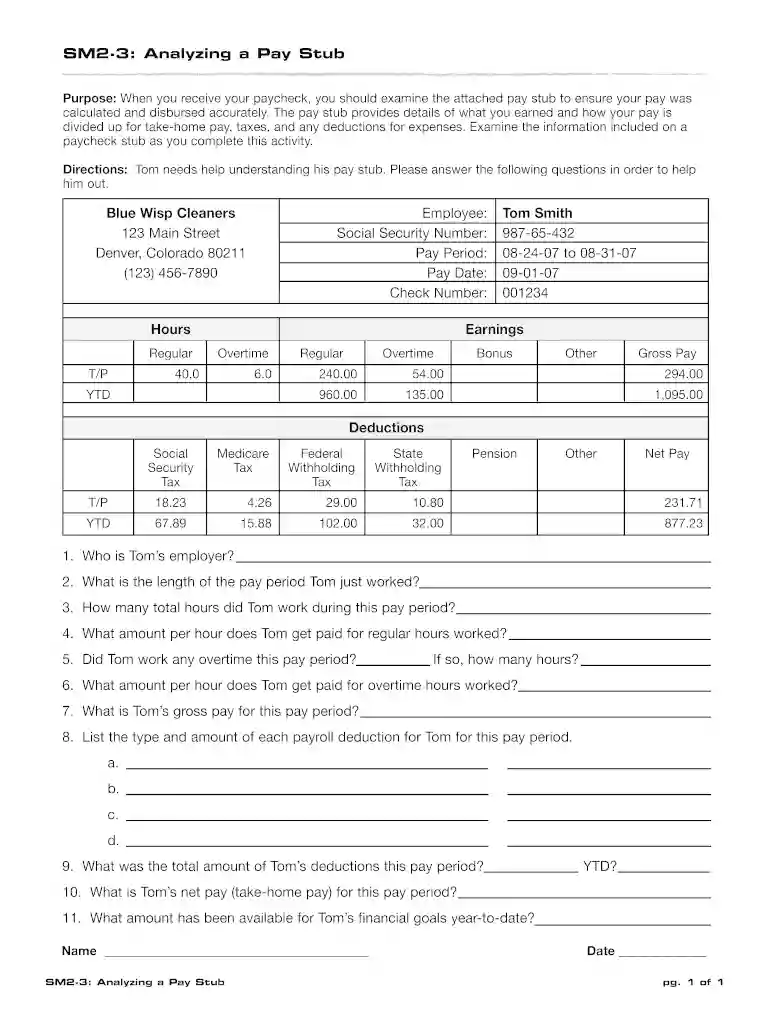
Analyzing a pay stub is essential for understanding an employee's earnings and deductions. A pay stub, also known as a paycheck or wage statement, provides a detailed breakdown of an employee’s earnings for a specific pay period. It typically includes gross wages, taxes withheld, and other deductions like health insurance and retirement contributions. Understanding a pay stub helps employees verify that they are accurately paid and helps them manage their finances effectively.
Employees should analyze their pay stubs regularly to ensure that:
Analyzing a pay stub involves a methodical review of its components to ensure everything is correct. The following steps can guide an employee through the analysis process effectively.
For instance, if Tom Smith receives a pay stub showing a gross pay of $3,000 for a semi-monthly pay period, he should assess what deductions (e.g., $600 for taxes, $200 for health insurance) leave him with a net pay of $2,200. If these numbers do not align with his previous stubs or pay agreements, he should consult HR for clarification.
Understanding the essential elements of a pay stub can aid in grasping its purpose and utility. Each component plays a vital role in the overall accuracy of earnings and compliance with employment laws.
Accurate reporting of these elements ensures compliance with labor laws and regulations. Misreporting may result in a variety of legal issues for both employee and employer.
Employees may encounter various scenarios when analyzing their pay stubs, leading to some common questions that require clarification.
For instance, if Tom discovers a significant increase in his tax deductions without any noticeable change in his income level or benefits enrollment, he should investigate whether this is a legal adjustment or a mistake on his employer's part.
Legal compliance is crucial when it comes to pay stubs. Employers are required by law to provide accurate pay stubs that reflect earnings and deductions. Misrepresentation can lead to legal consequences for both parties.
Employees are encouraged to analyze their pay stubs as a protection of their financial rights. Knowledge of one’s earnings and deductions empowers employees to address issues proactively, ensuring that their rights are upheld in the workplace.
We've got more versions of the analyzing pay stubs answer key form. Select the right analyzing pay stubs answer key version from the list and start editing it straight away!
| Versions | Form popularity | Fillable & printable |
|---|---|---|
| 2011 | 4 Satisfied (34 Votes) |
Microsoft Word doesn’t have signing tools to create valid eSignatures and enforceable paperwork. Luckily, DocHub is an online eSignature-compliant editor that works with different document formats, such as .doc files. Sign in to your account and add the Word version of your key stub from your device and cloud, or URL - our editor will automatically convert it into an editable PDF. Make all necessary adjustments in your form and click Sign to create your own legally-binding eSignature. There are four signing options from which to choose.
With DocHub, you have several convenient ways to edit your analyzing a pay stub worksheet online. You can drag and drop the form and edit it directly at the DocHub site or use our browser extension to fill out your form right away. Additionally, you can edit your PDF on your smartphone, as DocHub is compatible with all the accessible mobile platforms.
At DocHub, your data security is our priority. We follow HIPAA, SOC2, GDPR, and other standards, so you can work on your documents with confidence.
by FW Klaiber 2004 Cited by 4 The linear analysis method was used for this project due to its relative simplicity and the relative accuracy of the maximum pile moment when compared to valuesRead more
Shift 3 Pay - Salaried, Salaried, CLS, 5011230, Y, ALL, Amounts Only, Agency. 303 Use this query to analyze and resolve payroll problems before the PayRead more


