Vehicle suitable for safe use declaration 2014 form-2026

Get Form
safe use declaration Preview on Page 1

Here's how it works

01. Edit your safe use declaration online
Type text, add images, blackout confidential details, add comments, highlights and more.

02. Sign it in a few clicks
Draw your signature, type it, upload its image, or use your mobile device as a signature pad.

03. Share your form with others
Send notice os1 or permit os2 via email, link, or fax. You can also download it, export it or print it out.

How to use or fill out vehicle suitable for safe use declaration 2014 form with our platform

Form edit decoration
9.5
Ease of Setup
DocHub User Ratings on G2
9.0
Ease of Use
DocHub User Ratings on G2
  1. Click ‘Get Form’ to open the vehicle suitable for safe use declaration 2014 form in the editor.
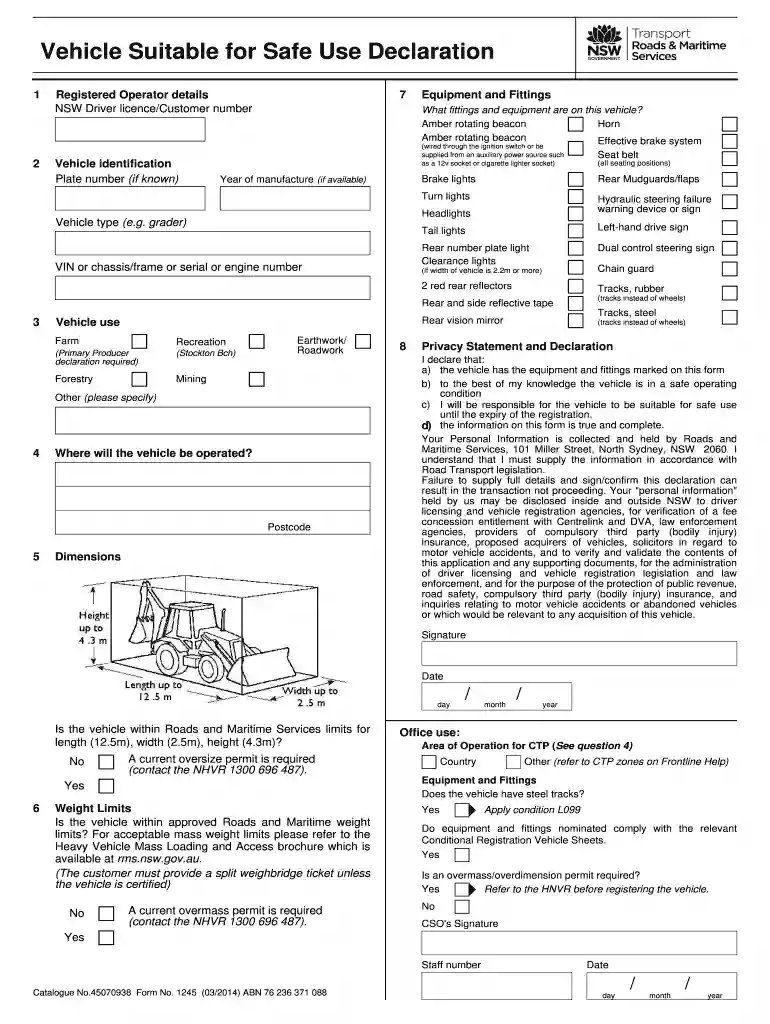
  2. Begin by entering the Registered Operator details, including your NSW Driver licence or Customer number. This information is crucial for identification.
  3. Fill in the Vehicle Identification section with the Plate number (if known), VIN, and other relevant identifiers such as chassis/frame or engine number.
  4. In the Equipment and Fittings section, check all applicable items on your vehicle, such as headlights, brake lights, and seat belts. Ensure you provide accurate details about any additional equipment.
  5. Specify where the vehicle will be operated by entering the postcode in the designated field.
  6. Complete the dimensions of your vehicle and confirm if it meets Roads and Maritime Services limits for length, width, and height.
  7. Finally, review the Privacy Statement and Declaration section. Confirm that all information is true before signing and dating the form.

Start using our platform today to fill out your vehicle suitable for safe use declaration form online for free!

See more vehicle suitable for safe use declaration 2014 form versions

We've got more versions of the vehicle suitable for safe use declaration 2014 form form. Select the right vehicle suitable for safe use declaration 2014 form version from the list and start editing it straight away!
Versions Form popularity Fillable & printable
2016 4.8 Satisfied (37 Votes)
2015 4.4 Satisfied (568 Votes)
2014 4.3 Satisfied (143 Votes)
be ready to get more

Complete this form in 5 minutes or less

Get form

Got questions?

We have answers to the most popular questions from our customers. If you can't find an answer to your question, please contact us.
Contact us
The declarations page is an important car insurance document that summarizes your policy. It is a handy reference that contains information like insurer contact information, coverage types and covered vehicles and drivers. You can look at the declarations page when you need to reference your policy and coverage.
A declaration form is a document that outlines all the information that is relevant and obtainable in a particular situation. In a declaration form, the person filling the form is expected to provide truthful and accurate information as is required.
An insurance declarations page tells you almost everything about your policy, from whos covered to which coverages you pay for. Your insurance company will send your declarations page to you via email, fax, or regular mail as soon as you buy your policy.
FMVSS are divided into three categories: crash avoidance (100-series), crashworthiness (200-series), and post-crash survivability (300-series).
Vehicle declarations include the make, model, year, MSRP, and current odometer reading of the car thats being registered. They also include a self-declaration where drivers are asked if they have claimed accelerated depreciation on that vehicle on their personal taxes.

Security and compliance

At DocHub, your data security is our priority. We follow HIPAA, SOC2, GDPR, and other standards, so you can work on your documents with confidence.

Learn more

People also ask

A Vehicle Declaration Form is a form template designed to streamline the process of declaring personal or company vehicle information. This form is essential for company fleet managers, HR and administrative departments, insurance providers, and property management teams.

Related links