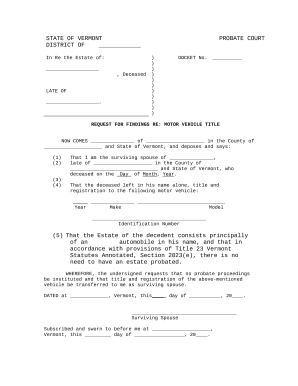
Get and manage Vermont Probate Forms online

Speed up your document administration using our Vermont Probate Forms online library with ready-made form templates that suit your requirements. Get the document, change it, complete it, and share it with your contributors without breaking a sweat. Start working more effectively with the documents.

The best way to manage our Vermont Probate Forms:

  1. Open our Vermont Probate Forms and look for the form you want.
  2. Preview your document to ensure it’s what you want, and click Get Form to start working on it.
  3. Edit, include new text, or highlight important information with DocHub tools.
  4. Complete your form and preserve the adjustments.
  5. Download or share your document template with other recipients.

Examine all the opportunities for your online file management with our Vermont Probate Forms. Get a totally free DocHub profile today!


Video Guide on Vermont Probate Forms management

video background

Commonly Asked Questions about Vermont Probate Forms

In your will, you can name the person you want to be in charge of following your wishes. This person is called your executor. After your death, your will must go through the Probate Division of Superior Court before any distributions can be made.
Every individual 18 years of age or over or emancipated by court order who is of sound mind may make a will in writing.
Assets That Avoid Probate Lifetime gifts. Trust assets. Jointly held property with rights of survivorship. POD and TOD accounts. Proceeds of life insurance. Retirement accounts.
Fill out a Petition to Open Decedents Estate that you can file with the probate court. This is the form you need to start the probate process after someone has died. The decedent is the person who died. You can find more information about the probate process on our website or on the Vermont Judiciary website.
Formal Probate If the person who died owned real estate or if the estate is worth more than $45,000.
Go to the Probate Division in the county where the decedent lived at the time of death. The court will appoint the executor. It is the executors job to locate and gather all of the assets, and then pay debts and distribute property ing to the terms of a will. The probate court will supervise this process.
Vermont Inheritance Law and Spouses If you die intestate in Vermont, which is not a community property state, your spouse will inherit everything if you have no children, or if your only descendants are with your spouse. Descendants include children, grandchildren, and great-grandchildren.
Living trusts In Vermont, you can make a living trust to avoid probate for virtually any asset you own -- real estate, bank accounts, vehicles, and so on.