Medication list template 2026

Get Form
medication form template Preview on Page 1

Here's how it works

01. Edit your medication form template online
Type text, add images, blackout confidential details, add comments, highlights and more.
02. Sign it in a few clicks
Draw your signature, type it, upload its image, or use your mobile device as a signature pad.
03. Share your form with others
Send medication list template free via email, link, or fax. You can also download it, export it or print it out.

How to use or fill out medication list template with our platform

Form edit decoration
9.5
Ease of Setup
DocHub User Ratings on G2
9.0
Ease of Use
DocHub User Ratings on G2
  1. Click ‘Get Form’ to open the medication list template in the editor.
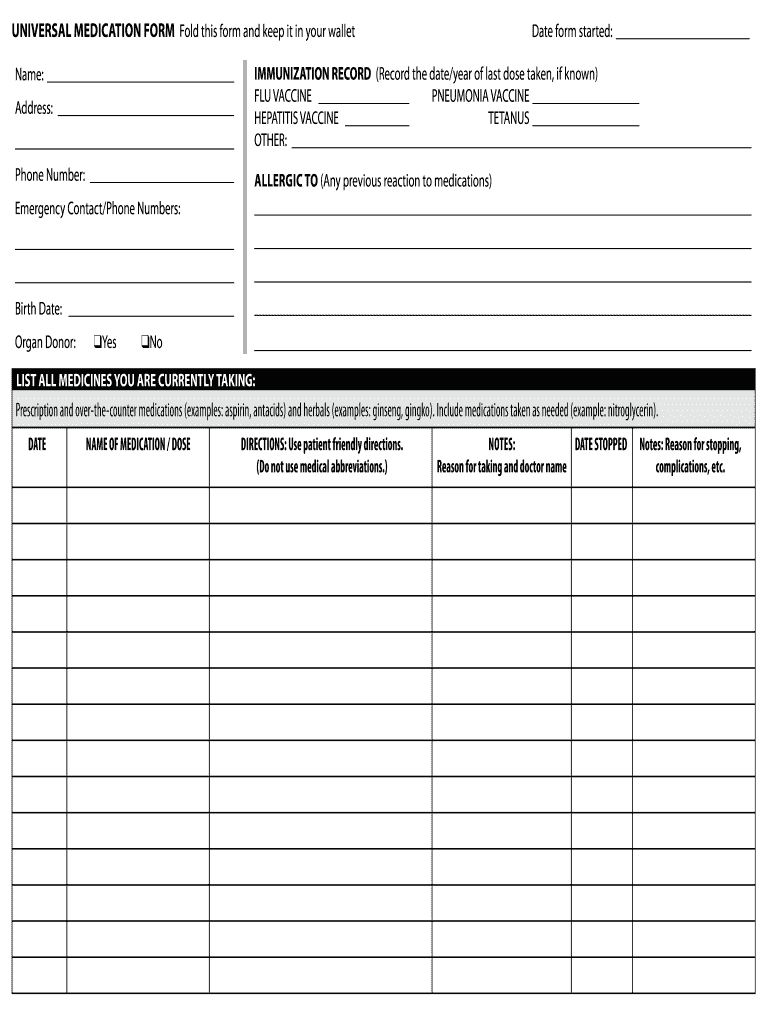
  2. Begin by filling in your personal information at the top of the form, including your name, address, and phone number. This ensures that your medication list is easily identifiable.
  3. Record your immunization history by entering the dates of any vaccines you have received. This section helps healthcare providers understand your vaccination status.
  4. Provide emergency contact information. This is crucial for medical professionals in case of an emergency.
  5. List all medications you are currently taking, including prescriptions, over-the-counter drugs, and herbal supplements. Be sure to include dosage and directions in clear language without medical abbreviations.
  6. Document any medications you have stopped taking along with reasons for stopping and any complications experienced. This information can be vital for ongoing care.

Start using our platform today to create a comprehensive medication list for free!

be ready to get more

Complete this form in 5 minutes or less

Get form

Got questions?

We have answers to the most popular questions from our customers. If you can't find an answer to your question, please contact us.
Contact us
5 Steps to Build a Medication Tracking App Define minimum viable features. Understand user needs (e.g., caregivers, millennials). Choose platforms (iOS, Android, web). Create a business plan (lean canvas).
A medicine chart should include the following columns: The name of the medication you are taking. The dosage you need to take. Time of day you need to take the medication. Any notes or side effects you experience. Whether the medication needs to be taken with food or not.
7 Rights of Medication Administration Right Medication. Right Child. Right Dose. Right Time. Right Route. Right Reason. Right Documentation.
Keeping Track of Medicines Make a master list of all your medicines. Write down the medicine names and doctors names. Plan a daily schedule of medicines. Keep your pills in a pillbox. Set reminders. Make it routine. Dont run out. Learn more about how to take medicines safely.
A Best Possible Medication History (BPMH) is an accurate and complete list (or as close as possible) of medicines the patient is currently taking. The BPMH also includes information relating to medicine allergies and adverse drug reactions. It is a crucial foundation (first two steps) in medication reconciliation.

Security and compliance

At DocHub, your data security is our priority. We follow HIPAA, SOC2, GDPR, and other standards, so you can work on your documents with confidence.

Learn more
ccpa2
pci-dss
gdpr-compliance
hipaa
soc-compliance

People also ask

The list should have your emergency contacts, allergies and information about your prescription and nonprescription medicines, vitamins and supplements, including: The name of each medicine. The strength of each medicine. What you take the medicine for. Instructions of when, how and how much of the medicine you take.
Follow the Seven Rights when you are administering medication to the individuals you support: Right Person, Right Medication, Right Dose, Right Time, Right Route, Right Reason, and Right Documentation.

medication list form