






Definition & Meaning
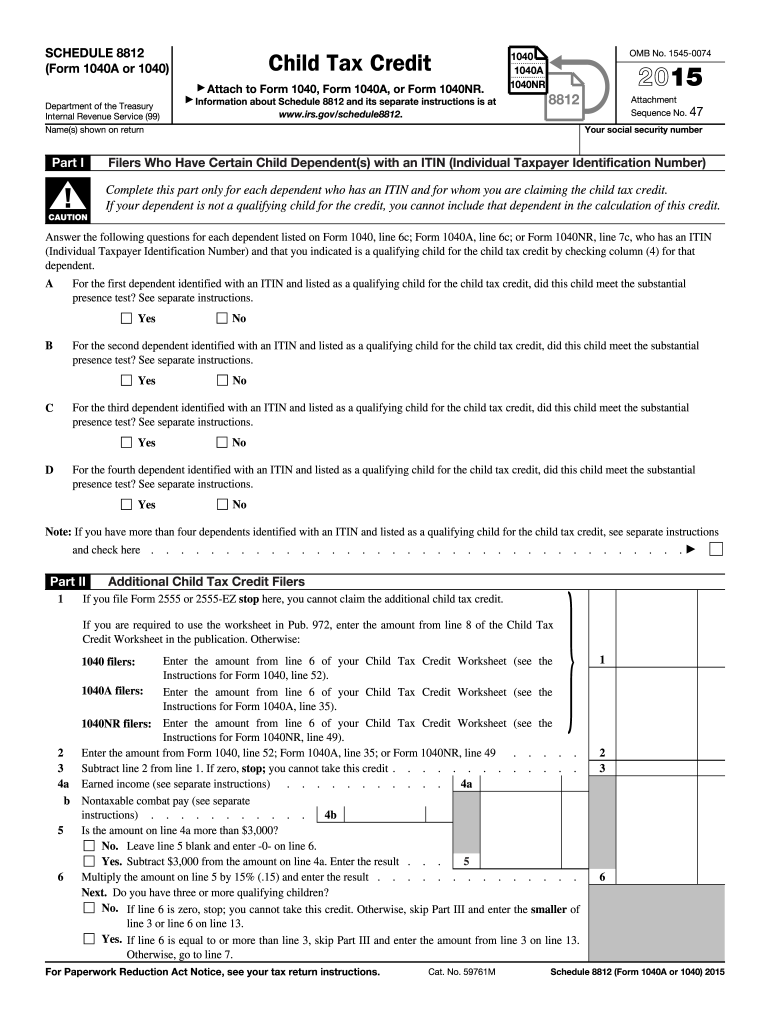
Schedule 8812 is used for claiming the Child Tax Credit and Additional Child Tax Credit. It is important for filers of Form 1040, 1040A, or 1040NR to accurately report eligible dependents. The form breaks down calculations tied to children who meet specific IRS criteria. Filers need to understand terminologies such as "qualifying child" and "substantial presence test" to ensure proper completion. Comprehending these terms helps in determining eligibility for both the Child Tax Credit and Additional Child Tax Credit.
Steps to Complete the 2 Form
- Filing Status: Verify your filing status on your income tax return, as this affects form eligibility.
- Listing Dependents: Use the form to detail children eligible for the credit. This includes their full names, Social Security numbers, and relationship to you.
- Income Requirements: Enter your adjusted gross income to check if you meet the income thresholds for the credit.
- Credit Calculation: Follow instructions to calculate the Child Tax Credit for each qualifying child. Enter the total on the form.
- Additional Child Tax Credit: If applicable, calculate any additional credits using the worksheet provided with the form.
- Transferring Totals: Once completed, transfer the final calculations to the relevant lines of your Form 1040, 1040A, or 1040NR.
Important Terms Related to 2 Form
- Qualifying Child: Under IRS guidelines, a qualifying child must meet residency, age, relationship, and support criteria.
- Substantial Presence Test: Determines if a child was physically present in the U.S. for a stipulated time, impacting eligibility.
- Adjusted Gross Income: A crucial figure determining credit eligibility, calculated before subtracting exemptions and deductions.
IRS Guidelines
The IRS provides comprehensive guidelines for completing Schedule 8812. These rules ensure consistency and accuracy in credit applications. Key IRS considerations involve age limits, residency periods, and dependency relationships. Adhering strictly to these guidelines minimizes the risk of errors or rejections.
Filing Deadlines / Important Dates
Submitting Schedule 8812 aligns with standard tax filing deadlines. Typically, this means your completed form and supporting documents must be submitted by April 15 of the following year. For extensions, forms must be submitted by October 15, avoiding penalties.
How to Obtain the 2 Form
The form is available on the IRS website, allowing users to download, complete, and print it. Alternatively, tax preparation software often integrates the form, streamlining the process. Ensure you are accessing the correct year version — the 2015 schedule — to avoid any discrepancies.
Why Should You Use the 2 Form
Using Schedule 8812 is necessary if you qualify for the Child Tax Credit. It ensures you receive the correct amount of credits, effectively lowering your tax liability. This can result in a significant tax refund or reduce your taxes owed.
Who Typically Uses the 2 Form
Taxpayers with one or more qualifying children can use the form. This includes individuals with different filing statuses, like single, married filing jointly, or head of household. Understanding this can significantly benefit eligible families or guardians by aligning with the IRS's credit-supportive framework.


Penalties for Non-Compliance
Failure to accurately complete and submit Schedule 8812 can lead to penalties, such as forfeiture of credits or fines. Misrepresentation or errors might trigger an IRS audit. Ensuring precision through each calculation and information entry is critical to avoiding such complications.
Eligibility Criteria
Eligibility involves having a Social Security number for each qualifying child, residing in the U.S. for more than half of the tax year, and meeting specified income levels. Understanding eligibility criteria is key to determining your rightful claim to the child tax credit.

Digital vs. Paper Version
The digital version of the form is compatible with various tax software, enhancing ease and accuracy. In contrast, the paper version requires manual proofreading to prevent mistakes. Selecting the appropriate medium depends on personal comfort and accessibility considerations.
Software Compatibility (TurboTax, QuickBooks, etc.)
Software platforms like TurboTax and QuickBooks support Schedule 8812 filings, offering features that simplify form completion. They provide built-in checks for errors, guidance on the tax credit calculation, and e-filing capabilities. Compatibility with these tools can streamline the submission process efficiently.
State-Specific Rules for the 2 Form
While the federal guidelines remain consistent, some states may have additional provisions or forms related to child tax credits. If your state has a particular child benefit system or rebates, verify if they require supplemental documentation when filing federal taxes along with Schedule 8812.
Examples of Using the 2 Form
An example is a family with two qualifying children, using Schedule 8812 to claim a potential $2,000 tax credit. They must ensure all information aligns with IRS instructions. In another case, a single parent with one child meeting the criteria can significantly reduce their taxable income using this form. Understanding these practical scenarios illuminates the direct impact of correctly claiming the child tax credit.