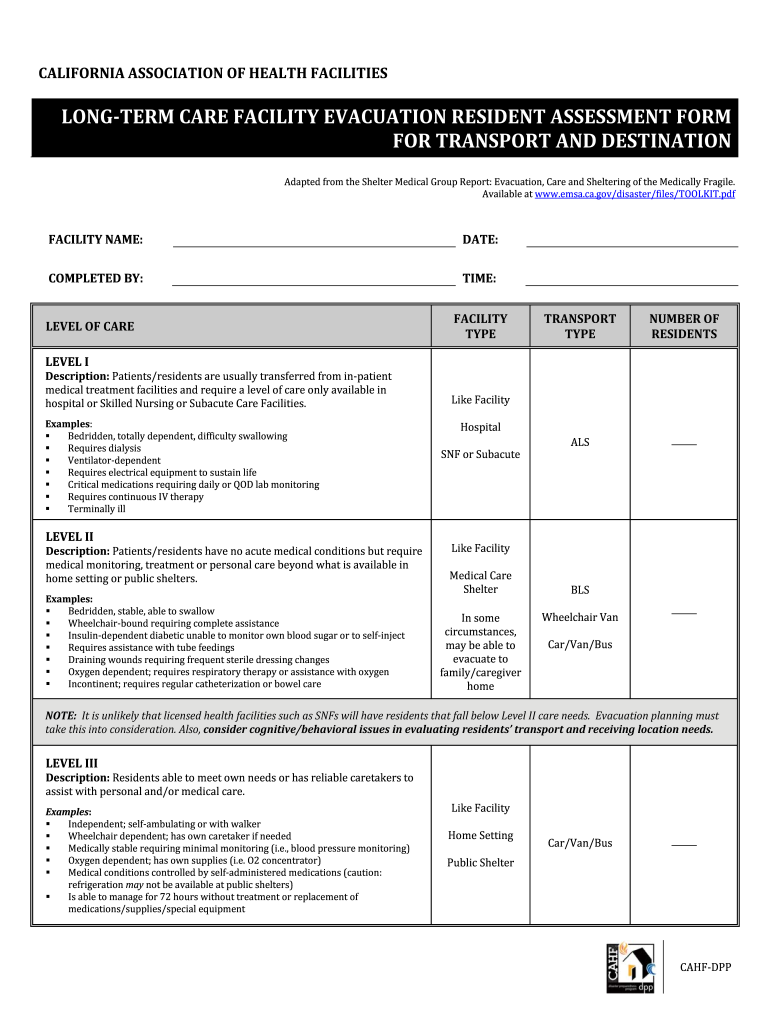
Rcf e resident evacuation assessment form 2026

Get Form
rcf form Preview on Page 1

Here's how it works

01. Edit your rcf form online
Type text, add images, blackout confidential details, add comments, highlights and more.
02. Sign it in a few clicks
Draw your signature, type it, upload its image, or use your mobile device as a signature pad.
03. Share your form with others
Send ccld forms via email, link, or fax. You can also download it, export it or print it out.

How to use or fill out rcf e resident evacuation assessment form with our platform

Form edit decoration
9.5
Ease of Setup
DocHub User Ratings on G2
9.0
Ease of Use
DocHub User Ratings on G2
  1. Click ‘Get Form’ to open it in the editor.
  2. Begin by entering the 'Facility Name', 'Date', 'Completed By', and 'Time' in the designated fields at the top of the form. This information is crucial for identifying the assessment.
  3. Next, assess and select the appropriate 'Level of Care' for each resident. Review the descriptions provided for Level I, II, and III to ensure accurate categorization based on their medical needs.
  4. Indicate the 'Facility Type' and 'Transport Type' that will be used during evacuation. Choose from options like Hospital, SNF, or Subacute for facility type, and BLS or Wheelchair Van for transport type.
  5. Finally, input the total 'Number of Residents' requiring evacuation. Ensure all entries are accurate before saving your completed form.

Start using our platform today to streamline your document editing and ensure a smooth evacuation process!

be ready to get more

Complete this form in 5 minutes or less

Get form

Got questions?

We have answers to the most popular questions from our customers. If you can't find an answer to your question, please contact us.
Contact us
General Procedures Patients in immediate danger should be moved first. They should follow a lead nurse into a safe area. Move patients who are closest to danger first (non-ambulatory and ambulatory). Direct ambulatory patients toward a safe area. Have wheelchair or walker dependent patients escorted to a safe area.
Introduction to evacuation planning (PDF 215KB) Evacuation aims to reduce loss of life or lessen the effects of a hazard on a community, before or during a disaster. There is a nationally consistent five-stage evacuation process: (1) Decision to evacuate (2) Warning (3) Withdrawal (4) Shelter (5) Return.
The three categories of evacuation in a fire are simultaneous evacuation, vertical or horizontal phased evacuation, and silent alarm evacuation. You can find out more about these different approaches in our guide to the three types of fire evacuation.
Prevention, mitigation, preparedness, response and recovery are the five steps of Emergency Management.
Evacuation Procedure Stop all activities immediately. Assess that all persons can evacuate the area. Follow EXIT signs to the nearest safe exit. Use the stairs. Allow others to enter the stairwell. Steer clear of hazards. Move away from the building. Do not re-enter the building without an all clear.

Security and compliance

At DocHub, your data security is our priority. We follow HIPAA, SOC2, GDPR, and other standards, so you can work on your documents with confidence.

Learn more
ccpa2
pci-dss
gdpr-compliance
hipaa
soc-compliance
be ready to get more

Complete this form in 5 minutes or less

Get form

People also ask

In the event of an emergency, such as a fire, chemical spill, hazmat issue, tornado, active shooter, bomb threat, inclement weather, or extended power outage, please follow the guidelines listed below for evacuation.
For employers that need a guide on how to write an emergency evacuation plan for their workplace, refer to the steps below: Step 1: Evaluate the Emergency. Step 2: Determine Exit Routes. Step 3: Identify Safe Areas. Step 4: Develop Evacuation Procedures. Step 5: Discuss with Employees. Step 6: Assign Responsibilities.
Grab these 6 Ps People and pets. Papers, phone numbers, important documents. Prescriptions, vitamins, and eyeglasses. Pictures and irreplaceable memorabilia. Personal computer hard drive and disk. Plastic (credit/debit cards) and cash.

resident evacuation assessment