Form 1023-2026

Get Form
form 1023 Preview on Page 1

Here's how it works

01. Edit your form 1023 online
Type text, add images, blackout confidential details, add comments, highlights and more.

02. Sign it in a few clicks
Draw your signature, type it, upload its image, or use your mobile device as a signature pad.

03. Share your form with others
Send form 1023 pdf via email, link, or fax. You can also download it, export it or print it out.

Definition and Purpose of Form 1023

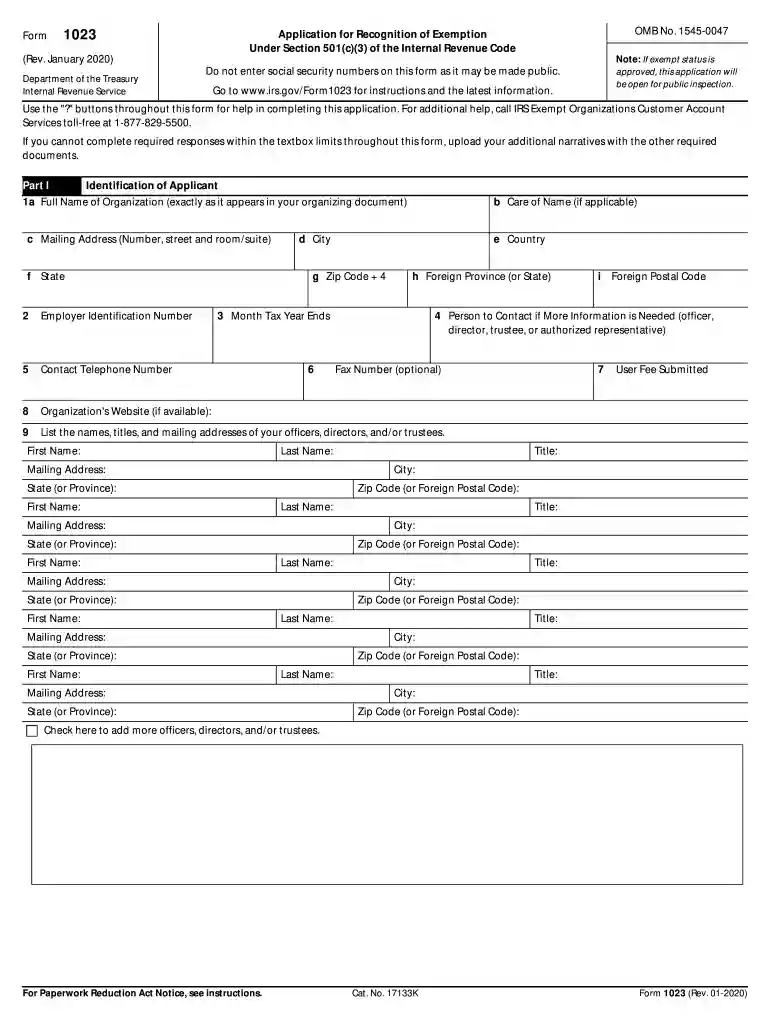
Form 1023 is the Application for Recognition of Exemption Under Section 501(c)(3) of the Internal Revenue Code. This form is used by organizations seeking tax-exempt status as a charitable entity. When an organization acquires this status, it can benefit from being exempt from federal income taxes and can offer donors the incentive of tax-deductible contributions. Form 1023 requires detailed information about the organization's structure, governance, activities, and financial assets to ensure compliance with IRS regulations.

Organizations Eligible for Form 1023

Eligible organizations typically include:

  • Charitable entities
  • Educational institutions
  • Religious organizations
  • Scientific entities
  • Literary organizations

These organizations must demonstrate that they operate exclusively for the aforementioned purposes and that their activities align with the charitable aims outlined by the IRS.

Key Elements of Form 1023

Form 1023 includes several critical sections, each asking for specific information about the applying organization.

Organizational Structure and Activities

  • The form requires a description of the organization's activities, mission, and future plans.
  • Detailed accounts of past, present, and planned fundraising activities must be documented.
  • The organization’s bylaws, articles of incorporation, and operational legal status are examined to ensure compliance with 501(c)(3) requirements.

Financial Details

  • Organizations must provide comprehensive financial data, including a statement of revenues and expenses.
  • Budget projections for the next two years are often requested to showcase financial planning.

Governance Information

  • Information about the board of directors, officers, and key management is required.
  • Potential conflicts of interest must be disclosed to ensure governance transparency.

Steps to Complete Form 1023

Completing Form 1023 can be a meticulous process that requires attention to detail. The steps outlined below aim to provide clear guidance.

  1. Gather Necessary Documents: Collect all foundational documents like articles of incorporation and financial statements.

  2. Provide Detailed Activity Descriptions: Outline all past, current, and planned activities comprehensively.

  3. Detail Financial Data: Assemble financial records, including statements of revenue and expenditure, as well as budget projections.

  4. Complete Legal and Governance Information: Ensure complete and correct listing of board members and associated individuals, along with any required disclosure of conflicts of interest.

  5. Review and Edit: Conduct a thorough review for accuracy and compliance. Make corrections as necessary before submission.

  6. Submission: Submit the form, ensuring all sections are complete and all necessary documentation is attached.

IRS Guidelines for Form 1023

The IRS provides specific guidelines that help ensure the proper completion and submission of Form 1023. These include clarifications on eligibility criteria, required documentation, and definitions of specific activities and organizational types.

Understanding Compliance

  • Organizations must understand various IRS guidelines to ascertain that they maintain compliance post-tax-exempt status recognition.
  • Frequent updates to IRS rules require organizations to stay informed of any changes affecting their exempt status.

Common Mistakes

  • Incomplete or inaccurate financial information.
  • Omissions in governance and management sections.
  • Insufficient description of organizational activities.

Filing Deadlines and Important Dates for Form 1023

Understanding and adhering to filing deadlines is essential for organizations applying for tax-exempt status.

Overview of Deadlines

  • Organizations should file Form 1023 within 27 months from the end of the month in which they were legally formed to ensure retroactive tax exemption back to the founding date.

Importance of Timely Filing

  • Late submissions may result in tax-exempt status commencing only from the date of filing, potentially affecting donations received before this date.

Required Documents for Form 1023

A complete application comprises of several critical documents that substantiate an organization's eligibility.

Essential Documents

  • Articles of incorporation
  • Bylaws
  • Financial statements from the inception of the organization to the present
  • Descriptions of all fundraising undertakings

Supplemental Information

Administrative documents relating to organizational governance and policy may also be requested during the review process.

Online vs. Paper Submission of Form 1023

Form 1023 can be submitted both online and in paper form, each with its advantages and considerations.

Online Submission

  • Easier tracking and faster processing
  • Notices of recognition are often received more promptly than paper submissions

Paper Submission

  • May still be necessary for organizations experiencing internet accessibility issues or for those needing to present particular additions or annotations not accommodated in the digital format

Digital Tools and Compatibility with Form 1023

Using digital tools to streamline the submission process can be advantageous.

Useful Digital Platforms

  • Software like TurboTax and QuickBooks can help manage financial data effectively but may not specifically support form preparation.
  • Online platforms, such as DocHub, facilitate the annotation, editing, and secure submission of documentation related to Form 1023.

Organizations must choose the tools that best align with their operational technologies to enhance efficiency in completing and managing Form 1023 applications.

See more form 1023 versions

We've got more versions of the form 1023 form. Select the right form 1023 version from the list and start editing it straight away!
Versions Form popularity Fillable & printable
2020 4.8 Satisfied (234 Votes)
2017 4.4 Satisfied (68 Votes)
2013 4.2 Satisfied (63 Votes)
2006 4 Satisfied (33 Votes)
be ready to get more

Complete this form in 5 minutes or less

Get form

Got questions?

We have answers to the most popular questions from our customers. If you can't find an answer to your question, please contact us.
Contact us
Generally, you dont need to file a federal tax return if you earn under $10,000 in 2025, as the standard deduction for a single filer under 65 is much higher (around $15,750), but you might need to file to get refunds for withheld taxes or claim refundable credits like the Earned Income Tax Credit (EITC). Key exceptions requiring a filing, even with low income, include having net self-employment earnings of $400 or more, or specific types of unearned income. When you generally dont have to file (for 2025 income): Single, under 65: Gross income less than $15,750. Married Filing Jointly, both under 65: Combined gross income less than $31,500. When you might still need to file (even if under $10k): Self-Employment: Net earnings from self-employment (like freelance work or a side gig) of $400 or more. To Get a Refund: You had federal income tax withheld from your paychecks (look for Box 2 on your W-2) and want it back. To Claim Credits: You qualify for refundable tax credits, such as the Earned Income Tax Credit (EITC), which can provide money back to low-income workers. Special Situations: Other conditions, like owing special taxes or having certain unearned income, may require filing. Bottom Line: If your income is below the standard deduction and you have no self-employment income or tax withheld, you likely dont have to file, but you might want to file to claim credits or get a refund. Always check the official IRS website or use their tools to be sure. For financial advice, consult a professional. Check if you need to file a tax return | Internal Revenue Service - IRS.govJan 14, 2026 Your income is over the filing requirement. You have over $400 in net earnings from self-employment (side jobs or otheIRS (.gov)Find out if you need to file a federal tax return | USAGovDec 1, 2025USA.gov
Organizations requesting recognition of tax-exempt status under section 501(c)(3) must complete and submit their Form 1023 (or Form 1023-EZ, if eligible) applications electronically (including paying the correct user fee) using Pay.gov.
Form 1023-EZ is used to apply for recognition as a tax-exempt organization under Section 501(c)(3). Applicants can learn more about the requirements, benefits, limitations and expectations of tax-exempt organizations by accessing the online courses at the IRS Small to mid-size tax-exempt organization workshop.
Form 1023 Checklist Form 2848, Power of Attorney and Declaration of Representative (if filing) Form 8821, Tax Information Authorization (if filing) Expedite request (if requesting) Application (Form 1023 and Schedules A through H, as required) Articles of organization Amendments to articles of organization
In general, an organization must file its exemption application within 27 months from the end of the month in which it was formed. If it does so, it may be recognized as exempt back to the date of formation.Oct 9, 2025

Security and compliance

At DocHub, your data security is our priority. We follow HIPAA, SOC2, GDPR, and other standards, so you can work on your documents with confidence.
Learn more
ccpa2
pci-dss
gdpr-compliance
hipaa
soc-compliance

People also ask

Form 1023 is an application an organization uses for the IRS to issue a determination letter or ruling letter that recognizes an organizations exemption from federal income tax.
Organizations must electronically file this form to apply for recognition of exemption from federal income tax under section 501(c)(3). Note. You may be eligible to file Form 1023-EZ, a streamlined version of the application for recognition of tax exemption.

fillable 1023 form