Marine Mammal Data Sheet form - National Marine Fisheries ... 2026

Get Form
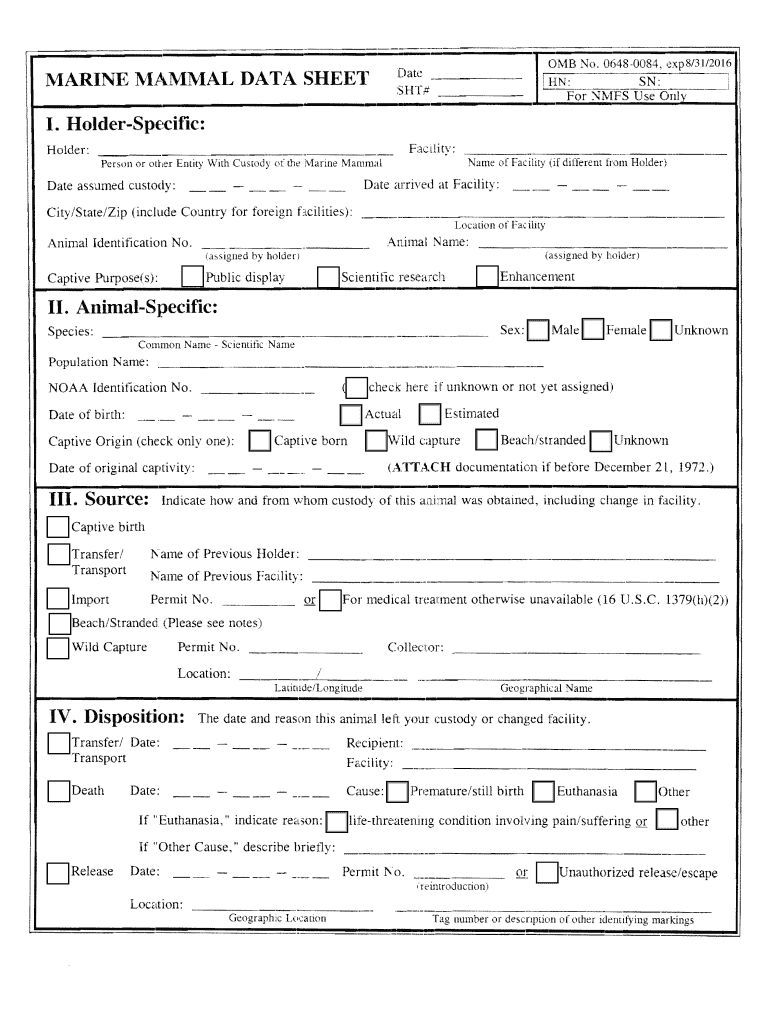
Marine Mammal Data Sheet form - National Marine Fisheries ... Preview on Page 1

Here's how it works

01. Edit your form online
Type text, add images, blackout confidential details, add comments, highlights and more.
02. Sign it in a few clicks
Draw your signature, type it, upload its image, or use your mobile device as a signature pad.
03. Share your form with others
Send it via email, link, or fax. You can also download it, export it or print it out.

How to use or fill out Marine Mammal Data Sheet form - National Marine Fisheries ... with our platform

Form edit decoration
9.5
Ease of Setup
DocHub User Ratings on G2
9.0
Ease of Use
DocHub User Ratings on G2
  1. Click ‘Get Form’ to open the Marine Mammal Data Sheet in the editor.
  2. Begin by filling out Section I, which includes details about the holder and facility. Enter the date, holder-specific information, and location of the facility.
  3. Proceed to Section II for animal-specific data. Fill in the animal's name, identification number, species, sex, and population name. Ensure you check the appropriate box for captive origin.
  4. In Section III, provide information regarding the source of custody. Include details about previous holders and any permits associated with transfers or transports.
  5. Finally, complete Section IV by documenting the disposition of the animal. Specify reasons for leaving custody and include relevant dates and locations.

Start using our platform today to easily fill out your Marine Mammal Data Sheet form for free!

be ready to get more

Complete this form in 5 minutes or less

Get form

Got questions?

We have answers to the most popular questions from our customers. If you can't find an answer to your question, please contact us.
Contact us
The Reconnaissance and Interdiction Division​ at NIWC Pacific manages the Navys Marine Mammal Program which trains bottlenose dolphins and California sea lions to detect, locate, mark and recover objects in harbors, coastal areas, and at depth in the open sea.
Marine mammals are classified into four different taxonomic groups: cetaceans (whales, dolphins, and porpoises), pinnipeds (seals, sea lions, and walruses), sirenians (manatees and dugongs), and marine fissipeds (polar bears and sea otters).
Quick Facts About Marine Mammals Warm-blooded. Have hair or fur. Breathe air through lungs. Bear live young. Nurse their young with milk produced by mammary glands. Live all or part of their life in the ocean.
The Marine Mammal Commission is an independent government agency charged by the Marine Mammal Protection Act to further the conservation of marine mammals and their environment. We work to ensure that marine mammal populations are restored and maintained as functioning elements of healthy marine ecosystems.
The Marine Mammal Protection Act prohibits killing or injuring marine mammals except under certain circumstances. The Marine Mammal Authorization Program provides an annual exemption for accidentally killing or injuring marine mammalsreferred to as incidental takeduring commercial fishing operations.

Security and compliance

At DocHub, your data security is our priority. We follow HIPAA, SOC2, GDPR, and other standards, so you can work on your documents with confidence.

Learn more
ccpa2
pci-dss
gdpr-compliance
hipaa
soc-compliance
be ready to get more

Complete this form in 5 minutes or less

Get form

People also ask

The average marine animal trainer salary in the United States is $33,750. Marine animal trainer salaries typically range between $22,000 and $50,000 yearly. The average hourly rate for marine animal trainers is $16.23 per hour. Marine animal trainer salary is impacted by location, education, and experience.

Related links